
 E-Paper



Pak national came in 1989, never left. SC gives him bail on plea by his children
Mohammad Qamar, who was arrested in 2011, was twice provided consular access but the Pakistani government couldn’t confirm his nationality because he told the high commission officials that he was an Indian.


NEW DELHI: The Supreme Court on Friday granted bail to a 62-year-old Pakistani national who entered the country in 1989-90 on a valid visa, married in Uttar Pradesh’s Meerut and never returned to Pakistan. He was caught in 2011 for staying in the country without a visa, sentenced to three-and-a-half years in jail and kept in detention ever since.
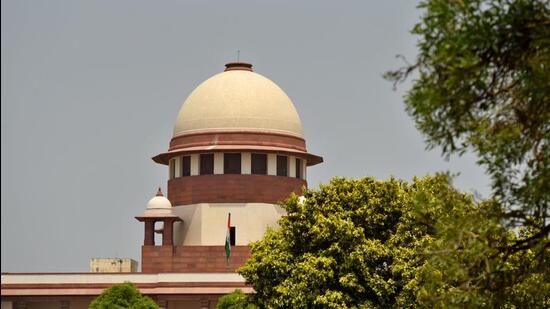
The top court’s order to release Mohammad Qamar came on a petition by two of his children that asked the bench of justices Dhananjaya Y Chandrachud and Hima Kohli to reunite the man with his five children and wife in Meerut.
“Keeping the detenue in jail would not be appropriate in the facts of the present case,” the bench ruled in view of the peculiar facts and circumstances of the case. The top court also told the Union home ministry to consider his request for grant of a long-term visa and report back its decision on the request within four months.
“If there is no security threat or adverse input bearing on national security, we are of the view that the detenue be released on a personal bond of ₹5,000 and two sureties of the like amount by Indian citizens.”
The court directed Mohammad Qamar to furnish his place of permanent residence to the local police station at Meerut and to report every week to the local station house officer.
The Centre earlier told the court that Mohammad Qamar was an “illegal migrant” convicted for living in the country without a visa and was convicted by a Meerut court in September 2014. For the past seven years, he was lodged at the Lampur detention centre in Delhi’s Narela awaiting confirmation from Pakistani authorities on his citizenship.
The Centre said he was ineligible to apply for Indian citizenship on account of this background but the home ministry did consider, on a representation received from Qamar’s daughter in 2020, to explore the possibility of granting him a long-term visa (LTV) but did not go ahead in view of the opinion of the state government.
The state government, acting on a detailed enquiry report by senior superintendent of police of Meerut, rejected the request in November 2020 by disclosing that the marriage between the detenue and his wife ended a decade ago in divorce. Since there was no marriage subsisting, there was no justification for him to reside in India, the SSP (Meerut) said. However, the top court noted that the wife was unable to produce any proof of divorce and it was undisputed that the entire family, including three sons and two daughters were staying in Meerut.
The bench held, “It will be appropriate if the Foreigners Division, Ministry of Home Affairs reconsiders the matter after assessing from security angle. They shall do so independent of the communication of SSP (Meerut).”
To be sure, the Centre objected to the detenue’s release till his Pakistani nationality was confirmed by the Pakistan High Commission and his travel documents issued by them in his favour. The government said that Qamar was provided consular access twice in 2011 and 2012 at Central Jail, Tihar. Following this, the High Commission of Pakistan at New Delhi through a Note Verbale dated January 31, 2019, informed the Indian Government that Qamar stated that he was an Indian national. The Pakistani authorities did not confirm his Pakistani nationality.
Senior advocate Sanjay Parikh and advocate Srishti Agnihotri representing the petitioners informed the court that the detenue was born in Meerut in 1959 but his mother took him to Pakistan in 1967. Parikh said that Qamar was keen on applying for Indian citizenship.
The bench told Parikh, “The government realizes this is a hard case. We have narrowed down the canvas, otherwise, the larger the canvas, less the chances of getting citizenship.”


