
 E-Paper



Pakistan open fires across LoC ahead of Army chief's Srinagar visit, India retaliates
The incident comes hours before Indian Army chief General Upendra Dwivedi is set to visit Srinagar and Udhampur on Friday.

 Prefer HTon Google


Pakistan Army troops opened fire at multiple locations along the Line of Control (LoC) in Jammu and Kashmir on Friday in an apparent attempt to breach the ceasefire agreement, leading to the Indian Army hitting back effectively, according to people familiar with the matter.
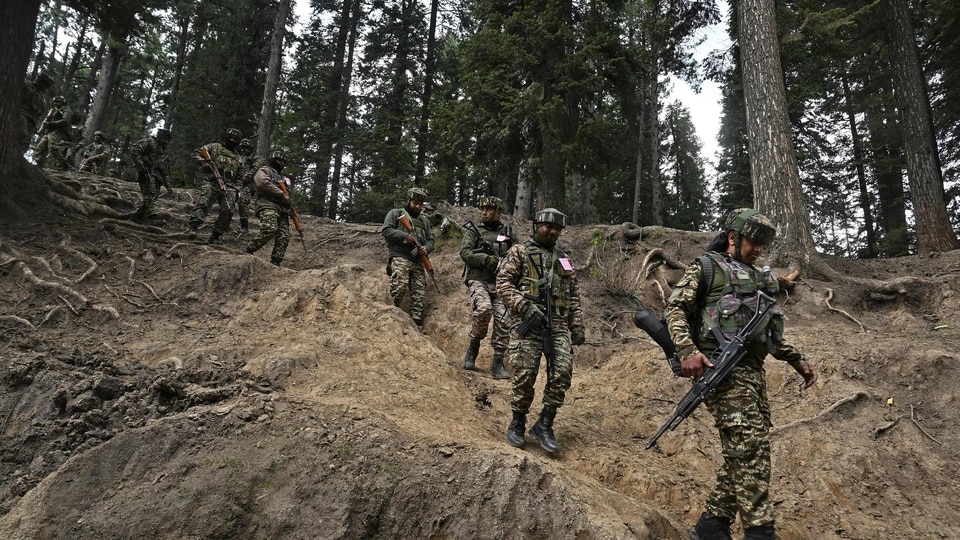
“There were incidents of small arms firing at some places on the Line of Control initiated by Pakistan,” PTI quoted an unnamed source as saying.
“The firing was effectively responded to,” it said.
Follow live updates on Pahalgam terror attack
Further details are being awaited.
The incident comes hours before Indian Army chief General Upendra Dwivedi is set to visit Srinagar and Udhampur on Friday. During the visit, he will discuss the situation with senior Army commanders stationed in the Kashmir Valley and other security agency officials.
The Army chief is expected to assess the prevailing security situation and review the Pakistan Army’s recent ceasefire violations along the LoC, the officials added.
The firing by the Pakistan Army comes amid increasing tensions between the two sides over the Pahalgam terror attack that killed 26 people.
India's retaliation after Pahalgam terror attack
Following the Pahalgam attack, India has initiated a series of strong countermeasures against Pakistan over its alleged backing of cross-border terrorism. In a Cabinet Committee on Security (CCS) meeting chaired by Prime Minister Narendra Modi and attended by Union home minister Amit Shah on Wednesday, India decided to suspend the Indus Waters Treaty of 1960, placing it in abeyance until Pakistan permanently withdraws its support for cross-border terror activities.
Additionally, India has shut down the integrated Attari Check Post.
India also declared several officials of the Pakistani High Commission as persona non grata and instructed them to leave the country within a week. Furthermore, it has revoked all visas issued under the SAARC Visa Exemption Scheme (SVES), giving Pakistani nationals 48 hours to exit India.
In response, Pakistan rejected the suspension of the Indus Waters Treaty and warned that any attempt to block or divert water flows owed to Pakistan under the treaty would be regarded as an “act of war.”
The Indus Waters Treaty, facilitated by the World Bank, has governed water-sharing arrangements between India and Pakistan since 1960. It covers the Indus river system, which includes the Indus and its tributaries. The Ravi, Beas, and Sutlej — the eastern rivers — are mainly allocated to India, while the western rivers — Indus, Jhelum, and Chenab — are largely assigned to Pakistan. The Kabul river, though part of the system, does not flow through Indian territory.
These rivers play a vital role in the water security of both countries.


