The journey from plastic to petrol, a pilot plant for which was inaugurated in Uttarakhand on Tuesday, started in 2006 when a small group of scientists at the Indian Institute of Petroleum (IIP), Dehradun, started work on a project to make something useful from the hazardous waste.
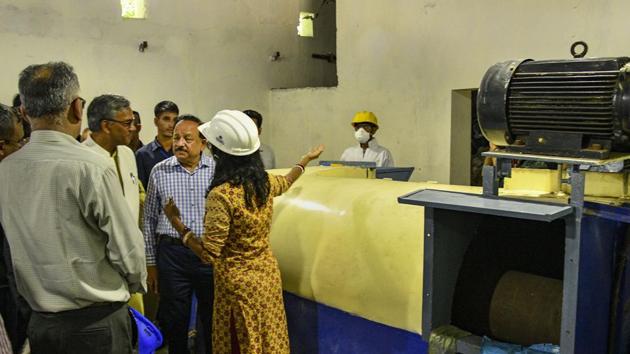
Their mission: To develop a technology that will not only help in disposing of the plastic but will also result in generating revenue from it. After much effort, the institute developed a technology to convert plastic into petroleum products such as diesel, petrol and other aromatic compounds. Sanat Kumar, senior scientist in-charge of the project at IIP Dehradun said many people find it difficult to understand how plastic can be changed into diesel.
Read: Three years after plastic waste rules were made, Delhi civic bodies draft by-laws
“What we have done here is that we have broken large plastic molecules also called polymers into small molecules by heating plastic in absence of air, so that it doesn’t burn. This is called pyrolysis. Then we experimented with these small molecules with different catalysts. And finally, after many trials and errors, we succeeded in finding the right combination of catalysts that help in turning these molecules into hydrocarbons like diesel and petrol. Once catalysts do their job, we set it for condensation, a process that helps us in getting the final products in liquid form, which is gasoline or diesel or aromatics”, he said.
Read: PM Narendra Modi writes thank you note to Aamir Khan for lauding anti-plastic initiative
{{/usCountry}}Read: PM Narendra Modi writes thank you note to Aamir Khan for lauding anti-plastic initiative
{{/usCountry}}Kumar said depending on the choice of the catalysts used in the process, they have three options. “From one kilogram of waste plastic, we can either produce 850 ml of diesel or 700 ml of petrol or 500 ml of aromatic products. And we have scaled up this technology for the first time for processing nearly one tonne of plastic waste at our pilot plant here on the campus, which was inaugurated here on Tuesday by Dr Harsh Vardhan, union minister for health, science and technology and earth sciences”, he said.
On the significance of the pilot plant, Kumar said, “It is the first such plant set up by a government research institute in the country. For the next eight to nine months, we will study the functioning of the plant and analyse data, following which we will be in a position to transfer the technology to the industry and the government. The government can use this technology to set up such plants in the municipal areas to deal with the problems of hazardous waste plastic. The potential for this technology is huge. The diesel produced can be used across the automobile industry, by farmers for powering generators and tractors and so on”, he said.
Read: Pollution body seizes 28,000 kilos of plastic
On whether the diesel produced using this technology and that sourced from refineries are same chemically, Kumar said, “You have to first understand that petrol or diesel is basically a combination of a large number of chemicals/hydrocarbons. Even diesel sourced from different refineries is not the same chemically. There is a difference. What we do is create a combination of chemicals that have the same aggregate properties like diesel. So natural diesel and the diesel we produce are chemically different, but they serve the same purpose”, he said.
IIP Dehradun, one of the constituent research institutions under the umbrella of Council of Scientific and Industrial Research (CSIR), conducts research on hydrocarbons, use of alternative fuels in engines and related technologies.
Here are the key points in the journey from plastic to diesel:
*The first pilot plant will convert 1000 kg of plastic waste to 800 litres of diesel daily.
*The diesel will be of automotive-grade, meeting the diesel specifications for use in vehicles -and could be straightaway filled in cars, trucks or generators.
*Estimated to be economically viable without subsidy with 10 tonnes per day of plastic processing facility.
*ll polyolefinic wastes(polyethylene and polypropylene), which account for approximately 70% of total plastics consumed, can be converted.
*Everything from plastic wrapping film to polybags, buckets to shampoo packaging, is made of polyolefins.
*After about 6 months of regular operation and data generation, CSIR-IIP in association with GAIL will roll out this technology nationwide.
*IIP has partnered with local NGO GATI Foundation who has worked with communities, commercial entities and rag pickers to develop an effective waste plastic supply chain