E-Paper



PM announces expansion of wildlife conservation efforts
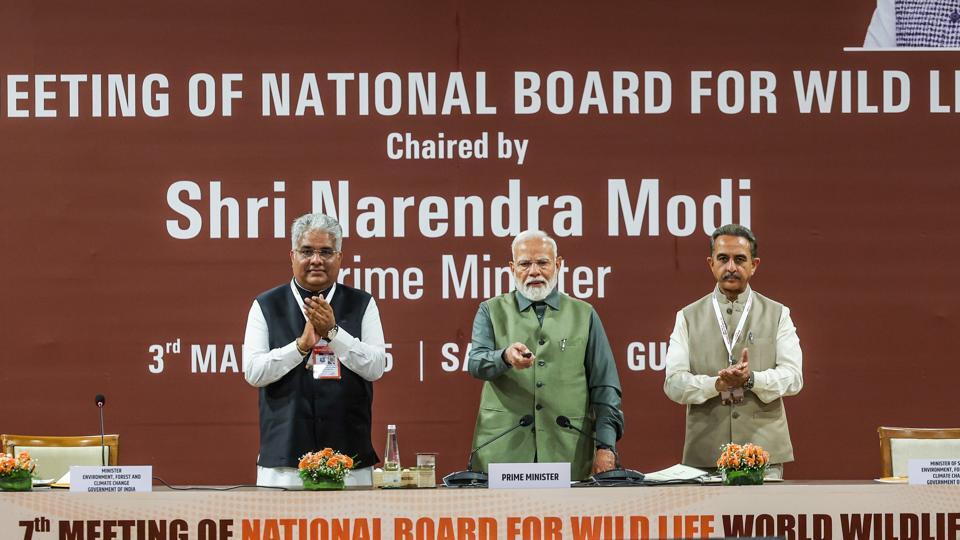
Prime Minister Narendra Modi chaired the seventh meeting of the National Board for Wildlife (NBWL) at Gir National Park in Gujarat on Monday, on the occasion of the World Wildlife Day

 Prefer HTon Google


Prime Minister Narendra Modi chaired the seventh meeting of the National Board for Wildlife (NBWL) at Gir National Park in Gujarat on Monday, on the occasion of the World Wildlife Day, and announced several significant decisions and findings to improve wildlife conservation efforts in India, including the expansion of the Cheetah reintroduction initiative to new locations.
One of the highlights of the meeting, which the prime minister attended after completing a lion safari in Gir in the morning, was the release of India’s first-ever riverine dolphin census report, which pegged the number of the aquatic mammals at 6,327 across the country.
The PM also laid the foundation stone for the National Referral Centre for Wildlife at Junagadh in Gujarat and announced the 16th Asiatic lion population estimation to be carried out in May this year. On the occasion, Modi also announced the setting up of a centre of excellence for human-wildlife conflict management, Salim Ali Centre for Ornithology and Natural History (SACON), at Coimbatore in Tamil Nadu, and unveiled a book on river dolphins.
“The Prime Minister announced that cheetah introduction will be expanded to other areas, including the Gandhisagar sanctuary in Madhya Pradesh and Banni Grasslands in Gujarat,” the Union environment ministry said in a release, without specifying details about the number of wild cats to be brought in at both forest areas and the timeline.
India, which had lost all its native cheetahs by 1950, received 20 cheetahs — eight from Namibia and 12 from South Africa — in two batches in September 2022 and February 2023 as part of its Cheetah Translocation Project to repopulate wild habitats with African cheetahs. These African cheetahs were reintroduced at Kuno National Park in Madhya Pradesh.
Of the 20 African cheetahs, seven adults died between March 2023 and January 2024, while of the 17 cubs born in India, 12 have survived.
While Banni Grasslands is a 2,500 sq km protected forest in the Kutch district of Gujarat, Gandhisagar Sanctuary spreads over Mandsaur and Neemuch districts in eastern Madhya Pradesh.
Dipankar Ghose, senior director – biodiversity conservation at WWF India, said that the introduction of cheetahs should draw more investment and improve protection for these two areas.
“Grassland ecosystems will primarily benefit from this initiative. Research on grassland ecosystems should aid conservation efforts and adhere to the processes outlined in the Project Cheetah Action Plan,” he said.
Releasing the country’s first-ever riverine dolphin census report, the PM emphasised the importance of raising awareness about dolphin conservation by involving local communities and organising educational visits for school children to the aquatic mammal’s habitats.
“This pioneering effort involved surveying 28 rivers across eight states, with 3,150 man-days dedicated to covering over 8,500 km. Uttar Pradesh recorded the highest numbers, followed by Bihar, West Bengal, and Assam,” the release said.
The report revealed that the Ganga mainstream holds 3,275 dolphins, while its tributaries hold another 2,414 dolphins. Brahmaputra river system is estimated to have 635 and the Beas three dolphins.
A total of 3,453 kilometres was surveyed in Uttar Pradesh covering mainstream Ganga and its tributaries for river dolphins. The highest encounter of dolphins was found in the 47 kilometre stretch between Bhind and Pachhnada in Chambal river followed by the Kanpur-Vindhyachal stretch.
The population between Kanpur and Narora is almost non-existent, the report said.
At the NBWL meeting, the PM also announced the initiation of a new conservation project on gharials (fish-eating crocodiles), and a National Great Indian Bustard Conservation Action Plan after considering the need to upscale conservation efforts of this critically endangered bird species, the release said.
“We hope the GIB project will focus on conserving and restoring GIB habitats throughout the GIB Arc, supported by protection and effective engagement with local communities. Infrastructure development in and around GIB habitats must be better planned, with appropriate mitigation measures,” Ghose added.
Earlier in the day, the prime minister — who is the ex-officio chairperson of the NBWL, a statutory body that advises the Union government on wildlife conservation — went on a lion safari in Gir, and hailed the collective efforts for a steady rise in the population of Asiatic lions.
“This morning, on #WorldWildlifeDay, I went on a Safari in Gir, which, as we all know, is home to the majestic Asiatic Lion. Coming to Gir also brings back many memories of the work we collectively did when I was serving as Gujarat CM,” Modi posted on X. “In the last many years, collective efforts have ensured that the population of Asiatic Lions is rising steadily. Equally commendable is the role of tribal communities and women from surrounding areas in preserving the habitat of the Asiatic Lion.”
Population estimation of Asiatic lions is carried out once every five years. The last such exercise was carried out in 2020. Modi announced the initiation of the 16th cycle of lion estimation to be conducted in 2025. The last count in 2000 pegged the population of the wild animal at 674, recording a growth of nearly 29% compared to 523 in 2015 census.
“Over the last decade, the population of tigers, leopards, rhinos have risen too, indicating how deeply we cherish wildlife and are working to build sustainable habitats for animals,” Modi wrote in another post on X.
For effective management of human-wildlife conflict, Modi Modi made an announcement for establishing a centre of excellence at Wildlife Institute of India campus in SACON, Coimbatore. The Centre will also support the states and UTs in equipping Rapid Response Teams with advanced technology, gadgets for tracking, forewarning; prescribe surveillance and Intrusion Detection Systems in human-wildlife conflict hotspots; and build capacity of field practitioners and community to execute conflict mitigation measures, the release said.
PM Modi also recommended usage of remote sensing and geospatial mapping and artificial intelligence (AI) & machine learning to combat issues such as forest fires and human-animal conflicts. He suggested engagement of the WII with the Bhaskaracharya National Institute for Space Applications and Geo-informatics (BISAG-N) to address the challenge of human-wildlife conflict.
“To enhance the monitoring and management of forest fires, particularly in highly sensitive protected areas, focusing on prediction, detection, prevention, and control, the Prime Minister advised for a collaboration between the Forest Survey of India, Dehradun, and BISAG-N through use of space technology,” it added.
Modi commended the active participation of local communities in conservation, especially through the establishment of community reserves. Over the last decade, India has witnessed more than six-fold increase in the number of community reserves.
“We hope PM Modi continues to chair these meetings, as his personal supervision is essential to preventing the approvals of harmful development projects within wildlife habitats for which the standing committee of NBWL has been criticised in the past,” Debadityo Sinha, Lead, Climate & Ecosystems, Vidhi Centre for Legal Policy, said.