E-Paper



PM Modi announces projects worth over ₹1,000 crore at Sabar Dairy in Gujarat
PM Modi said that the projects unveiled on Thursday will empower local farmers and milk producers and increase their income and boost the rural economy in the region

 Prefer HTon Google


Prime Minister Narendra Modi on Thursday laid foundation stones for various projects collectively worth more than ₹1,000 crore at the Sabar Dairy in Sabarkantha district of Gujarat, where assembly elections are scheduled to be held later this year.
The dairy is part of the Gujarat Cooperative Milk Marketing Federation (GCMMF), which manufactures and markets milk and a whole range of milk products under the Amul brand.
Addressing the gathering, the prime minister said that measures such as increasing ethanol blending in petrol are creating new avenues for farmers.
“Until 2014, less than 40 crore litres of ethanol used to be blended in the country. Today, it has reached around 400 crore litres. Our government has also provided Kisan Credit Cards to more than three crore farmers by running a special campaign in the past two years,” he said, adding that the projects unveiled on Thursday will empower local farmers and milk producers and increase their income and boost the rural economy in the region.
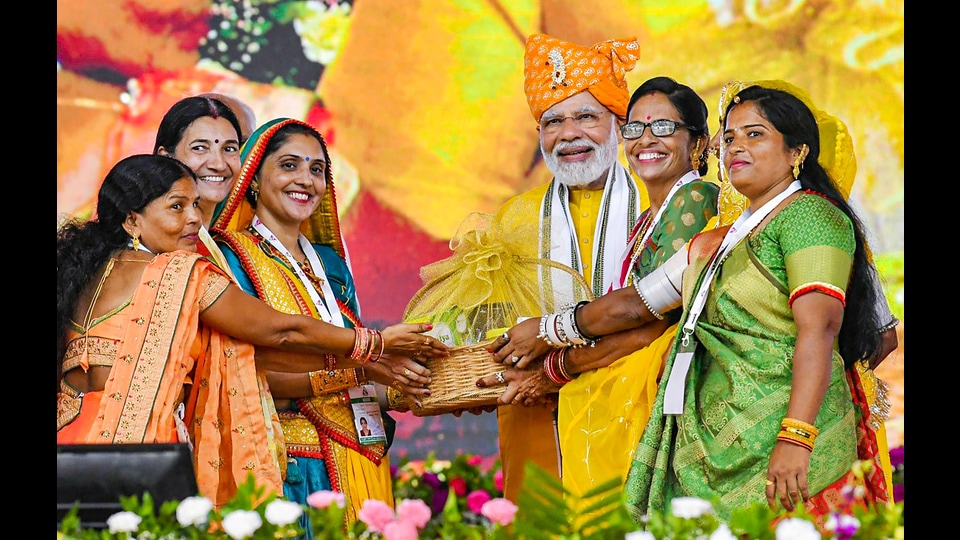
At the event, PM Modi also felicitated beneficiaries of the Sukanya Samriddhi Scheme in the presence of Gujarat chief minister Bhupendra Patel.
“Today Sabar Dairy has expanded as new projects worth hundreds of crores are being set up here. The dairy’s capacity will increase further with the addition of a milk powder plant with modern technology and one more line in the aseptic packing section,” he said.
PM Modi recalled the situation of deprivation and drought the state experienced two decades ago, and how he, as the then chief minister, drew people’s cooperation to improve the situation.
Also Read:Grief shrouds villages in Gujarat, hooch toll at 42
Stating that cattle rearing and dairy was the key element of these efforts, Modi talked about steps to promoting animal husbandry by providing fodder, medicine and Ayurvedic treatment for cattle.
Making a special mention of the Gujarat Jyotigram Scheme to provide round the clock electricity in all villages as a catalyst of development, he said that due to efforts of the past two decades, the dairy market in Gujarat is now worth ₹1 lakh crore. He recalled his earlier visits in 2007 and 2011 and request to increase women’s participation, which has led to most of the committees now having good female representation. Payments for milk is mostly done to women, he said.
“The work of formation of 10,000 farmer producer associations (FPOs) is going on in full swing in the country. Through these FPOs, small farmers will be able to directly connect with the food processing, value linked export and supply chain. The farmers of Gujarat are also going to benefit a lot from it,” he said.
The prime minister said that the strategy of creating alternative income streams for farmers is turning fruitful, and practices such as horticulture, fishery, honey production are generating “good income” for the farmers. The turnover of Khadi Gramodyog has crossed ₹1 lakh crore for the first time, he said, adding that more than 15 million new jobs are being created in this sector in villages.
Steps such as neem-coating of urea, revival of fertiliser plants that were shut down, promoting nano fertilisers and ensuring urea availability at affordable prices despite global price hike have benefited farmers of Gujarat and the country, he said.
The ‘Sujlam Suflam Scheme’ has made water available to many tehsils of Sabarkantha district, Modi said. Connectivity has increased at an unprecedented scale in the district and nearby areas due to railway and highway projects, helping tourism and employment for the youth, the prime minister told the gathering.
The projects inaugurated today include a powder plant at Sabar Dairy with a capacity of around 120 metric tonnes per day (MTPD) at a cost of over ₹300 crores, an aseptic milk packaging plant with a production capacity of 3 lakh litres per day at a cost of ₹125 crore, foundation stone for the Sabar Cheese & Whey Drying Plant Project at a cost of around ₹600 crores (the plant will manufacture 20 MTPD cheddar cheese, 10 MTPD mozzarella cheese and 16 MTPD processed cheese). Whey generated during the manufacturing of cheese will also be dried at the Whey Drying Plant, having a capacity of 40 MTPD.