E-Paper



PM Modi gives 106,000 land certificates in 1st visit ahead of Assam polls
Prime Minister Narendra Modi addressed a large gathering at Jerenga Pathar, a historic site where Joymoti, an Ahom princess, sacrificed her life in the 17th century.


In his first visit to Assam, where assembly election is scheduled in April-May, Prime Minister Narendra Modi distributed land allotment certificates to 106,000 landless indigenous families on Saturday. He personally handed over certificates to 10 recipients.
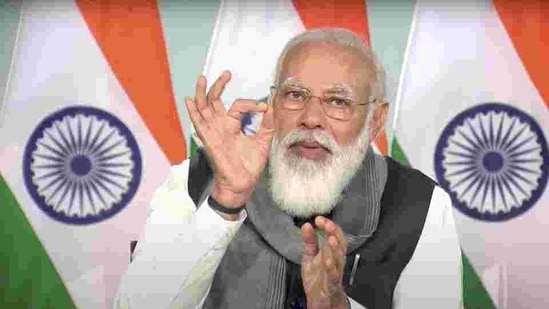
“When our party came to power in Assam there were nearly 600,000 families who were landless and had no land documents. Earlier governments didn’t care for these families. But our government started working on it earnestly to give them land certificates,” he said.
The PM said allotment of these certificates would ensure benefit of several central and state government schemes to these families and they would even be able to take bank loans based on land ownership.
As part of the initiative, landless families in rural areas will get seven ‘bighas’ of agricultural land and another one ‘bigha’ to construct houses. One ‘bigha’ is equal to 14,400 sq. ft. In urban areas, allotment would be 1.10 ‘katha’ and in Guwahati, it would be 1.50 ‘katha’. One ‘katha’ in Assam is equal to 2,880 sq. ft.
Modi addressed a large gathering estimated to be over 200,000 at Jerenga Pathar, a historic site where Joymoti, an Ahom princess, sacrificed her life in 17th century to protect the life of her husband Prince Godapani, who went on to become a king of the Ahom dynasty.
“Jerenga Pathar is the ‘balidan-bhoomi’ (sacrifice land) of Joymati. I salute her indomitable courage and this land. Considering the importance of this place, we are taking steps to include it in a list of five iconic archaeological sites in the country,” said the PM.
Jerenga Pathar is located in Sivasagar district in upper Assam, which was earlier called Rangpur and was one of the capitals of the Ahom dynasty for nearly six centuries.
Giving land rights to indigenous landless families was an important promise made in 2016 by the BJP, which came to power in Assam with the slogan of protecting ‘jaati’, ‘maati’ and ‘bheti’ (community, land and hearth).
According to government data, the state had around 575,000 landless families in 2016. Since coming to power five years ago, the government has given land allotment certificates to nearly 228,000 such families. Saturday’s event was a continuation of that initiative.
Also Read: PM Narendra Modi to visit Kolkata to celebrate Netaji’s 125th birth anniversary
In his speech, Modi listed the central and state schemes that have benefited people in the state in the past few years. He also highlighted the schemes for the tea-tribe community, which is influential in many assembly constituencies in upper Assam.
“The steps taken by our government in the past four and half years have ensured protection of rights of the state’s indigenous people and ensured peace and development,” said chief minister Sarbananda Sonowal in his address.
Modi’s visit was preceded by torch rallies across the state on Friday evening against Citizenship Amendment Act (CAA), carried out by the All Assam Students Union (AASU) and several indigenous organizations.
AASU, which spearheaded the anti-CAA protests in the state in December 2019, launched a three-day protest against the legislation beginning Friday.