
 E-Paper



PM Modi warns against corruption and nepotism
The PM also identified five resolutions or “panch pran” that every citizen should strive for in the next 25 years.


Prime Minister Narendra Modi in his Independence Day address on Monday launched a scathing attack against what he described as the twin challenges of corruption and nepotism, and said if not addressed in time, these could become formidable challenges.
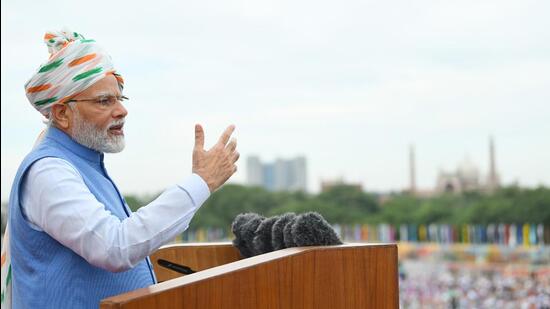
The PM also identified five resolutions or “panch pran” that every citizen should strive for in the next 25 years.
In his 83-minute speech from the ramparts of the Red Fort, Modi said the country needs to come together as a society to punish those who have propagated the evils of corruption and nepotism. He was critical of the tendency to felicitate and glorify those who have been convicted or are facing trial or are behind bars and said, “Today the nation shows anger towards corruption, but not the corrupt. Until and unless people adopt the approach to penalise the corrupt, the nation cannot progress at an optimum pace.”
Both corruption and nepotism have been recurring themes in many of the PM’s speeches, including those delivered during election rallies. He came to power in 2014 on a pro-development, anti-corruption platform.
Modi went on to add that social sanctions against corruption are much needed to eradicate the problem. “This mentality is not going to end until there is hatred towards corruption and the corrupt and they (corrupt) are not belittled socially.”
He drew a parallel between the poor who do not have a place to stay and those who are running out of places to store their ill-gotten wealth to underscore the urgency to fight corruption, which he described as termites that hollow out the insides. The PM said while the government is making all efforts to bring to book those who have looted the country and scammed the banks, he wants the help and support of 1.3 billion Indians to strengthen the fight against corruption, which is now entering a “decisive period”.
Announcing a war against nepotism, he said when he speaks about the challenge, people assume it is limited to politics alone, but the preferential treatment is an impediment for talented people getting their due. “Unfortunately, that evil from the political field has nurtured nepotism in every institution of India,” he said.
He cited India’s medal haul at the recent Commonwealth Games as an example of talent getting its due in the absence of nepotism.
“Our stellar performances at the international sporting events are an example of India’s shining talent. We need to promote and support such talent,” he said.
This is not the first time that Modi has underlined the perils of dynastic politics and taken an aggressive stance against it. On an earlier occasion, he said dynastic politics promotes casteism and he is dead against it. “…Even in politics, nepotism has done injustice to the country’s strength. Dynastic politics is for the welfare of the family, it has nothing to do with the welfare of the country,” he said.
Modi also urged people to follow five resolutions for the next 25 years of the “Amrit Kal” till when India celebrates the centenary of her Independence. He said the first resolve should be to work towards a ”developed India”; the second to get rid of our colonial past and shed the baggage of colonialism and slavery; the third resolve is to take pride in India’s heritage, the fourth to strengthen unity to fulfil the aspiration of Ek Bharat, Shresht Bharat (one India, excellent India) and the fifth resolve to fulfil the duties as a citizen.
Stressing on the need for self-reliance, another theme that has recurred in his speeches and driven several government policies over the past eight years, the PM said the country has to set its own parameters for measuring growth and adopt an “India First” approach.
“We need to shed the mentality of slavery; how long will we survive on the certificates given out by others. We need to form our own standards… I see hope in the new education policy, the way it has come about after inputs from thousands of people and rooted in Indian thought, it will give us power to decolonise,” he said.
Dynasty has now become the Bharatiya Janata Party (BJP)’s internal problem, said Congress spokesperson Pawan Khera. “Is Modi’s attack against his own ministers and their children,” he asked, referring to Modi’s speech.
The Congress also demanded a report card of the eight years of rule by the BJP and an explanation on “unfulfilled promises”.
Congress leader Rahul Gandhi refused to comment on Modi’s remarks.
Political commentator Manisha Priyam said Modi’s speech put women and the youth at the center, which is an important indication of how policy will be shaped. “He sets the goals and talks directly to the people. The issues that he raised, of fighting corruption and giving respect to women, will be lapped by the people, especially women,” she said.
 ABOUT THE AUTHORSmriti Kak Ramachandran
Smriti covers an intersection of politics and governance. Having spent over a decade in journalism, she combines old fashioned leg work with modern story telling tools.


