
 E-Paper



Prosecution of 26/11 attacks planners is “high priority” for US: Top US diplomat
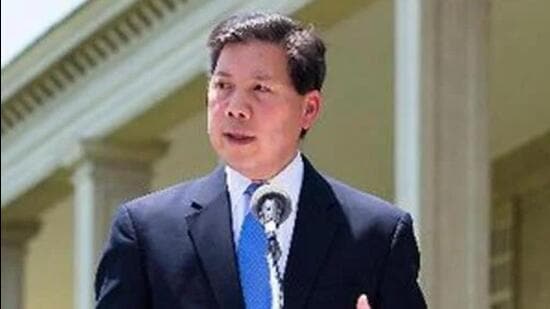
Ambassador Christopher Lu said the US thinks that India can play an important role in ending this tragedy that’s happening right now in Ukraine.


NEW DELHI: Ensuring the prosecution of those behind the 26/11 attacks is a “high priority” for the US since six Americans were among those killed in the carnage in India’s financial hub, Ambassador Christopher Lu has said. The top US diplomat, who headed the US delegation that joined the special meeting of the UN Security Council’s Counter-Terrorism Committee (CTC) hosted by India last week, told Rezaul H Laskar in an interview that it was “shameful” that New Delhi and Washington’s efforts to sanction terrorists at the UN Security Council were being blocked. Edited excerpts:
What are the areas where India and the US can work more closely on shaping the UN’s response to the misuse of new and emerging technologies by terrorists?
First of all, it’s an honour to be here at this important event. The US and India have a very strong relationship, particularly when it comes to counter-terrorism. So my presence here really is to affirm the closeness of our relationship and look for additional areas of collaboration. I think even just in my short period of time here, I’ve seen it in a very personal way why this issue matters so much to the Indian people. The event we had [on October 28] in Mumbai was moving. As somebody who is a long-time resident of Washington DC and a current resident of New York, I’ve seen how terrorism has affected our country as well. So, it’s all in the way of saying collaboration is important on this issue. I think certainly we in the US have seen the transformative effects, both positive and negative, of emerging technologies. Obviously, a free and open internet is an important concept. Vibrant social media is important, but we’ve also seen the dangers of them. We’ve obviously seen the positive aspects of new forms of digital currency, but we’ve seen how they can be used for bad as well...Frankly, this conference was both the culmination of a lot of discussions, but really the beginning of more conversations, I think really to increase awareness of both the upsides and the downsides...how you find this right balance between counterterrorism, innovation, human rights. It’s not an easy situation and it’s one that we’re wrestling with right now in the US.
The two issues that are in focus are digital payments and crypto-currencies and drones. In India, drones are being increasingly used by terror groups. What can India and the US do to tackle these issues?
I don’t profess to be the expert on either one of these things. I think particularly when it comes to crypto-currency, it’s the new frontier and obviously it provides a level of freedom and flexibility for countries that don’t have stable currencies. It provides an alternative. But we have not in the US come to an internal consensus now on if and how they should be regulated in any way. When it comes to drones, obviously, we’re seeing very painfully right now in Ukraine the use of Russian drones against civilian targets. We have certainly felt this in terms of US military facilities that have been targeted in other countries as well. Again, this is something that I think there needs to be a hard look at and something that we are certainly taking a hard look at in terms of greater controls, greater regulation against the use of these tactics.
US secretary of state Antony Blinken, in his message to the CTC meeting, mentioned joint efforts by India and the US to sanction terrorist entities and individuals. But there’s a particular country that has blocked five listing proposals at the UN Security Council since June. How do you work around this issue?
I don’t want to get into the specifics of these 1267 [Sanctions Committee] designations, but we certainly, as secretary Blinken said yesterday, share India’s concerns about bringing the perpetrators of the 2008 [Mumbai] attacks to justice. We think through these designations at the UN, we can help do that. It is unfortunate that all countries don’t share our belief, but like so many other current issues in the UN Security Council, there are countries that are blocking meaningful action in providing better security around the world. We will continue talking to those countries, trying to convince them of that. But it is, frankly, I think, shameful that there are countries that are blocking action on this important issue.
The second point that secretary Blinken mentioned, and which you referred to, is bringing the perpetrators of the Mumbai attacks to justice. The trial in Pakistan has gone nowhere. How does one tackle this issue in the case of a country like Pakistan?
I think the designations at the Security Council are one way to do that. I know law enforcement officials between our two countries are working closely on this. It’s a high priority to our country, given the fact that six Americans died in those attacks...India is one of our closest partners, we will continue working all possible means to ensure that justice is done. But it is challenging.
Would something like sanctions on Pakistan be an option?
I’m not at liberty to discuss sanctions on that.
In the context of UN reforms, is there a need for reforms in the case of something like the “technical hold” on terrorist listings?
We are committed at the UN to ensure that it fits the needs of the 21st century. I think we have seen in recent years, again, I think most prominently with Russia’s invasion of Ukraine, Russia’s veto of resolutions, that reform is needed to ensure that...the Security Council can do its effective work. And I do think this is an issue that needs to be examined.
There’s also the issue of reforms of the Security Council and giving countries such as India and Japan a place at the high table. What is the thinking in the US on this?
Both my boss, Ambassador Linda Thomas-Greenfield, and President Joe Biden, in recent weeks, have issued statements supporting a broader call for reform. And this is something we are currently engaged in a meaningful way in New York. We believe the Security Council needs to change. I mean, it is based on the world as it existed in 1946, when the UN was created. That is not current. That is not the way that the world currently looks right now. So we are open to and supportive of an expansion of the Security Council, of adding additional permanent and non-permanent members, ensuring greater geographical representation to ensure that it is as effective and credible a body as it can be.
In the context of reforms, are there specific areas that India and the US can work together on, such as UN peacekeeping?
We do have a very effective collaboration. I know that there are Indian peacekeepers and it’s an important contribution. These peacekeeping missions are critically important, particularly in places like Africa, where but for those peacekeeping missions, innocent people would be dying. Again, I will take this out of the Security Council context. I am the ambassador for management and reform. I’m the only ambassador in New York that has the title of reform there. And I do think this is kind of a moment that we need to relook at how the UN does all of its work. The secretary-general has a new, broader second term vision called “Our Common Agenda”, where he’s looking not just at security matters, but he’s looking at human rights, education, development, healthcare, about how the UN could be more fit for purpose in the 21st century. And that’s the process we’re going to be engaging over the next couple of years.
On the Ukraine conflict, India and the US have approached the issue in different ways although India has pushed Ukraine and Russia to end the hostilities. What is the thinking on the fact that India has abstained on most issues related to Ukraine at UN bodies?
The US and India have a very close working relationship, not only around the world, but certainly at the UN. We in the US believe that really, the core principle of the UN Charter is territorial integrity. When a country like Ukraine is attacked by its neighbour, there can be no sitting on the sidelines. Friends like the US and India can disagree on this issue. But we are going to continue to make this case about why. Really, I think India’s voice on this matter is so important and obviously we are encouraged by some of the messages that in particular have come out from Prime Minister [Narendra] Modi on this. We think India can play an important role in ending this tragedy that’s happening right now in Ukraine.


