
 E-Paper



Punjab gets India's largest bio-energy plant, CM Mann says it'll help curb farm fires
Describing it as a “red letter day” for the state, Mann said “this step will go a long way in wiping out the menace of paddy straw burning from the state".


Punjab chief minister Bhagwant Mann and Union petroleum minister Hardeep Singh Puri on Tuesday dedicated India’s largest bio energy plant constructed at a cost of ₹230 crore over 20 acres of land.
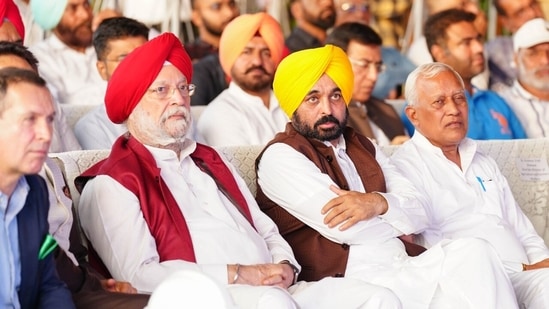
The inaugural was attended by cabinet minister Aman Arora, Punjab Energy Development Agency (PEDA) chairman HS Hanspal, MLA Lehra Varinder Goyal, additional chief secretary to CM A Venuprasad, ‘Invest Punjab’ CEO KK Yadav and PEDA CEO Sumit Jaranghal..
Describing it as a “red letter day” for the state, Mann said “this step will go a long way in wiping out the menace of paddy straw burning from the state".
Also read: Double grants for outstanding woman sarpanches: Punjab minister Dhaliwal
According to Mann, the Bio-CNG project of 80,000 m³/day capacity will produce biogas by the anaerobic digestion process and is a great way to solve the problem of stubble burning. “The annual straw consumption in this unit will be 1.30 lakh ton adding that it will help in solving the vex problem of paddy straw burning,” he said.
In a statement, Mann said the unit will contribute to an annual reduction of 1.50 lakh MT of pollutants and 20,000 MT of fly ash. He further said it will also give employment to 1000 youth and affect more than 5,000 families.
Quoting the verse ‘Pawan Guru, Paani Pitaah, Mata Dharat Mahat’ from Gurbani, Mann said the project is “in consonance with the commitment of the state government to make Punjab clean, green and pollution free”.
“Now the time has come when we must imbibe the teachings of Gurbani in our lives for restoring the pristine glory of the state by resolving not to burn crop residue,” he said.
The statement added that “with the intense cropping pattern of wheat and paddy, Punjab is facing the problem of disposal of crop residues, particularly the paddy straw and stubble which have no other usage”.
He said that about 18 MT of straw/stubble is generated every year but only five MT is being used in biomass power plants, industrial boilers, and the plywood industry. “Rest of the 13 MT is being burnt by farmers in the fields as no other safe disposal techniques are available,” he added.
Also read: PAU V-C ‘illegally’ appointed, remove him: Punjab guv tells CM Mann
Mann said about 200 more projects of capacity 10 TPD each can be set up in Punjab - for which the state government is providing various incentives under State NRSE Policy-2012. He added “the target is to make Punjab free from the menace of paddy straw burning”.
He said the “ministry of Petroleum & Natural Gas, GoI has also notified the National Policy on Biofuels in June 2018 which emphasises the need for promotion and development of projects for the production of the biofuels.”


