E-Paper



Pure data on ‘Pure Veg’: A look at how India eats
.
Updated on: Mar 20, 2024, 21:59:35 IST

 Prefer HTon Google
Share via


Copy link

Zomato’s green-themed “Pure Veg” delivery fleets announcement, made with much fanfare by CEO Deepinder Goyal, was tweaked a few hours later to ensure “the fleet meant for vegetarian orders will not be identifiable on the ground”, after the idea was pilloried by several people on social media.
What is the best way to understand the larger issue behind this controversy? Here are four charts which look at various aspects of it.
Vegetarians are a minority in India, including among Hindus
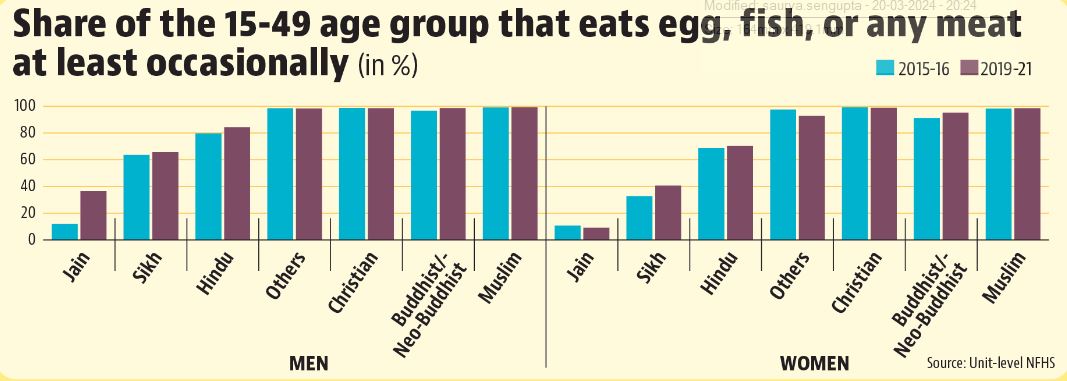
 Vegetarians are a minority in India, including among HindusThe data is unambiguous on it. According to the 2019-21 round of the National Family and Health Survey (NFHS), 87% men and 75% women in the 15-49 age group reported eating either meat, fish or eggs in India. This number was at least 40% across every religious group listed in the NFHS schedule with the exception of Jains. In fact, a comparison with the previous NFHS conducted in 2015-16 shows that the share of people who eat meat, fish or eggs has increased for all major religious groups. The only exception to this trend are Christians but the share of meat/egg/fish eaters among them is still close to 99%. This was pointed out in an earlier story in these pages when the NFHS data was released.
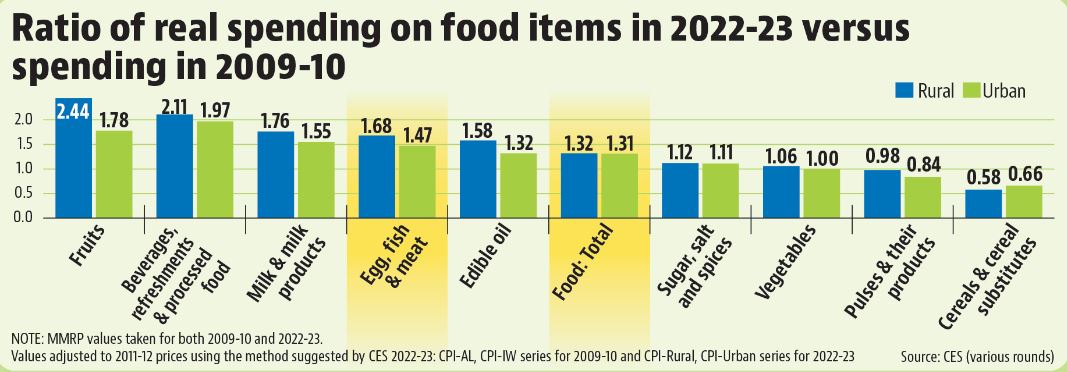
- There is reason to believe that the consumption of meat, fish, eggs, etc. is increasing at a much faster pace than other food itemsThe recently released factsheet on the Consumption Expenditure Survey (CES) conducted in 2022-23 shows this clearly. This survey collected data using the modified mixed reference period (MMRP), which allows comparisons back to 2009-10. This shows that the average household spending on eggs, fish, and meat increased at a compound annual growth rate (CAGR) of 4% and 3% in rural and urban areas between 2009-10 and 2022-23, in real terms. In comparison, the growth rate for food overall was only 2.2% and 2.1% in rural and urban areas respectively.
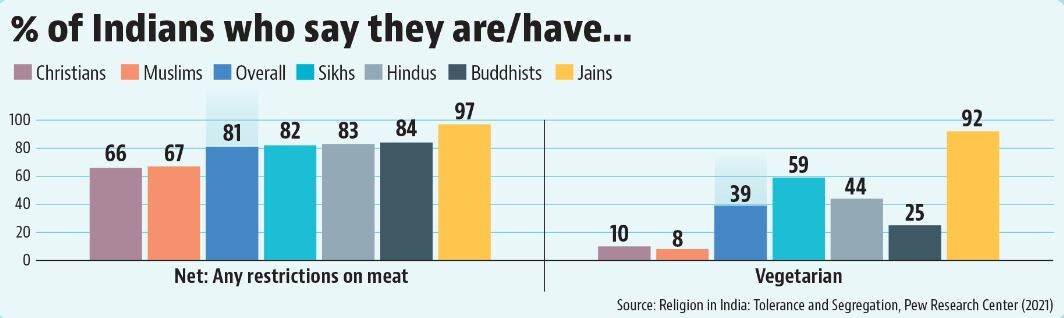
- But a large share of non-vegetarians could have vegetarian-like food preferences at timesThis is what is often missed in the debate on food segregation in India. A 2021 survey conducted by Pew Research on “Religion in India: Tolerance and Segregation” shows this clearly. The survey found that the share of “pure vegetarians”, a term one is unlikely to encounter outside this country, who never eat meat was under 40% for all Indians and just 44% for Hindus. However, the share of quasi-vegetarians -- people who do not eat meat on certain days or do not eat certain kinds of meat -- is almost double the share of “pure vegetarians”: 81% and 83% for all Indians and Hindus. Anecdotally, this statistic makes a lot of sense, especially among Hindus. What is also remarkable about this statistic is that it is almost similar across caste (upper and lower caste are categories used by the Pew Survey) unlike in the case of “pure vegetarians” where the gap is much larger. Nor is it a function of religion being very important for the respondent or the political party they support.
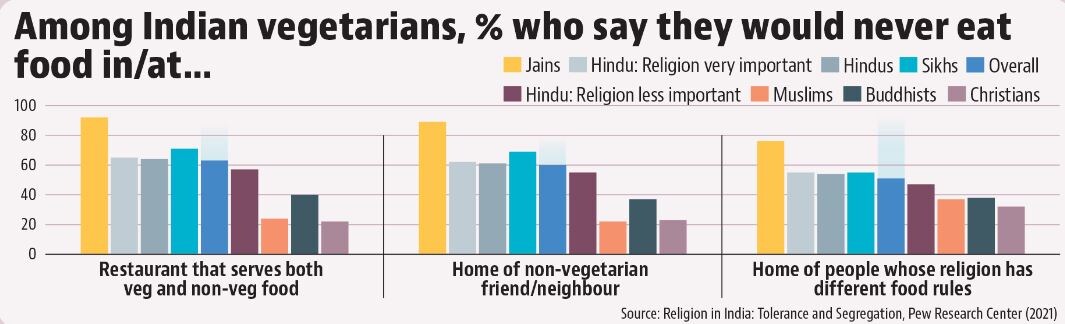
- And a large number of vegetarians are unwilling to share food spaces with meat eatersThis is the most important fact about Indian food markets which might have motivated Zomato to announce “pure veg” deliveries. Just about 37% and 40% of all Indian vegetarians said they would “ever eat food in a restaurant that serves both vegetarian and non-vegetarian food” or “in the home of a friend or neighbour who is non-vegetarian” according to the Pew Survey. These exclusionary practices do not change much with education or age. They are slightly lower among men and people who do not give a lot of importance to religion. The data also shows that such beliefs are the lowest in southern India. The western and northern parts of the country have the lowest share of vegetarians who are willing to share their food space with non-vegetarians. Among different religious groups, Jain vegetarians are the most rigid about separate food spaces while the practice is the lowest among vegetarians among Muslims and Christians. To be sure, the Pew Survey data also shows that almost half of Indians (and Hindus) are averse to eating food in homes or functions hosted by people of different religious groups. These numbers show that food segregation is a widespread practice in India.
- The bigger questionIn an ideal world, there is nothing wrong with either “pure veg” restaurants or delivery services. However, the bigger question is whether a section of the population can impose its food segregation preferences on another cohort. Anecdotal evidence on such things happening is widespread in India and perhaps this is what prompted Zomato to backtrack on its segregation plans. But ensuring that such segregation does not impinge on other people’s freedom or safety is a problem for law enforcement rather than a private company. And it is as much a social issue as it is a commercial and law-and-order one.