
 E-Paper



Qassem Soleimani killing: Strike could snowball conflict
Qassem Soleimani was killed with a top leader of pro-Iran militias at Baghdad airport in a US drone strike on the orders of President Donald Trump


Any escalation of tensions between the US and Iran following the death of al-Quds Force commander Qassem Soleimani could have far-reaching implications for India’s energy security and the fate of some 8 million Indian expatriates in West Asia.
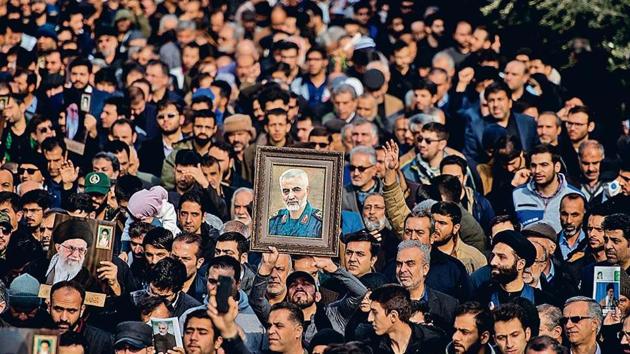
Soleimani was killed with a top leader of pro-Iran militias at Baghdad airport in a US drone strike on the orders of President Donald Trump, who appears to have acted with an eye on both an impending impeachment trial in the US Senate and his re-election bid later this year.
Reports from Tehran indicated Iran’s top leadership is considering ways to retaliate to the killing of Soleimani, a general who was seen as second only to Supreme Leader Ali Khamenei. Experts believe any retaliation could trigger a spiralling confrontation that could spread from Iraq and engulf the wider region.
“The killing of a top Iranian general is almost like a declaration of war,” said Waiel Awwad, an India-based Syrian journalist who closely tracks developments in West Asia. “Iran will retaliate and it remains to be seen whether the US president is really prepared for the mess that will follow,” he said.
Talmiz Ahmad, who served as India’s ambassador to Saudia Arabia, Oman and the UAE, said Soleimani’s killing was the fallout of an escalation in actions involving US forces and Iran-backed militias in Iraq since December 27.
A rocket strike on an Iraqi military compound killed an American contractor, prompting a series of US airstrikes that killed 25 militia fighters. All of this culminated in the attacks on the US embassy in Baghdad this month.
“There were other sources of tensions between Iran and the US – the attacks on oil tankers in June last year, the detention of Iranian tankers and the attacks on Saudi oil facilities last September – and the US has held Iran directly responsible for the attacks,” Ahmad said.
“At the same time, people in Iraq, which is one of the largest producers of oil, feel they haven’t benefited from the ethnic and sectarian quota-driven political system put in place by the US. They think it’s an inherently corrupt system,” he said, adding the security situation in Iraq was precarious.
Ahmad believes Trump decided on the action against Soleimani to enhance his standing ahead of the 2020 election and to send out a message that he is a decisive leader ahead of the possible impeachment trial in the Senate. “There is a now a fear of escalation on all sides. The US has complete control of the skies and waters in the region, There are only some 5,000 US troops in Iraq and another 750 are expected to join them but they are spread across 25 bases and well positioned. So there could be a region-wide conflagration,” Ahmad said.
From India’s perspective, any such conflict would not only have an impact on energy supplies – oil prices surged as much as 4% after Soleimani’s killing – but it could affect the fortunes of the nearly 8 million Indian expatriates living in West Asia. Nearly 3 million Indians live and work in Saudi Arabia alone, and past conflicts in the region has triggered a huge exodus of expatriates.
More worryingly for India, Indian nationals in West Asia account for about $40 billion of the $70 billion that the country receives in remittances annually, and any conflict could hit these remittances at a time when the Indian economy is grappling with a host of other problems.
A potential conflict between the US and Iran will also have implications for India’s project to develop the strategic port of Chabahar, central to Indian plans to ferry supplies to war-torn Afghanistan and to access Afghan and Central Asian markets while bypassing Pakistan. The project has so far been protected from US sanctions imposed on Iran thanks to a waiver from the Trump administration in view of its importance for Afghanistan.
During external affairs minister S Jaishankar’s recent visit to Iran, the two sides agreed to take steps to boost the economic viability of Chabahar following the achievement of political objectives for developing the port. Any conflict between the US and Iran is bound to hamper such plans.
Trita Parsi of the Quincy Institute for Responsible Statecraft said Soleimani was an enemy of the US but “his assassination will make America less safe, not more”.
He added, “America benefits from reduced tensions with Iran. With this assassination, Trump has instead inflamed these tensions... Diplomacy makes America safer, assassinations and escalation do the opposite.”
Parsi said the biggest risk to the US may not be Iran’s response, but that “other elements, who Iran may not control, may start targeting the US”. He added, “So even if both Washington and Tehran seek de-escalation, they may not be able to ensure that others don’t add fuel to the fire.”


