
 E-Paper



Red corridor to white flag: The lives of former Naxalites
From January 1 to December 15, a total of 1,552 Maoist cadres have surrendered

 Prefer HTon Google


Last Thursday marked two months of his surrender. A winter sun hung gently over Jagdalpur, Chhattisgarh that day as Rupesh, whose real name is Takkallapalli Vasudeva Rao, sat under a mahua tree inside the police training centre, a yellow cap on his head and an old digital watch, the kind that went out of vogue in the 1980s but is strangely seeing a resurgence now, around his wrist.
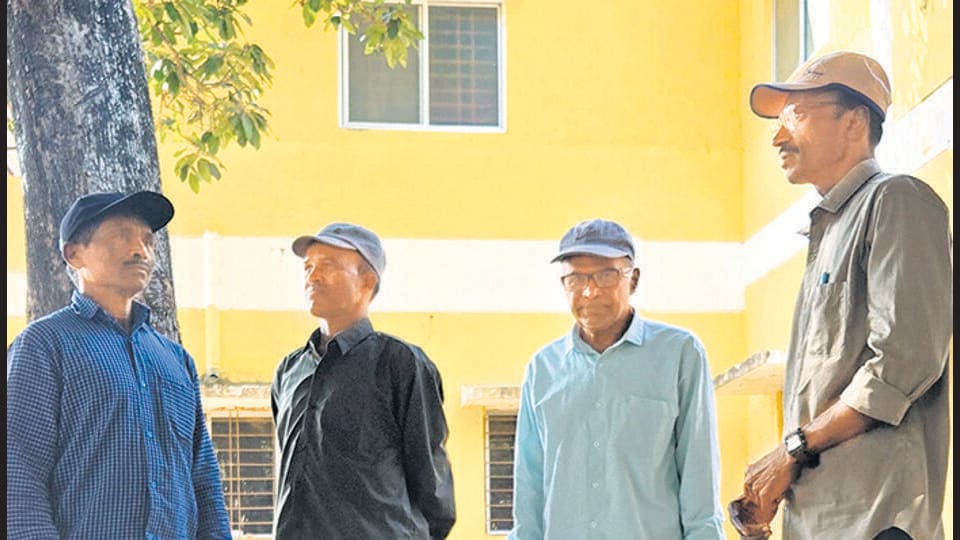
The forest was no longer his world, but the one waiting beyond the camp gates still felt distant.
Rupesh — in his mid-50s — a central committee member and one of the most senior Maoists to surrender, is among nearly 200 Maoists who lay down their arms on October 17, in what security officials describe as one of the largest mass surrenders since Maoism entered Chhattisgarh in the 1980s.
For years, Rupesh lived deep inside forests, governed by ideology, secrecy and survival. Much of that time was spent in Abujhmad , a vast and rugged expanse that remained largely inaccessible to security forces for decades and functioned as one of the insurgent movement’s most secure bastions.
Though he has stepped out of the jungle, Rupesh says he is as busy as he was in his past life. The routines are different, but the sense of discipline is the same.
His day begins at around 5.30am with physical exercise in the open field in front of the compound.
Most of his day is spent reading and writing about party activities, perusing statements and allegations and drafting detailed responses.
“I am busier here. I have to read, write responses, and study other subjects as well,” said Rupesh.
The Maoist leader is careful to emphasise that the surrendered cadres are not confined or caged.
“Families visit frequently and at times stay with them for days. The compound, though guarded, allows a degree of normalcy.”
Living arrangements inside the facility reflect a structured routine. The men stay in barrack-style halls on the ground floor, and the women are on the second floor.
Inside the barrack are several beds. A handbook of the Indian Constitution, gifted at the time of surrender, alongside a carrom board, a Ludo set, and an Oxford dictionary can be seen.
Rupesh says he has begun reading the Constitution.
“I am reading it, especially the parts that talk about tribal rights. As I have said earlier, my fight for the people will continue,” he said.
The kitchen is run by the surrendered Maoists themselves and they decide what to cook and what to eat, managing their daily meals without interference.
Nearby, Ranita — in her mid-40s — another senior Maoist leader who once headed the Maad division, listened carefully as Rupesh spoke and followed the conversation quietly, her attention fixed on his words.
“Things are good here,” she said, but her thoughts are elsewhere.
“I want to go back to my village in Kanker district. Now I will farm.”
Then there is Chaitu, another senior Maoist leader, now in his sixties. He spends most of his time reading.
“I read everything,” he said, carefully turning the pages of a Hindi newspaper, his eyes moving methodically from one column to the next. He tells this reporter that he is keen to read Nandini Sundar’s book The Burning Forest, a work that documents conflict, displacement and state presence in Bastar.
Around 80km from Jagdalpur, inside the police line compound at Dantewada, are other Maoists who have surrendered, other lives in a similar transition.
Nirmala, the former secretary of the North Bastar Zonal Committee of CPI (Maoist), sits quietly under a Pipal tree near the helipad.
At 35 and unmarried, she was among the senior Maoist leaders who surrendered on November 30, stepping out of a life shaped by secrecy and command.
Nirmala says she is eager to return home to Ghot village in Narayanpur and reclaim an ordinary existence interrupted long ago.
“I will go to my village and live a normal life. The government was offering me a job in the police, but I have decided that I will never pick up arms again. I hope the government will help me with a job,” Nirmala said.
Her words carry a sense of closure. Like others who have surrendered before her, Nirmala now measures the future not in ideology or control, but in the promise of work, land and family.
As sunlight filtered through the mahua leaves above the Jagdalpur campus, and routines unfolded inside the Dantewada police lines, Rupesh, Ranita, Chaitu and Nirmala appeared suspended between two world. They are no longer underground commanders, and not yet fully civilians.
This personal transition mirrors a wider shift across Bastar. This year has marked a significant phase in the decline of Maoist activity, reflected in the growing number of cadres laying down arms and returning to the constitutional mainstream. From January 1 to December 15, a total of 1,552 Maoist cadres have surrendered.
A key turning point came with the first mass surrender on October 17. Till then 1,051 cadres had surrendered. In the weeks that followed, another 501 gave themselves up, taking the cumulative total to 1,552, underscoring the cascading impact of collective surrenders.
The surrenders have cut across organisational hierarchy. In the senior leadership, one Central Committee Member, 11 DKSZC (Dandakaranya Special Zonal Committee; one of the strongest units of Maoists at one time) members, and one Regional Committee Member surrendered. In middle management, 47 Divisional Committee Members and 129 Area Committee Members surrendered. And in the military formations, the surrenders include 13 Company Commanders, five Deputy Company Commanders, 103 Platoon Commanders, 124 Platoon Members, and eight Section Commanders.
“After surrender, cadres are processed strictly under the government’s surrender and rehabilitation policy. They are first kept in transit camps for verification, debriefing, security assessment, medical check-ups and counselling. Eligible cadres are then shifted to rehabilitation centres for livelihood and skill development training, with financial assistance, housing support and structured reintegration measures, before being reunited with their families,” said a senior police officer who asked not to be named.
The wave of surrenders fits into the Union government’s declared endgame against Left Wing Extremism.
Union home minister Amit Shah has announced that Maoism will be completely eliminated from the country by March 31, 2026, with Bastar identified as the most critical theatre in this final phase.
Shah has said intensified intelligence-led operations, expansion of forward security camps in core forest areas, development initiatives and a robust surrender-and-rehabilitation framework have pushed the Maoist movement into irreversible decline, while assuring dignified rehabilitation for those who lay down arms.
Reflecting on the trend, Sundarraj Pattlingam, Inspector General of Police, Bastar Range, said the large-scale surrenders are the outcome of sustained operations, effective area domination and the government’s humane rehabilitation policy.
According to him, the Maoist organisation has lost its command structure and morale, and cadres are increasingly realising that violence offers no future or dignity.
He noted that many former cadres have undergone a positive transformation after surrender, reconnecting with their families and society through continuous counselling and support.
It helps that the surrenders have also been accompanied by the killing, in clashes with security forces of those Maoists unwilling to lay down their arms — thus far this year around 270 have been killed — including senior leaders such as Basavaraju, Madvi Hidma, Kosa and Katta Ramchandra Reddy.
Taken together, the statistics and the lived experiences inside rehabilitation camps point to more than an operational success. The scale, spread and depth of surrenders this year signals a fundamental change in attitudes among those once drawn into the Maoist movement, and speak of a Bastar cautiously stepping away from decades of armed conflict.
-kW0H-U20214218012MgB-250x250%40HT-Web.jpg)


