
 E-Paper



Reject elite notion that only educated should have the right to vote, says CJI
The elite perception that only educated or few individuals should have the right to vote shows contempt and distrust towards democracy, CJI Dhananjaya Y Chandrachud said on Friday.

 Prefer HTon Google


The elite perception that only educated or few individuals should have the right to vote shows contempt and distrust towards democracy, Chief Justice of India (CJI) Dhananjaya Y Chandrachud said on Friday, calling the Constitution a “feminist” document that brought about a “silent revolution” through its “boldest move” of giving all adult citizens the right to vote.
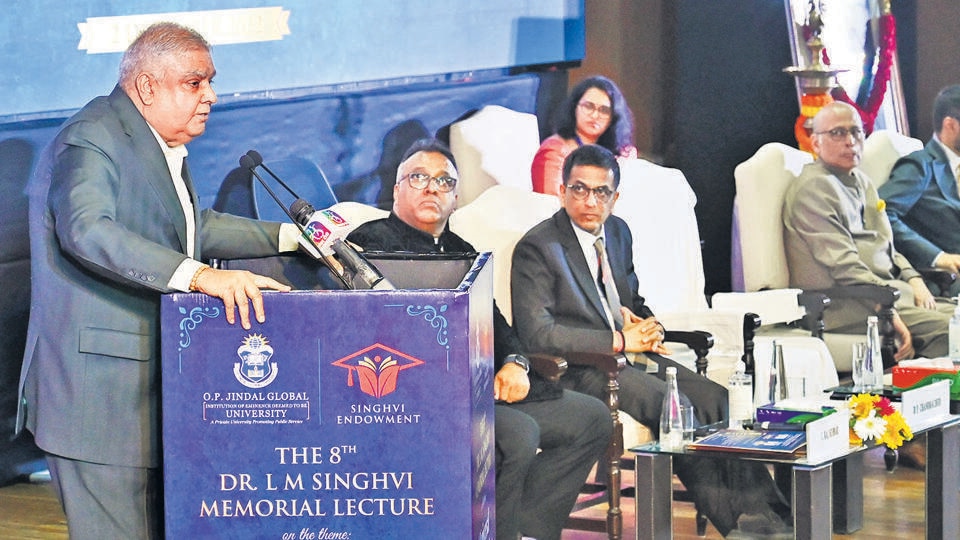
Speaking at the eighth Dr LM Singhvi Memorial Lecture, the CJI underscored that the Indian experience demonstrates that even the most vulnerable have the political consciousness to choose the leader they want.
“Therefore, we must reject every form of elite understanding of the democratic process, which we keep hearing constantly, that only the educated are better decision-makers. Individuals whom society has despised as being uneducated have shown tremendous political acumen and awareness of local problems, which even the educated may not understand,” said justice Chandrachud.
Also read: Presidential assent on Jallikattu considered all aspects: Centre to SC
Emphasising that the universal adult franchise acted as an equalising force in shaping the future of India, the CJI pointed out that the marginalised and oppressed classes, who were denied rights and powers, have gradually become a deciding force in selecting the composition of Parliament.
“This is an example of how political transformation through universal adult franchise led to social transformation of the Indian society. Universal adult franchise provided confidence to the oppressed communities whose right to even believe in themselves was taken away by the oppressive structures and groups,” he added.
Applauding the wisdom of the framers of the Constitution to introduce universal adult franchise under Article 326, the CJI pointed out that society was regulated by denying power to certain communities and, therefore, the emergence of adult suffrage as a demand aimed at undoing the centuries of oppression.
“The marginalised communities had to struggle every inch to claim equal rights. Therefore, the idea of universal adult franchise is not just a political idea... (it) is social at its core... After detailed deliberations, the Constituent Assembly decided to adopt universal adult franchise and affirm political equality, marking the transformative character of our Constitution,” he said.
Justice Chandrachud stressed that the introduction of adult suffrage was a “revolutionary act” at a time when such a right had only recently been extended to women, people of colour, and the working class in supposedly “mature” Western democracies.
“In this sense, our Constitution was a feminist document, as well as an egalitarian socially transformative document. It was a break from the colonial and pre-colonial legacy, the boldest move adopted by the Constitution that was truly a product of Indian imagination,” he said.
Highlighting how the right to vote enthused the Indian citizens right from the first general elections in 1951-52, the CJI added that this zealousness to participate in the electoral democracy proved all commentators wrong who predicted that the country will not be able to survive as a constitutional democracy.
Also read: ISRO espionage case: SC rejects HC order for bail to former officers
“Universal adult franchise helped establish a sense of belonging and responsibility among citizens as equal stakeholders in the country’s progress... the marginalised communities such as Dalits have considered the right to vote and the idea of universal adult franchise as the sacrosanct feature of the Indian Constitution. The communities have shown a kind of ownership of the Constitution because they believed that it was the Constitution which gave them equal rights as well as the power to exercise and claim those rights,” he said.
It has to be ensured that everyone is able to participate in elections, said justice Chandrachud, adding that the Election Commission should also consider the plight of the migrant workers, who most often are unable to effectively cast their vote in their constituencies.



