
 E-Paper



RSS attacks West Bengal government for fostering ‘anti-national’ elements
The RSS on Tuesday sharpened its attack against the West Bengal government, accusing it of fostering a vote bank policy that encourages “anti-national elements” and for failing to check violent attacks against “Hindus” in the state.


The RSS on Tuesday sharpened its attack against the West Bengal government, accusing it of fostering a vote bank policy that encourages “anti-national elements” and for failing to check violent attacks against “Hindus” in the state.
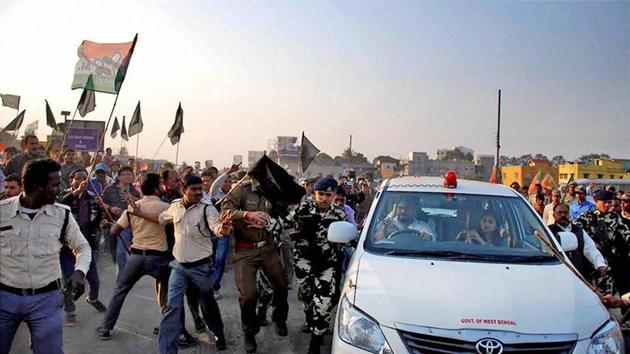
Without naming the Mamta Banerjee-led TMC government, the RSS passed a resolution at its Akhil Bharatiya Pratinidhi Sabha (ABPS) in Coimbatore, expressing “grave concern” over the violence in West Bengal.
The resolution condemned the “unabated rise in violence by jehadi elements in West Bengal, encouragement to the anti-national elements by the state government due to its Muslim vote bank politics and declining Hindu population in the state”.
Apart from its conflict with the LDF-led government in Kerala, the Sangh has accused the TMC government in West Bengal of patronizing hardline groups, who it says perpetrate violence against Hindus.
The recent reports of the TMC government dropping the traditional name for rainbow in Bengali ‘Ramdhenu’ (Lord Ram’s bow) for ‘Rongdhenu’ ( bow of colours) in textbooks for Council for Higher Education were cited by RSS as the instances of appeasing to one community .
Ahead of the 2016-assmebly polls , the BJP and the RSS had raised the issue of violence in the state. The RSS reiterated these claims, and said the “burning down of the crime records by anti-national jehadi elements and growing incidents of attack on security forces in the state are posing a serious challenge to national security ”.
To buttress its ‘concerns’ about terrorism taking roots in the state, the RSS said during the investigation of Burdwan bomb blasts, the NIA had found several terror modules to be existing across the state.
It also flagged the issue of changing demography in the state and claimed that at the time of partition, Hindu majority area of Bengal came into existence as West Bengal. “It is surprising that despite the large influx of Hindus displaced from Bangladesh to West Bengal, Hindu population of the state which constituted 78.45 % in 1951 has declined to 70.54% as per census of 2011.”


