E-Paper



Russia’s aggression against Ukraine is shaking G20 foundation, says Kishida
Kishida reiterated his characterisation of India as an “indispensable partner” for Japan’s plans to achieve a “Free and Open Indo-Pacific

 Prefer HTon Google


Russia’s aggression against Ukraine is “shaking the very foundation of cooperation at the G20” and the leaders’ declaration at the summit in New Delhi is a significant achievement as all members concurred on principles such as territorial integrity, Japanese Prime Minister Fumio Kishida said on Sunday, addressing criticism that the joint communique wasn’t strong enough on the issue, and explaining that it was actually much more detailed and specific .
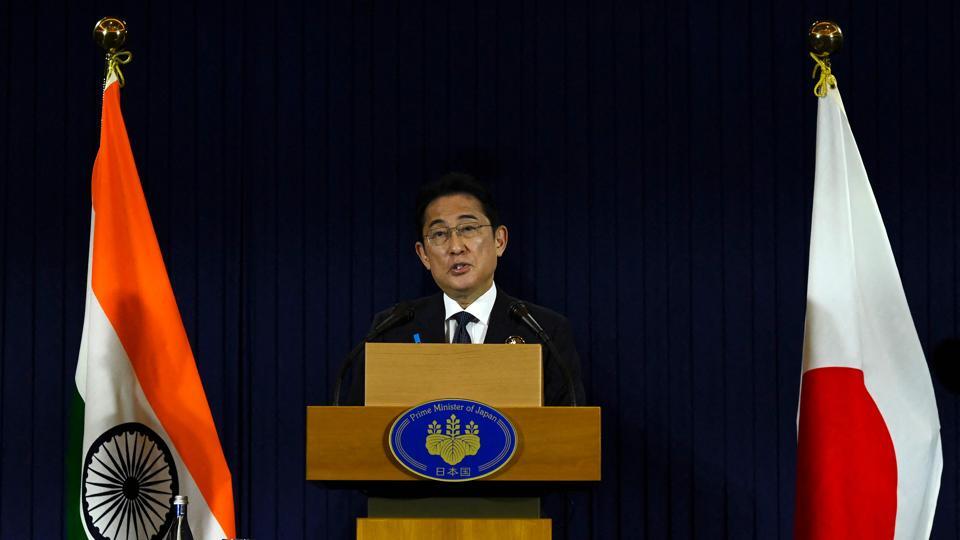
Kishida reiterated his characterisation of India as an “indispensable partner” for Japan’s plans to achieve a “Free and Open Indo-Pacific” — a vision he first outlined at a speech in the Indian capital in March. He noted that bilateral defence cooperation is deepening steadily as the three services of both countries have conducted joint exercises.
“Russia’s aggression of Ukraine is shaking the very foundation of cooperation at the G20...Further, it is causing enormous impact to the world economy through such factors such as protracted rise of food and energy prices. Today, as the world faces complex crisis, collaboration at the G20 as a premier forum for economic cooperation is becoming increasingly important,” Kishida said, speaking in Japanese.
The G20 leaders’ declaration adopted under the Indian presidency is a “truly meaningful” and significant achievement as all members concurred on the importance of a just and durable peace in Ukraine and principles of the UN Charter, including territorial integrity and sovereignty, as was reflected in the communique, he said.
Most G20 members confirmed the need for the bloc to respond to the intensifying impact of the Ukraine crisis on the global economy, and discussed challenges faced by the world community such as food security, development, health and digital issues, he said. They also concurred on the importance of the G20 cooperating and responding to such challenges, he added.
Kishida was responding to a question from Hindustan Times on whether geopolitical issues had divided the G20 more than ever at a time when the world was looking to the bloc to handle such crises as the UN is viewed as dysfunctional.
“While the G20 cannot replace the functions of the UN, Japan will continue to deal with the challenges facing the international community through the G20 framework ,which we think is playing a very important role, as well as utilising other frameworks,” he said.
Kishida also responded to criticism that the leaders’ declaration was seen as weak and without any explicit condemnation of Russia’s actions by saying that the communique includes new items such as the call for refraining from use force to seek territorial acquisition, the call to stop the destruction of civilian infrastructure and the pursuit of a just and durable peace. “That this was adopted along with the participation of Russia is very meaningful,” he said.
Japan’s vision of a Free and Open Indo-Pacific (FOIP) is a concept to uphold and reinforce a free and open international order based on the rule of law in the region, and this is aimed at ensuring peace, stability and prosperity in the region and across the world, he said.
“In March this year, in this very city of New Delhi, I announced the new plan for FOIP and under this plan, the security and safety of the sea and the sky is positioned as one of the pillars of cooperation for FOIP,” Kishida said. “In particular, India is an indispensable partner to realise FOIP.”
Kishida hastened to add that this is an inclusive and open concept that has “no specific country in mind”, and that Japan is open to cooperating with any country on region that agrees on such a perspective.
Japan’s Self Defence Forces and all three of India’s services have conducted joint exercises this year, and all members of the Quad – India, Japan Australia and the US – are now part of the Malabar joint naval exercise, he pointed out.
Japan will work to ensure that the Indo-Pacific will not be a region where things are decided by force and instead be an area that values freedom and rule of law, and as part of this vision, the country will continue active defence cooperation and exchanges with India, he said.