E-Paper



US sanctions force refiner retreat on Russian oil
The sanction on Russian oil giants will force refineries, in India and China to curtail imports because the payments are mainly made in US dollars

 Prefer HTon Google


The US late on Wednesday announced sanctions on Russian oil giants Rosneft and Lukoil, the Trump administration’s strongest bid yet to pressure President Vladimir Putin into negotiating an end to the war in Ukraine, a move that could force Indian refiners to sharply reduce their purchases.
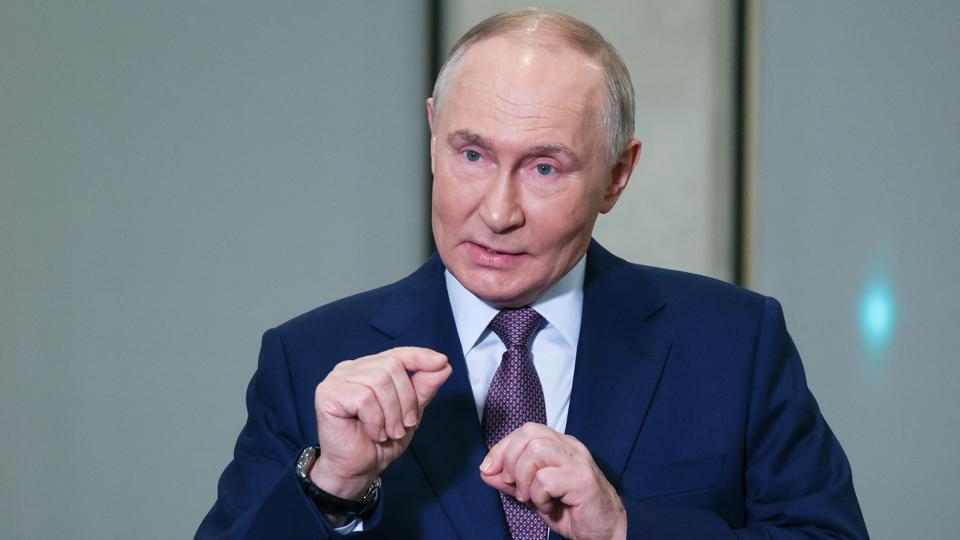
The sanctions mean that apart from blocking the companies’ assets inside the US, they will largely be cut off from the global monetary exchange underpinned by the American dollar. The US Treasury department warned that transactions with these companies risks “the imposition of secondary sanctions on participating foreign financial institutions”.
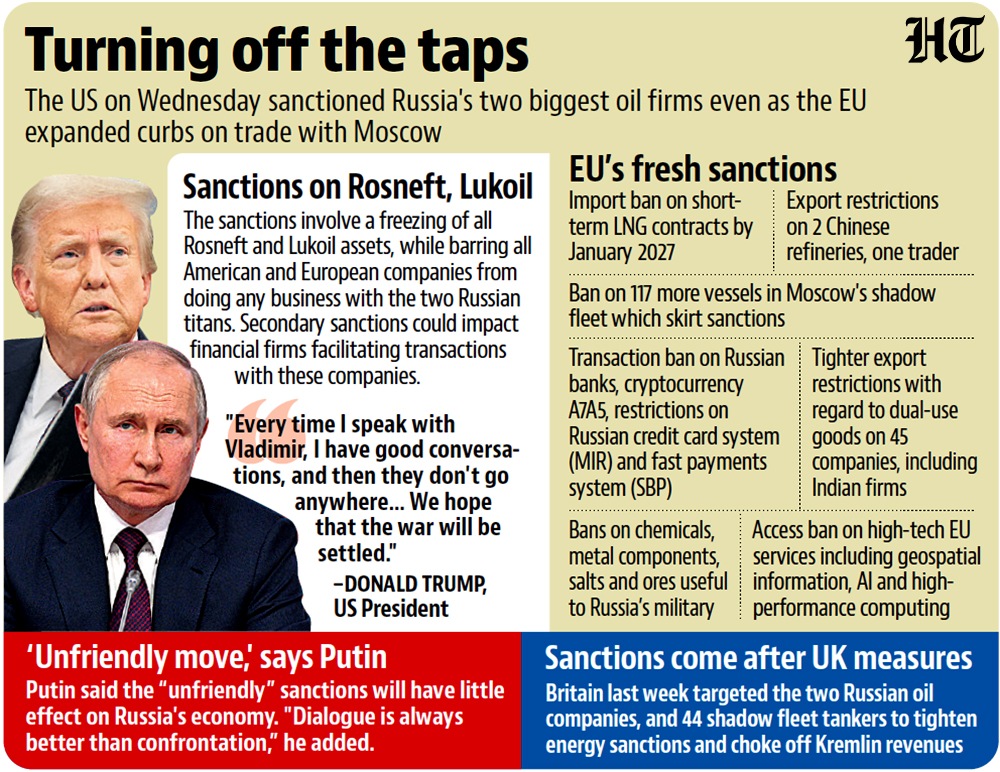
“Now is the time to stop the killing and for an immediate ceasefire,” treasury secretary Scott Bessent said in a statement announcing the sanctions. He added that the Treasury is prepared to take further action if necessary.
Brent crude surged more than 5% to trade above $65 a barrel on Thursday, after having risen 2% the day before, following the US announcement.
The move will force refineries, in India as well as China -- the world’s two biggest purchasers of Russian crude—to sharply curtail imports because the payments for consignments are mainly made in US dollars.
According to people aware of the matter, private and government-controlled refiners in India have contingency measures in place and are moving to reduce or cease imports of Russian oil including halting purchases under large long-term deals.
Reliance Industries, the top Indian buyer of Russian crude, will halt purchases under its long-term deal with Rosneft to import nearly 500,000 barrels per day, news agency Reuters quoted unnamed sources as saying.
“Recalibration of Russian oil imports is ongoing and Reliance will be fully aligned to GOI (Government of India) guidelines,” a Reliance spokesman said in response to a query on whether the company plans to cut its crude imports from Russia.
Indian state refiners including Indian Oil Corp, Bharat Petroleum Corp and Hindustan Petroleum Corp are also reviewing their Russian oil trade documents and will wait government guidance, two people aware of the matter said, adding that there had been no specific directions yet but contingency plans were ready.
“Since the US administration’s reactions are often unpredictable, oil companies had contingency plans ready,” one of these people told HT, asking not to be named. “We have time up to November 21, which is sufficient to make necessary arrangements, if required,” this person added.
The US Treasury has given companies until November 21 to wind down their transactions with the Russian oil producers. On Wednesday, US President Trump claimed that India had agreed to bring energy buys from Russia down to “almost nothing” by the end of the year.
India’s oil ministry and the state refiners did not respond to requests for comment. Nayara Energy, whose biggest shareholder is Rosneft and which has a processing capacity of about 400,000 barrels per day, also did not respond to a request for comment.
Indian refiners source Russian oil through long-term contracts directly with producers or through third-party trading intermediaries. State refiners have typically relied on intermediaries rather than direct purchases from Rosneft and Lukoil, whilst private refiners like Reliance have used both methods.
One of the officials explained that financial institutions are a critical decision point and future plans could depend on if there are alternative pathways established to make payments for Russian oil outside of the sanctions net.
State-controlled Rosneft, headed by Putin’s close ally Igor Sechin, and privately held Lukoil are Russia’s two largest oil producers, jointly accounting for nearly half of the nation’s total crude oil exports, or around 2.2 million barrels a day. The UK sanctioned both companies on October 15, while the European Union has approved a 19th package of sanctions against Russia that includes a ban on imports of Russian liquefied natural gas and on 117 more oil tankers.
The EU sanctions package also targets entities supporting Russia’s military and industrial complex, identifying 45 new entities that will face tighter export restrictions on dual-use goods and items that could enhance Russia’s defence sector. Of these 45 entities, 17 are located in third countries outside Russia—12 in China, including Hong Kong, three in India and two in Thailand.
India has emerged as the biggest buyer of discounted seaborne Russian crude since Moscow’s 2022 invasion of Ukraine, importing about 1.7 million barrels per day in the first nine months of this year. The world’s third-largest crude oil consumer imported 243.2 million tonnes of crude—over 88% of what it consumed—in 2024-25, paying more than $137 billion.
No price volatility expected
Officials expect the sanctions will neither affect India’s energy security nor impact consumer fuel prices or oil company export earnings. Three people in the know said India has 40 reliable supply sources to meet its energy needs.
“Yes, pricing will be a problem, but it may not linger for long because supply is more than demand. Current spike in international oil prices is due to the news and companies, particularly state-run oil firms, will absorb such price shocks,” one of them said.
OPEC countries said they are ready to offset any shortage in the oil market by rolling back output cuts, as signs show demand is shifting to the Gulf and Middle East after the sanctions, Kuwait’s oil minister Tariq Al-Roumi told reporters on Thursday.
“At this time, all these refiners are also looking at the fine print. But my sense is that whenever sanctions have been placed, India has not been very adventurous. If you look at even Venezuela, India has generally abided by the sanctions. So I think volumes are likely to be impacted here,” said Prashant Vashisht, senior vice president at ICRA, referring to the sanctions announced on the South American country in the past decade.
SC Sharma, an energy expert and former officer on special duty at the erstwhile Planning Commission, said Reliance’s refineries operated at maximum capacity with crude throughput of 39.9 million tonnes in the first half of the current financial year, at almost the same level as the previous year. “It’s believed that there may not be shortages of crude supplies for both refineries at Jamnagar in near future,” he said.
Sharma noted that the US Department of Energy’s Short-term Energy Outlook released on October 7 shows oil markets will remain well supplied above consumption levels. “Projections show that Russia would maintain its oil production at 10.5-plus million barrels per day during the balance period of 2025 and the year 2026. The outlook also provides surplus oil supplies during this period,” he said.
“It looks there may be few price spikes in the short term due to various news floating in oil markets. However, as the markets remain well supplied there may not be any shortages of crude oil availability,” Sharma added.
Geoffrey Pyatt, former US assistant secretary of state for energy resources, said the sanctions represent a significant escalation by the Trump administration. “This in turn reflects President Trump’s obvious frustration with Putin’s refusal to accept a negotiated solution to the war in Ukraine,” he said, adding that the impact would also depend on how China’s state-owned enterprises respond to the measures.
With inputs from Reuters