E-Paper



Supreme Court denies abortion plea, sticks to letter of the law
The 2021 Medical Termination of Pregnancy Act permits abortion beyond 24 weeks only in cases of substantial foetal abnormalities.

 Prefer HTon Google


New Delhi The Supreme Court on Monday turned down the plea of a married woman seeking immediate termination of her 27-week pregnancy, relying on her latest medical report which indicated that there were no foetal abnormalities, nor was the health of the 27-year-old mother of two at risk, to let her end her pregnancy beyond the cut-off period fixed under law. It said that the court is “averse” to passing a direction for stopping a foetal heartbeat at this stage.
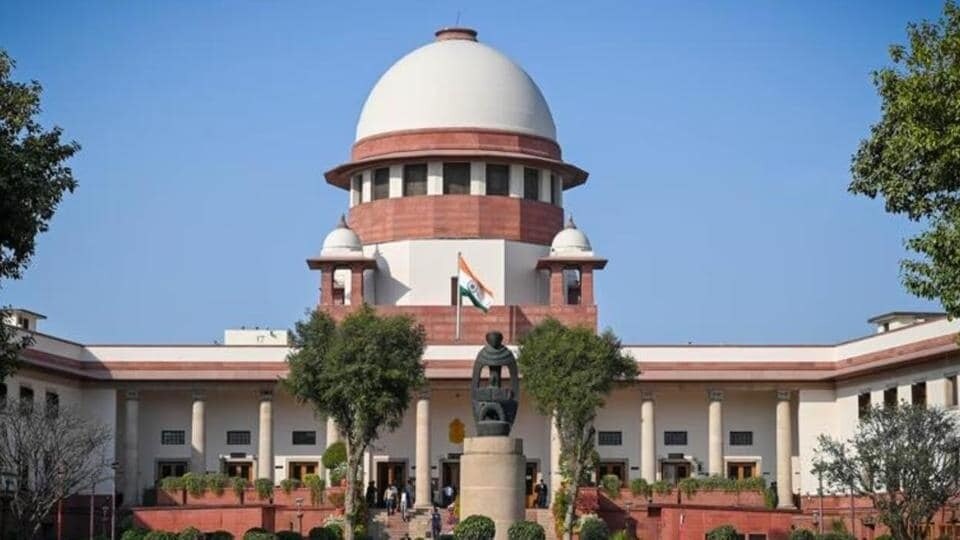
The 2021 Medical Termination of Pregnancy Act permits abortion beyond 24 weeks only in cases of substantial foetal abnormalities, or when there are serious threats to the pregnant woman’s life or well-being. The woman approached the court earlier this month, saying she was unaware of her third pregnancy due to a disorder called lactational amenorrhea, which prevents a patient from menstruating, and suffered from postpartum depression and poor financial conditions.
Drawing the curtains on a case that witnessed two women judges on a previous bench delivering a split verdict in less than 48 hours after they unanimously allowed abortion; and finally, a refusal by the larger bench after a week, a three-judge bench led by Chief Justice of India (CJI) Dhananjaya Y Chandrachud went by the letter of the law to state that the termination of pregnancy after 24 weeks cannot be allowed in the given facts of the case.
“Under Article 142 of the Constitution, this court has the power to do complete justice. However, this power may not be attracted in every case. If a medical termination were to be conducted at this stage, the doctors would be faced with a viable foetus. One of the options before this Court, which the email from AIIMS has flagged, is for it to direct the doctors to stop the heartbeat. This Court is averse to issuing a direction of this nature,” the bench, also comprising justices JB Pardiwala and Manoj Misra, said in its order.
It further noted that the petitioner also did not want the foetal heart to be stopped, which would mean a pre-term delivery of the viable foetus with a significant risk of lifelong physical and mental disabilities. “For these reasons, we do not accede to the prayer for the medical termination of the pregnancy,” it held.
The court took note of the latest report of the All India Institute of Medical Sciences (AIIMS), which stated that though the woman was suffering from postpartum psychosis and was on medication for her medical condition, it did not have any adverse effect on her pregnancy. No substantial foetal abnormalities were detected due to the medication, the report added. The fresh report, which was submitted on Monday following the court’s order on October 13, also prescribed a safer medication for the woman.
In its order, the court added that allowing the woman to end her pregnancy of over 26 weeks would violate Sections 3 and 5 of the MTP Act, which has fixed the outer limit for abortion at 24 weeks, except in extraordinary situations. “There is no threat to the pregnant woman in this matter and this is also not a case of substantial foetal abnormalities,” noted the bench, rejecting her plea.
Allowing the Centre’s application to recall the October 9 order of the previous bench permitting the abortion, the court said that the State shall bear all the expenses of her pregnancy, clarifying it would be completely the mother’s decision to give up the child for adoption after birth and that the government would provide all assistance to her.
The order followed a brief hearing during which the bench pointed out that “it has to apply the law as it stands today”, and that international literature or jurisprudence cannot have an overriding effect on the legal regime in India, regulated through the MTP Act.
The woman’s lawyer Amit Mishra argued that allowing the woman to end her pregnancy is a facet of her reproductive autonomy and right to lead a “meaningful” life under Article 21 of the Constitution, only to be told by the bench that such a broad interpretation of “meaningful life is difficult to accept”.
“Suppose a woman wants to terminate her pregnancy in her 34th or 35th week because she thinks she won’t be having a meaningful life after delivery of the child, can we allow that? That would be contrary to Section 3 of the Act which has prescribed a cut-off,” it told Mishra.
Additional solicitor general Aishwarya Bhati, representing the Centre, said that a woman’s absolute right to make her choice goes once there is a viable foetus since the only decision then can be made at that point would be between a pre-term delivery, seriously putting the physical and mental health of the foetus in jeopardy, or timely delivery. “It does not remain a question of termination of pregnancy at 26 weeks or more. Once a report says it’s a viable child, the right to make a choice goes,” she added.
Appearing for one of the intervenors of the case, senior counsel Colin Gonsalves pressed for an absolute gestational right of a pregnancy women, irrespective of the period fixed under the MTP Act. “There is no right of an unborn child or a foetus. It has to be the choice of the woman,” said Gonsalves, citing some international laws and a WHO report.
But the bench remained unimpressed. “Why do we have to look at international laws? It’s not that India has a regressive regime. It’s very easy to criticise our own country but see what happened in the US in overturning Roe Vs Wade. The legislature has done an act of balancing. The question will be whether that act of balancing violates any right or not. But that’s not the issue here. In this case, we are not concerned with the validity of the Act. We have to apply the law as it stands today,” it said.
In June 2022, the Supreme Court of the United States overturned the landmark 1973 decision that institutionalised right to abortion nationwide. The 6-3 ruling of the US Supreme Court eliminated the constitutional right to choose abortion that existed for almost 50 years, clearing the decks for the states to severely restrict or completely ban the practice.
The court’s decision on Monday came a week after the bench of justices Hima Kohli and BV Nagarathna first permitted the abortion but later put it on hold due to divergence of opinion. The judges, on October 11, sharply differed on whether the abortion could go forward, after a medical report sought the court’s approval to put an end to the foetal heart.
Taking up the matter on October 12, the CJI-led three-judge bench had given the woman 24 hours to reconsider her plea for immediate abortion. Responding the next day, the woman stood firm on her plea for immediate termination of her pregnancy, prompting the bench call for a fresh medical report.
Under the MTP Act, first enacted 1971, a pregnancy could only be terminated if it did not exceed 20 weeks. The 1971 law restricted the applicability to married women, except in cases where courts passed orders.
The Act was amended in 2021, allowing both married and unmarried women to access safe abortion up to 20 weeks. Between 20 and 24 weeks, women can terminate their pregnancy on account of mental anguish, rape, assault and health complications, among other reasons.
The culmination of the 12-day proceedings in the court on Monday brought to fore intricate legal conundrums surrounding rights, competing interests, and a complex web of laws that the highest court of the land must navigate through in individual cases to reach its final decision.