
 E-Paper



SC extends Narwekar’s deadline to decide on Shiv Sena MLAs disqualification pleas
The Supreme Court on Friday extended by 10 days the December 31 deadline set by it earlier for the Maharashtra assembly speaker Rahul Narwekar to decide on a bunch of disqualification petitions linked to the vertical split in the Shiv Sena


The Supreme Court on Friday extended by 10 days the December 31 deadline set by it earlier for the Maharashtra assembly speaker Rahul Narwekar to decide on a bunch of disqualification petitions linked to the vertical split in the Shiv Sena, which had brought down the then Maha Vikas Aghadi (MVA) government last year.
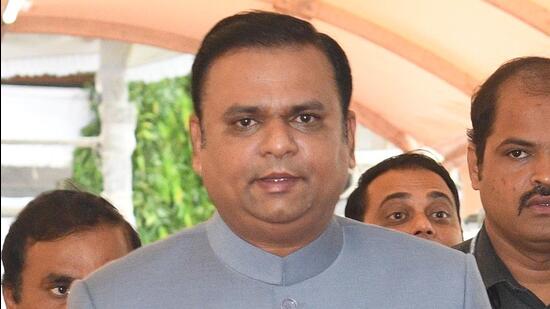
A bench, led by Chief Justice of India Dhananjaya Y Chandrachud, agreed to give additional days to Narwekar after he assured the court that the proceedings in the disqualification petitions will get over by December 20 and that he would need some more time only to prepare his judgments.
While Narwekar, appearing through solicitor general Tushar Mehta, asked for three more weeks, the bench gave him time till January 10 to deliver his rulings on a clutch of disqualification petitions that will decide the fate of 53 MLAs from the rival camps led by current Maharashtra chief minister Eknath Shinde and former CM Uddhav Thackeray respectively.
“The speaker has sought reasonable time for declaration of orders. Bearing in mind the time limit set in our order on October 30, we grant an extension of time for the pronouncement of orders until January 10,” the bench, which also comprised justices JB Pardiwala and Manoj Misra, recorded in its order.
During the brief hearing, S-G Mehta said that there were around 270,000 ldocuments that Narwekar had to go through before he could finalise his judgments. “These are not judicially trained minds. They will need some more time to go through such a massive volume of documents and give their judgments. After all, these will be quasi-judicial orders,” argued Mehta, asking for three weeks.
But senior counsel Kapil Sibal and Abhishek Manu Singhvi opposed the grant of additional three weeks. The lawyers said that granting three weeks to Narwekar would in turn mean delaying the adjudication of a separate set of disqualification petitions connected to the split in the Nationalist Congress Party (NCP).
Singhvi pointed out that the speaker has been directed by the court to decide these disqualification petitions by December 31, adding a week more should be good enough in the Shiv Sena case.
Observing that a “reasonable time” may be granted to the speaker for preparing and delivering his rulings, the bench ordered a new deadline of January 10.
Emphasising that sanctity of the anti-defection law must be maintained, the court had on October 30 set down deadlines on the politically sensitive cases -- the Sena split triggered a change in guard with Shinde taking at the helm and the NCP fissures added a new party, and deputy chief minister, to the ruling coalition earlier this year – entailing that the issue will be decided well in time for the general elections next summer, and state polls expected in October 2024.
“Procedural wranglings between contesting parties cannot delay the disposal of these petitions... These proceedings cannot linger on until elections are announced, and the petitions are rendered infructuous. That seems to be the idea,” the bench had said on October 30 while fixing the deadlines for the speaker.
During a previous hearing on October 13, the apex court pulled up Narwekar, commenting that he reduced the adjudication of the disqualification petitions to a “charade”, and adding that the speaker could not defeat the orders of the apex court by delaying his decision.
At least 39 petitions were filed against Shinde and lawmakers who backed him during the rebellion last year. More than a dozen petitions remain pending against the legislators of the Thackeray group too.
Upon disqualification, a member of a House loses membership, and the seat is declared vacant. A consistent line of Supreme Court rulings has held that disqualification relates back to the date when the act of defection takes place. Thus, it is not only the membership of the 39 lawmakers but also the position of Shinde as chief minister that is at stake.
The court’s order in the Shiv Sena case came while hearing a petition by Sunil Prabhu, a Shiv Sena (UBT) legislator in Maharashtra assembly, who as the chief whip of the undivided Sena, had filed separate disqualification petitions under the 10th schedule of the Constitution against 39 Sena MLAs, including Shinde. These petitions accused the rebel MLAs of defying the party whip in the House for the election of the speaker and the floor test.
The Shiv Sena suffered a vertical split last year when Shinde and 39 other legislators walked out of the party then led by Thackeray and joined hands with the Bharatiya Janata Party (BJP) to form the government. By its judgment on May 11, a Constitution bench invalidated the Maharashtra governor’s decision asking then CM Thackeray to face a floor test last year and flagged a flurry of errors during the political drama that toppled the MVA government, but refused to put Thackeray back in the saddle because he voluntarily resigned instead of facing the trust vote in the assembly.
At the time, the court left it for Narwekar to decide the disqualification petitions pending against both Shinde and Thackeray groups, rejecting Thackeray camp’s plea that the court should decide the disqualification petitions by itself because of the alleged bias of the BJP leader. By a separate decision on February 17, 2022, the Election Commission ruled that Shinde’s faction will inherit Shiv Sena party’s name and its bow-and-arrow symbol.
NCP suffered a similar fate in July this year, prompting Sharad Pawar loyalist Jayant Patil to move the top court, seeking a directive to Narwekar for a time-bound disposal of the disqualification petitions filed against Ajit Pawar and the MLAs backing him.
Patil’s petition was filed before the Supreme Court on September 24, lamenting that Narwekar was sitting over the disqualification petitions for the last three months. The Sharad Pawar camp filed three petitions for disqualification of rebel MLAs. The first petition was filed against nine MLAs, including Ajit Pawar; the second petition was against 20 MLAs; and the third against 11 MLAs.


