
 E-Paper



SC questions blame on farm fires for Delhi pollution, demands report: ‘Should not become political or ego issue’
Top court presses for immediate action on multiple factors: “Stubble burning was there during the Covid, but why could the people still see clear blue sky?”

 Prefer HTon Google


The Supreme Court on Sunday questioned the persistent focus on farmers burning paddy stubble as the primary cause of toxic air in Delhi and the National Capital Region. “Stubble burning was there during the Covid (pandemic of 2020-21), but why could the people still see clear blue sky?” the court remarked, as per Live Law.
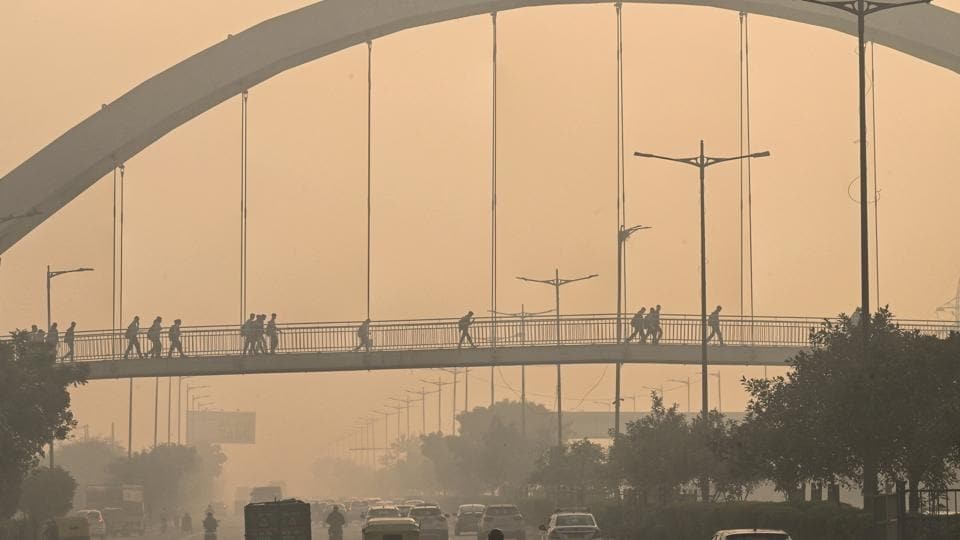
The bench comprising Chief Justice Surya Kant and Justice Joymalya Bagchi, hearing the long-running case on air pollution in Delhi-NCR, stressed that the narrative around the burning of farm residue must not become “a political issue or an issue of ego” and emphasised that the causes are multiple.
The court pressed for immediate action on factors outside of farm-residue fires, issuing a directive to the central government. "Very soon, we want a report, within a week, on the effective measures taken to prevent causes other than the stubble burning," the CJI said.
What court said on air pollution, farm fires
"As per the scientific analyses, which is contributing the most? We do not want to comment on stubble burning… incorrect to burden the people who are hardly represented in the court," CJI Surya Kant observed during the hearing.

He further pointed out: “Stubble burning was there during the Covid, but why could the people still see clear blue sky? The issue of stubble burning should not unnecessarily become a political issue or issue of ego.”
The bench sought a reply from the government on its mitigation efforts, and details of tangible results of existing action plans. "If you have been able to finalise the action plan, why don't you revisit it? Have you been able to bring any positive impact?” the bench said.
Justice Joymalya Bagchi highlighted another critical contributor: construction activity, asking the ASG how effectively the construction ban had been implemented on the ground.
What govt told SC on major pollutants
Additional Solicitor General (ASG) Aishwarya Bhati, appearing for the government, informed the court that Action Taken Reports from all relevant authorities, including Punjab, Haryana, and the Central Pollution Control Board (CPCB), would be filed.
The Centre's lawyer further said that the target for all states was “zero burning", which has not yet been achieved, but acknowledged stubble burning as only a seasonal factor.
Bhati also referred to IIT studies from 2016 and 2023, confirming that vehicular emissions and industrial dust remain major pollutants.
Paddy stubble burning cases ‘down 90 per cent’
The Supreme Court’s observations came on the same day that the government informed Parliament that Punjab and Haryana together recorded about 90 per cent fewer farm fire incidents during the 2025 paddy harvesting season compared to 2022.
Environment minister Bhupender Yadav acknowledged in the Lok Sabha that air pollution in Delhi-NCR results from several local and regional factors, with stubble burning being an additional “episodic event”, as per news agency PTI.
As part of the government’s efforts, over 2.6 lakh crop residue management machines have been distributed to individual farmers, and the Commission for Air Quality Management (CAQM) has directed states to ensure rent-free availability of these machines to small and marginal farmers, he added.
The government also noted that Delhi recorded 200 "good" air quality days (AQI less than 200) so far in 2025, a significant increase from 110 in 2016.
Need for measures like CNG mandate?
The Supreme Court, however, went deeper into the systemic response. The bench sought details regarding the expertise and background of the members serving on the Commission for Air Quality Management (CAQM) that's tasked with managing air pollution in Delhi-NCR.
A counsel appearing in the matter pointed out that vehicle density in Delhi exceeds that of "several metro cities combined", according to the Live Law report. The lawyer highlighted the need for remedies similar to the implementation of CNG buses following SC orders in the 1990s.
The Supreme Court will hear the matter next on December 10.


