
 E-Paper



Shah returns to the forefront of UP campaign with Kairana visit
Shah, who has been helming talks with allies, ironing out differences within the party unit, and lending an ear to disgruntled party workers, besides playing a key role in ticket distribution, will now be actively campaigning in the state, according to functionaries aware of the developments

 Prefer HTon Google


New Delhi/Meerut Starting with a door-to-door campaign in Kairana, a constituency that has figured prominently in the Bharatiya Janata Party’s election discourse in Uttar Pradesh, Union home minister Amit Shah has signaled he is back in the saddle in the poll-bound state.
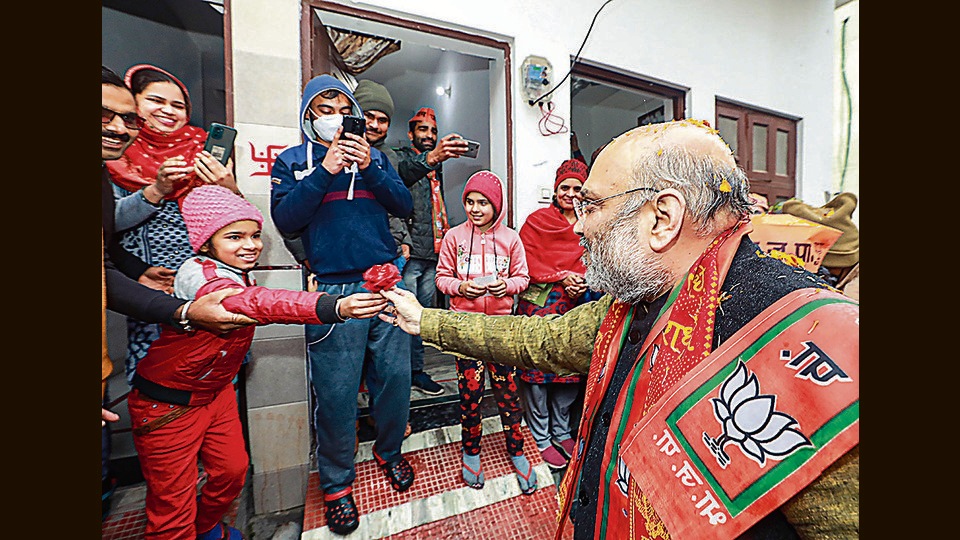
Shah, who has been helming talks with allies, ironing out differences within the party unit, and lending an ear to disgruntled party workers, besides playing a key role in ticket distribution, will now be actively campaigning in the state, according to functionaries aware of the developments. He was in charge of the party’s campaign in the state in the 2014 election, when it won 71 of the 80 Lok Sabha seats.
Shah has hit the ground along with party president JP Nadda, UP chief minister Yogi Adityanath, and state unit president Swatantra Dev Singh to mobilise support for the party at a time when large gatherings and rallies are prohibited (and will remain so till January 31). He is expected to address small groups and call on voters in door-to-door campaigns.
“The choice of Kairana as the starting point for his campaign shows he’s invested in mobilising support and encouraging workers in the western part of the state, which is perceived as a challenging demographic for the party,” said a party functionary who asked not to be named.
Kairana, where the Bharatiya Janata Party’s then MP Hukum Singh alleged an exodus of Hindu families, goes to polls on February 10. Shah met some of these families that moved out following alleged communal tension in the area in 2017. Singh’s daughter Mriganka Singh is the party’s candidate in the constituency.
Of the 1.7 million- plus voters in Kairana, over 3 lakh are Muslims and 1.5 lakh are scheduled castes from the Jatav community, considered the traditional vote bank of the Bahujan Samaj Party.
In his door-to-door campaign, Shah raised the issue of “palayan (Hindu exodus)” during the Samajwadi Party (SP) rule and stated that those who were forced to leave have now started returning.
Shah distributed pamphlets carrying information about various welfare schemes that were launched by Prime Minister Narendra Modi and chief minister Yogi Adityanath. He also visited a 70-year-old sweet shop in the Gumbad locality of Kairana where he met those who were previously forced to migrate out of the area, but have since returned.
“This is my first visit to Kairana since January 2014. I see a sea change. All welfare schemes by Prime Minister Narendra Modi ji have been implemented by CM Yogi Adityanath till the grassroots level. It’s the same Kairana from where people were migrating earlier. Today, I interacted with many of those who had migrated earlier. I met all 11 family members of the Mittal family (who fled the area but have since returned). All of them said that CM Yogi improved the law and order situation and they have no fear. That’s why I say that those who made the people migrate have now migrated themselves,” Shah said.
Party functionaries are resting their hopes on Shah’s campaign in the western region to help the BJP tide over the challenges posed by the recent farmers’ agitation that found support in the area and created friction between the Jats and the BJP. The party also faces formidable opposition in the region with the coming together of the Samajwadi Party and the Rashtriya Lok Dal.
“We are hoping that the party will be able to repeat its 2017 performance in western UP ( it won 66 of the 76 seats then). Over the course of the next few weeks, Shah will cover several constituencies, meeting people and holding discussions with party workers on streamlining the election campaign,” added the first functionary.
“In west UP, elections begin on February 10. With folded hands, I want to appeal to all the voters of west UP that if due to Covid-19, our cadres are unable to reach you, all of you should go out to vote early to help set up a BJP government with a massive majority for the next five years,” Shah added.
Shah, also a former BJP president, is credited with scripting the BJP’s stellar show in UP in the 2014 general elections and the 2017 assembly polls, when the party saw its seat and vote share leap. From 47 seats and a 15% vote share in 2012, the party went on to win 312 of the 403 seats in 2017 and increased its vote share to 39.67%. In the 2019 Lok Sabha elections, it garnered almost 50% of the votes.
In his recently released book, union environment minister Bhupender Yadav said that Shah opted for a four-pronged approach to turn around the party‘s fortunes in UP. The book details how he set out by building a cadre of booth level workers and recruiting about four lakh full-time workers to keep tabs on the ground. He also identified seats that the BJP just wouldn’t win and where contesting would be a waste of effort.
“The third and the biggest challenge was social engineering required to navigate the caste politics of UP. Here, Shah focused attention on 30% of the backward caste voters, excluding the Yadavs, Jatavs and the Muslims, who had no political representation at the state and national levels. Finally, Shah devised various strategies to reach out to the voters. He organised election campaigns banking on (Narendra) Modi‘s popularity and his OBC status,” Yadav said in the book co-authored by him along with economist Ila Patnaik.
The BJP’s ability to build a rainbow coalition of OBCs (other than the Yadavs) and some from the SC communities is believed to have helped it consolidate the Hindu vote.
Similarly, ahead of the 2017 election, Shah was credited for building support through empowered booth-level committees. “Ahead of the 2017 elections, he gave clear directions to set up booth-level committees of about 10 to 20 people in every booth. The state was carved into zones and specific election campaigns were designed, keeping in view the peculiarities of each zone, which helped the party in addition to the focus on social engineering,” said a second functionary who too asked not to be named.


