
 E-Paper



Slow pace of development in Janjatiya Diwas icon Birsa Munda’s village
The renewed focus on Birsa Munda this year at the national stage brought symbolic windfall for Sukhram Munda in an era of the growing identity politics


The Narendra Modi government’s announcement to observe Birsa Munda’s birth anniversary on November 15 as the national ‘Janjatiya Gaurav Diwas’ has brought the tribal icon back into political limelight but development of his ancestral village of Ulihatu near Jharkhand’s capital of Ranchi has largely remained symbolic.
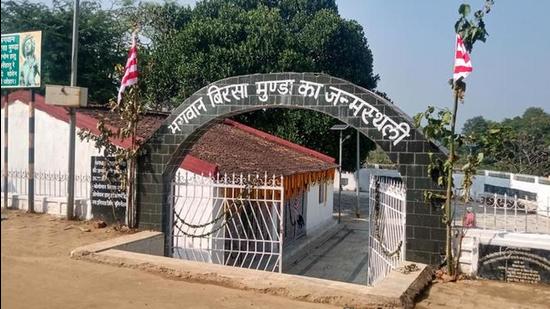
With plenty of landmarks such as airport, stadiums and academic institutions named after the symbol of tribal identity, Birsa Munda is perhaps the most revered figure in Jharkhand’s politics, which is amply reinforced by the fact that the state’s formation day falls on Birsa Jayanti. Every year on that day, top politicians and bureaucrats make a beeline to Ulihatu, around 70 kilometres south of Ranchi, deep inside the hilly and forested terrain under Arki block in Khunti district, known in recent years (2017-18) for its Pathalgadi movement.
The ride to Ulihatu from Khunti district headquarters is an easy one, thanks to the 12.5 km double-lane black top road, off the Khunti-Tamar state highway, constructed before Union home minister Amit Shah’s 2017 visit, when he was the Bharatiya Janata Party’s (BJP) national president.
It was past noon when this correspondent entered the Birsa Complex on November 19, a few days after Birsa Jayanti, to find a few workers painting the iron grills of the huge round platform there. Birsa Complex is the state’s showcase tourism project, spread over seven acres of land, housing a boarding school, a hospital and a guest house.
The complex has been in the works since 2008 when the school became operational first, but the many years in between have not only failed to mark any significant addition to its proposed grandeur but, to the contrary, left pronounced signs of wear and tear on the structure instead. One of the buildings for the school is now home to a company of the Shahastra Seema Bal (SSB), stationed permanently here as part of the state’s anti-Maoist operations.
The school, which aims to teach students from class I to 10th, started in 2008, yet it has only three permanent teachers against the sanctioned strength of 18, said principal Kartik Singh Munda, posted here since 2017.
“Till the first lockdown we were given 13 extra temporary teachers who were paid on hourly basis. We have reopened this month and a few students from class 6 and above have returned. Classes remained almost suspended as online teaching was not possible,” he said.
The school principal also complained about erratic water supply to the hostel which has 320 students.
The workers said they were completing the renovation, including whitewashing and painting work at the complex, which was disrupted by a rainy spell and couldn’t be completed before Birsa Jayanti.
“Our Baba (Birsa Munda) has become the face of the state. Every year, top politicians and senior officials come here. But this is the real situation on the ground. Why couldn’t this work start 10 days before the Jyanati,” asked Gangi Munda, granddaughter-in-law of Birsa Munda, pointing at workers taking the measurements of the external boundary and the whitewashing of the back walls of the small hut at the memorial complex.
The memorial, with a marble floor, has a small two-room hut. The outside wall of the hut has two marble plaques. One lists the family lineage of Birsa Munda while the second one has names of two former ministers who had laid the foundation stone of the memorial in 2003-04.
As per the family tree, Birsa had two siblings, Konta and Kanu Munda. While Birsa was unmarried when he died, the history of Konta Munda is unavailable. Kanu Munda’s grandson Sukhram Munda who lives just next to the memorial is the last recognised living member of Birsa’s family. As a mark of honour, Sukhram and his family have received economic assistance by the state government over the past two decades.
In 2007, two sons of Sukhram Munda, Jungle Singh Munda and Kanu Munda were inducted as peons in Khunti district administration, bringing prosperity to the family.
Also Read: Rail track blown in Jharkhand’s Latehar, Maoists-link suspected
While Jungle Singh Munda and Kanu Munda live in government quarters in Khunti, their parents Sukhram Munda and his wife Lakhmani Devi live in their house next to the memorial. While their house still has an asbestos roof, the floor is tiled and their inner courtyard covered by paver blocks. The tiles and paver blocks were laid in 2017 ahead of Amit Shah’s visit, along with piped water connection that draws water from a solar-power tank.
The renewed focus on Birsa Munda this year at the national stage brought a symbolic windfall for Sukhram Munda in an era of growing identity politics. The morning after Birsa Jayanti, Sukhram Munda along with his two sons, was flown to New Delhi by the office of Union tribal affairs minister Arjun Munda who represents Khunti in Lok Sabha. During his three-day trip, Sukhram was given the honour of inaugurating the Aadi Mahtosav at Dilli Haat, a tour of the Rashtrapati Bhawan besides a health check up at the prestigious All India Institute of Medical Sciences (AIIMS) in New Delhi.
Most other residents of Ulihatu still live in kachha houses with most of them still dependent on rain-fed agriculture. While a majority of them speak Mundari, they are reluctant to interact with an ‘outsider’. Shyam Singh Munda, a young man in his early 20s, said he was “tired speaking to even the press as it hardly made any difference”.
“I have been seeing this since childhood. Nothing happens. People come once in a year but things remain unchanged,” said Shyam in broken Hindi.
On November 15, almost the entire district machinery was at the village with the Sarkar Aapke dwar programme. The 42-day outreach programme for service delivery at panchayat level was inaugurated by the chief minister at an event in Ulihatu itself.
Deputy commissioner-cum-district magistrate of Khunti, Shashi Ranjan, said the delay in providing Pucca houses to the villagers was due to villagers demands. “Pucca houses in this village are being provided under Shaheed Gram Vikas Yojna and not under the PM Awas Yojna. The villagers had been demanding bigger houses. Now all formalities have been completed. Few from the village were even given certificates for their entitlements. All houses will be completed soon,” said Ranjan.
As per the 2011 census, Ulihatu has 196 families with a population of 1,126.
On the Birsa complex, Ranjan said they are all set to make the hospital functional within a fortnight, even as he refused to provide the total cost of the project. “I don’t have the figures of total cost off hand as funds from the tourism department are also involved in it. As far as the lack of teachers in the school is concerned, I will have to check with the education department,” he added.
Karia Munda, eight time Parliamentarian of the BJP from Khunti Lok Sabha and one of the tallest tribal leaders in the country, expressed displeasure over the prevailing state of affairs. The Septuagenarian, a former Union minister and the deputy speaker of Lok Sabha, is leading a retired political life since 2019 when he was asked by the party to make way for incumbent Arjun Munda.
“It was in mid 90s when the then chief minister Lalu Prasad made a visit to Ullihatu. Then, we used to have a tribal welfare commissioner. With active support from him, I got funds valuing ₹3.5 crore sanctioned for development of Birsa Munda memorial and the complex at around 1996-97. But the funds were not released. After the creation of Jharkhand, we got that money and the development work started,” said Munda.
Sukhram Munda, however, expressed hope that the renewed focus on his grandfather on the national stage might bring changes in the life of the tribals across the state.
“Tribals need to be given good education and modern training in whichever work they do. Be it farming or poultry or any other work. They should be given proper training and exposure with the best practices in the trade. I keep telling all this to people who come to see me. I am hopeful that things will change,” Munda said on his return to Ranchi airport from New Delhi on Friday, expressing happiness about his lifetime experience of flying and the attention he received in the national capital.


