
 E-Paper



Special welcome from PM Modi, rare carpool and a dinner: Day 1 of Russian President Putin's India visit
Putin in India: PM Modi and Russian President Vladimir Putin carpooled together from Delhi's Palam airport on Thursday evening.

 Prefer HTon Google


Russian President Vladimir Putin kick-started his two-day visit to India, the first in over four years, on Thursday evening, with a warm and personal welcome from Prime Minister Narendra Modi, 'carpooling' with the Indian leader, and dinner at 7 Lok Kalyan Marg, the PM's residence in New Delhi.
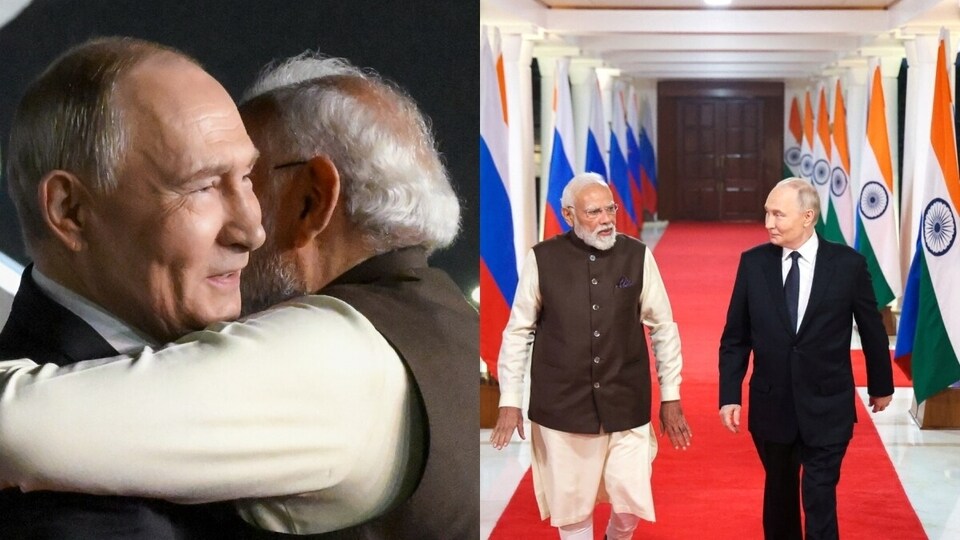
Putin is in India for the 23rd Annual India-Russia Summit, and is working at a tight 27-hour schedule. Follow live updates on Putin's India visit
Putin in India - Day 1 | Key points
As Putin landed at Delhi's Palam airport at around 7 pm on Thursday, PM Modi broke protocol and personally received the Russian President, welcoming him with big smiles and a hug. The prime minister led the way, with Putin greeting both Russian and Indian officials present at the site.
After his arrival, PM Modi and Putin repeated their moment from Tianjin and travelled in the same car from the airport to the Prime Minister's residence at 7 Lok Kalyan Marg. The two leaders were seen talking and sharing some laughs as they 'carpooled' together.
Following the rare carpool, PM Modi and Russian President Putin reached the official residence of the prime minister, 7, Lok Kalyan Marg, where he was hosted for a private dinner, details of which have not yet been revealed.
Putin on Modi, oil trade, US tariffs
Russian President Vladimir Putin hailed Prime Minister Narendra Modi and said that India got lucky with a leader like him.
"PM Modi lives and breathes India," Putin said in an interview with India Today.
Putin praised PM Modi's stance on the tariffs imposed by US President Donald Trump and said that the prime minister "is not one to give in to pressure".
“India is a great power, not an English or British colony, and everyone will have to take that into account," Putin said. He stressed the historical India-Russia defense and trade relations.
He said that Indians can indeed take pride in their leader as "Prime Minister Modi is not someone who succumbs to pressure easily".
"His stance is unwavering and straightforward, without being confrontational. Our goal is not to provoke conflict; rather, we aim to protect our lawful rights. India does the same," Putin added.
Putin also responded to a question on Trump's remarks on India's Russian oil purchases and said, "As for India's purchase of energy resources from Russia, I would like to note and have already mentioned publicly this once, the United States itself still buys nuclear fuel from us for its own nuclear power plants."
He argued that if the US buys oil from Russia for its reactors, then India should have the same privilege.
Putin's schedule for Dec 5
The Russian President will be accorded a ceremonial welcome on Friday, along with a tri-services guard of honour at Rashtrapati Bhavan.
He will then visit Raj Ghat to pay homage at Mahatma Gandhi's memorial.
After this, Putin will hold talks with PM Modi, along with the respective delegations, at Hyderabad House. The two leaders will then make statements at a joint press briefing.
PM Modi and Putin will also attend a business event jointly organised by the Federation of Indian Chambers of Commerce and Industry (FICCI) and Roscongress.
In the evening, President Droupadi Murmu will host a state banquet for her Russian counterpart.
Putin is expected to leave India at around 9 pm on Friday.
What's on agenda tomorrow?
Earlier, Kremlin spokesperson Dmitry Peskov said that there may be a discussion on Russia possibly supplying Su-57 fighter jets to India.
The meeting between PM Modi and Putin will also have oil trade as a focus point, with New Delhi seeking to balance its need for inexpensive crude amid Trump tariffs and sanctions.
Officials of the ministry of external affairs had said that the two sides have also finalised an agreement for mobility of skilled and semi-skilled manpower, and negotiations began last week on a free trade agreement (FTA) between India and the Eurasian Economic Union, a five-member bloc including Russia, HT reported earlier.
The two sides are also expected to sign several agreements covering areas such as trade, academia, agriculture and culture, the officials said.
PM Modi and Putin are expected to discuss raising bilateral trade from the current $68 billion to $100 billion by 2030, and to improve systems to settle transactions in their own currencies.


