E-Paper



India-Russia trade, defence ties on agenda for Modi-Putin summit on Dec 5
This will be Russian President Vladimir Putin’s first visit to India since the start of the invasion of Ukraine

 Prefer HTon Google


New Delhi: Measures to insulate India-Russia trade from sanctions imposed by the US, an offer on small modular reactors for nuclear energy and deepening of defence cooperation will be on the agenda for the summit between President Vladimir Putin and Prime Minister Narendra Modi this week, a key aide to the Russian leader said on Tuesday.
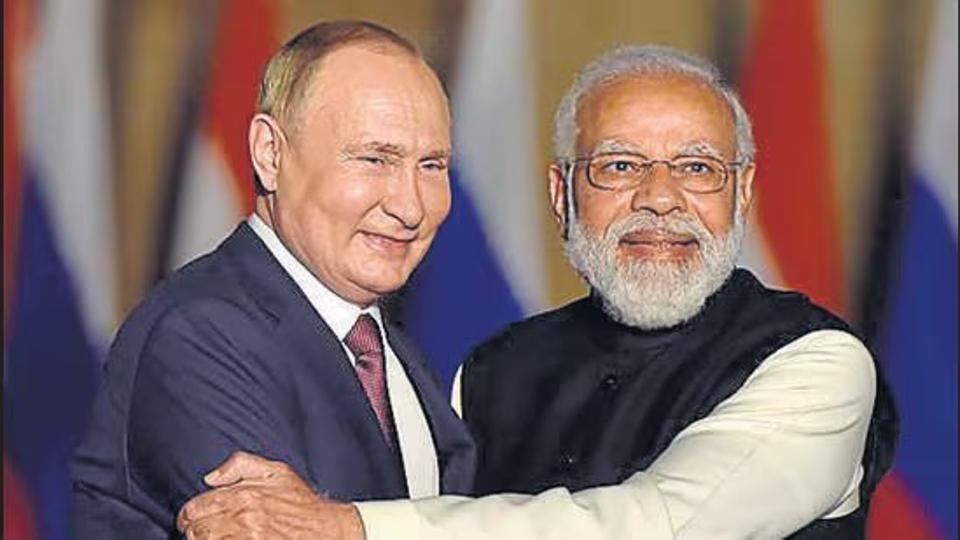
Putin will travel to New Delhi on December 4 for the annual summit the following day, with the meeting being seen as an opportunity for India to emphasise its strategic autonomy by reinvigorating defence and economic ties with Russia against the backdrop of pressure from the US to draw down on purchases of Russian energy and military gear. This will be Putin’s first visit to India since the start of the invasion of Ukraine.
Moscow intends to use the summit to protect growing trade and economic ties with New Delhi from sanctions imposed by the US, and to inject new life into long-standing cooperation in the defence and civil nuclear energy spheres, Dmitry Peskov, the spokesman for Putin, told an online media briefing.
The two sides have finalised an agreement for mobility of skilled and semi-skilled manpower and negotiations began last week on a free trade agreement (FTA) between India and the Eurasian Economic Union, a five-member bloc including Russia, that is expected to address New Delhi’s concerns about tariff and non-tariff barriers to trade, officials of the external affairs ministry said.
Peskov described a 25% tariff imposed by the US on Indian goods over Russian oil purchases as a bilateral matter between New Delhi and Washington, but said Russia is determined not to allow anyone to interfere in the growth of trade with India. Noting that this issue will be discussed at the summit on Friday, he acknowledged that US sanctions could lead to “insignificant drops and decreases” in oil trade with India in the short term.
“We have to organise our trade interaction in a way that it cannot be affected by third countries. Nearly the whole volume of our trade is being paid in national currencies,” Peskov said. “Thus, we’re securing our trade [and the] sovereignty of Russia and India, and we’re securing our trade cooperation. We know there are some countries that would try to put obstacles in the way of further development of our trade.”
“We consider these sanctions to be illegal [under] international law…We’re doing our best to ensure that we continue our trade and…guaranteed supplies of oil. We’re managing that quite successfully,” he said. Russia’s experience of operating under a “regime of illegal sanctions” has led to technologies for continued trade that can be made “more sophisticated” if the levies continue, he added.
Russia is the top crude supplier to India, though oil imports are set to hit a three-year low this month.
Peskov said Rosatom director general Alexey Likhachev, who will be part of Putin’s delegation, will present an offer to help India build small modular reactors (SMRs). “This offer will be on the table of negotiations. Russia possesses this very important technology for small and very flexible nuclear reactors. We’ll be ready to discuss this issue with India and to supply this technology to our Indian friends,” he said.
In the field of defence, Peskov noted that Russian-made weaponry accounts for 36% of the inventory of India’s armed forces and said Moscow is keen to expand cooperation in this sector. The supply of the Su-57 combat jet and additional batteries of the S-400 air defence system will be up for discussion, he said. “The Su-57 certainly will be on the agenda during the visit…We’re standing for just competition and someone can hardly compete with us in this field,” he said.
The external affairs ministry’s officials said the agreement on mobility will facilitate the movement of Indian workers to Russia, with numbers being decided by the needs of the labour market. The pact will also outline conditions for the recruitment of Indian workers, they said. Russia currently has some 20,000 Indian students.
Besides the FTA with the Eurasian Economic Union, India and Russia are working on several measures aimed at balancing two-way trade, currently skewed overwhelmingly in Moscow’s favour. Bilateral trade increased more than five-fold from $13 billion in 2021 to $68 billion in 2024, driven by India’s energy imports, and the two sides aim to boost this volume to $100 billion by 2030. However, India’s exports are worth less than $5 billion.
The external affairs ministry’s officials said there have been intensified efforts to increase Indian exports, including agricultural items such as potatoes and pomegranates, marine products, processed food items and consumer goods. A business event will be organised by FICCI and Roscongress to coincide with the summit to drive exports, they said. The officials also noted Russia’s important position as a supplier of three to four million tonnes of fertilisers annually and said both sides are looking to deepen cooperation in this field.
The two sides also expect to sign several agreements covering areas such as trade, academia, agriculture and culture, the officials said.
Both sides acknowledged that the war in Ukraine was expected to come up in the discussions. “We appreciate the position of India vis-a-vis the Ukrainian affair. We appreciate the readiness of New Delhi to contribute to the search of a peaceful solution in this very complicated conflict. We [expect] the possibility of exchanging information first hand between [Modi] and our president,” Peskov said.
The Indian officials reiterated New Delhi’s long-standing position that the war cannot be decided on the battlefield and without dialogue and diplomacy. In the context of ongoing US efforts to end the conflict, they said India supports any move leading to cessation of hostilities and lasting peace. The officials also referred to an article jointly authored by the envoys of France, Germany and the UK that accused Putin of blocking peace efforts and described it as “unusual”. It is “not an acceptable diplomatic practice to give advice on relations with third countries”, an official said.