E-Paper



Speed up trials of crimes on women: PM to courts
PM Narendra Modi urged the judiciary to expedite cases on crimes against women, enhancing their security. He highlighted new laws and the need for active district committees.

 Prefer HTon Google


Prime Minister Narendra Modi on Saturday urged the Indian judiciary to accelerate the resolution of cases involving crimes against women, stressing that swift justice would significantly enhance the sense of security for women and girls, who make up half of the country’s population.
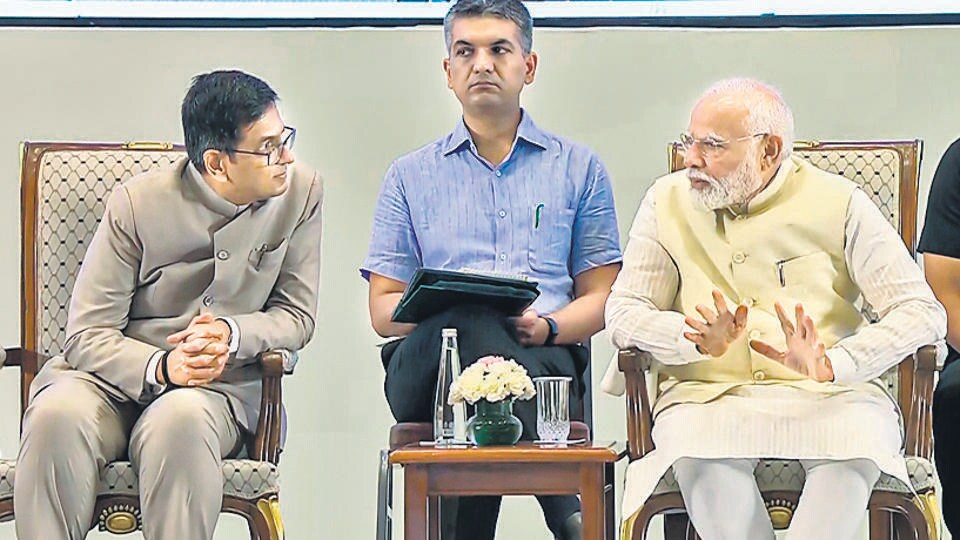
Inaugurating the National Conference of the District Judiciary, organised by the Supreme Court of India, Modi termed the issue of atrocities against women and safety of children a “burning issue” and a matter of “serious concern for society”. He emphasised: “In cases of atrocities against women, as quickly the decisions come, half the population in the country will have greater assurance of their safety.”
The PM pointed out that many stringent laws have been made for the safety of women, including in 2019 when the government planned for establishing fast-track special courts. “Under this, there is a provision for setting up deposition centres for key witnesses. To effectuate this, the role of district monitoring committee is yet again important. This committee comprises the district judge, district magistrate and superintendent of police. In order to have coordination and synergy between different aspects of the criminal justice system, they have an important role to play. We need to make these committees more active,” he said.
Modi’s appeal comes amid a national outrage over the horrific rape and murder of a 31-year-old doctor in Kolkata. The incident has sparked a wave of protests across Kolkata, with students and members of the BJP taking to the streets to demand accountability and justice.
Since the brutal incident on August 9, West Bengal chief minister Mamata Banerjee has penned two letters to PM Modi, urging the introduction of more stringent central laws to combat sexual assault. The political tension between the state and the Centre intensified, with Union women and child development minister Annapurna Devi responding to Banerjee just a day ago, berating the state government for attempting to “cover up delays” in the operationalisation of fast-track special courts in the state and the alleged failure of the state in implementing the stringent legal regime.
On Saturday, Chief Justice of India Dhananjaya Y Chandrachud and his two successor CJIs, justices Sanjiv Khanna and Bhushan R Gavai, shared the stage with the PM at the event in the national capital. Union law minister Arjun Ram Meghwal, attorney general R Venkataramani, Supreme Court Bar Association president Kapil Sibal and Bar Council of India chairman Manan Kumar Mishra were also present at the dias.
Referring to the implementation of three new criminal laws to replace the colonial era legislation, PM Modi highlighted the stricter provisions under the Bhartiya Nyaya Sanhita (the BNS, which has replaced the Indian Penal Code), for crimes against women and children.
“The spirit of these laws is ‘Citizen First, Dignity First and Justice First’. With the implementation of these laws, India’s criminal laws have been freed from the colonial mindset of rulers and slaves,” said Modi, as he underlined the crucial role of policies and laws along with infrastructural and technological advancements in the transformational journey of the nation. The PM also gave the example of repealing a colonial-era law like sedition and the provisions of community service for punishment for minor crimes for the first time, stating that the idea behind the BNS to not punish citizens but to protect them.
Imploring the Supreme Court to take necessary steps to train the district judiciary in this new system, Modi expressed confidence that the district judiciary conference will come up with solutions to several issues to fulfil the promise of “justice to all”, as he noted that people in the country have reposed unwavering faith in the Indian judiciary.
“The Supreme Court of India’s journey of 75 years does not merely associate with one institution but is also a journey of India’s Constitution, its values and the journey of India evolving as a democracy...People in India have never shown lack of trust for the Indian judiciary. This is why 75 years of the Supreme Court emboldens India’s glory as the mother of democracy,” he stressed.
Noting that the nation has completed 75 years of its independence and is about to celebrate 75 years of the Constitution, Modi said that the occasion is filled with pride and inspiration as he underscored that the judiciary is considered as the “protector of the Constitution” in our democracy.
“It is a huge responsibility. We can say it with a sense of satisfaction that the Supreme Court and our entire judiciary have efficiently discharged their responsibilities. The Judiciary has safeguarded the spirit of justice since Independence. Even during the dark times of Emergency, the judiciary played an important role in protecting the Constitution,” said the PM.
Adding that the Supreme Court also protected against the attacks on fundamental rights, Modi asserted that whenever the question of national security arose, the judiciary protected the unity and integrity of India by keeping the national interest paramount.
The PM underscored that a developed and modern India is the shared vision of 140 crore citizens during “Azadi ka Amrit Kaal,” with the judiciary, particularly the district courts, serving as a foundational pillar. He stressed that modernising district courts is essential since they are the first point of contact for justice for ordinary citizens.
Highlighting the importance of improving the standard of living through better access to justice, PM Modi said that modern infrastructure and technology in district courts are key to achieving this.
Modi also referred to some of the government’s efforts over the past decade to modernise the judiciary, emphasising the mission-level work to upgrade court infrastructure. He pointed out that over the past decade, significant efforts have been made to reduce delays in justice, with around ₹8,000 crore spent on judicial infrastructure, and 75% of the funds spent in the last 25 years being utilized in the past decade alone. This has led to the development of over 7,500 court halls and 11,000 residential units for the district judiciary.
Citing the role of e-Courts in speeding up judicial processes and reducing burdens on all stakeholders, the PM mentioned the approval of the third phase of the e-Courts project in 2023 and India’s progress towards a unified technology platform incorporating AI and optical character recognition. Such advancements, he said, would help analyse and predict case trends, and integrate the work of various departments like police, forensics, and courts, making the justice system future-ready.
Praising the Supreme Court and judiciary for their contributions, the PM also noted the significance of events like the national conference for district judiciary and all India district court judges conference that was held earlier this year in Gujarat.
Modi pointed to the upcoming discussions on managing case backlogs, enhancing human resources, and improving the legal fraternity, and expressed satisfaction that a session on judicial wellness, crucial for promoting health in the work culture, was also planned.