E-Paper



Students, teachers protest against new recruitment system, say positions reserved for SC/ST, OBC reduced
The new quota system, which treats each department as the unit for reservation, was ordered by Allahabad high court in 2017. The Centre filed a petition in the Supreme Court, which upheld the HC judgment last week.

 Prefer HTon Google


Students, teachers and political workers hit the streets on Thursday to protest against a new formula for recruitment in colleges and universities.
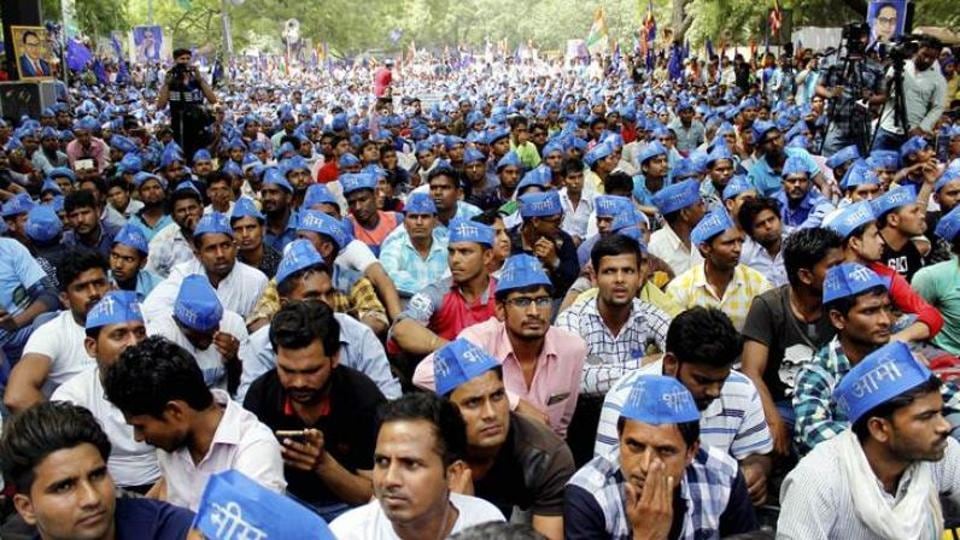
The protesters were opposing the 13-point roster, which many professors claim will drastically reduce positions reserved for scheduled caste (SC), scheduled tribe (ST) and other backward classes (OBC). “Under the new system, every fourth post will be reserved for OBC, every seventh for SC and 14th for ST. This means smaller departments will have effectively no reservation,” said Saikat Ghosh, an assistant professor in Delhi University (DU).
The new system, which treats each department as the unit for reservation, was ordered by Allahabad high court in 2017. The Centre filed a petition in the Supreme Court, which upheld the HC judgment last week.
On Thursday, SC/ST/OBC groups held protests in MP, Haryana, UP, Bihar, Rajasthan, Maharashtra and Kerala. “The presence of these teachers gave us confidence. Now, we will be excluded structurally,” said Komal Rajak, a PhD student.
Leaders from the Samajwadi Party, Bahujan Samaj Party, Rashtriya Janata Da, Aam Aadmi Party , Left parties and the Bhim Army, backed the protests. “The government is an anti-Dalit party,” said RJD leader Tejashwi Yadav.
Experts said Thursday’s protests could be the making of second wave of Dalit anger because it hit three key concerns: Reservation, education and government jobs. The first wave was seen following the dilution of the SC/ST Act in April, which forced the government to undo the changes. “The Constitution is like a mother to Dalits, and education is an emotive issue because of the importance given by Ambedkar,” said Sheoraj Singh, a DU professor.
Activist Ashok Bharti warned Dalit groups will call for a bigger strike if the system was not rolled back. “The government is giving more representation to upper castes through 10% quota but failing SC/ST/OBC.”
For the Bharatiya Janata Party (BJP), the challenge is to retain Dalit and OBC votes in the face of disappointment and a concerted campaign around reservation, said Sumeet Mhaskar, an associate professor at Jindal University. “The roster issue will add to the campaign against the BJP. The opposition will take it up in a big way because it is about government jobs and hurts OBCs as well,” he said.
The BJP has not commented but last year, HRD minister Prakash Javadekar told Parliament the government was committed to SC/ST/OBC reservations.