
 E-Paper



Supreme Court judges, lawyers share bench in rare Lok Adalat to clear case backlog
The litigants interacted freely with the judges, who settled several cases after ascertaining whether the parties who came with settlement deeds had done so consciously and without any pressure.

 Prefer HTon Google


The Supreme Court on Friday held a rare special Lok Adalat where judges, lawyers and senior advocates shared the bench to mediate and settle long-pending disputes, as the top court began a three-day exercise to clear its case backlog.
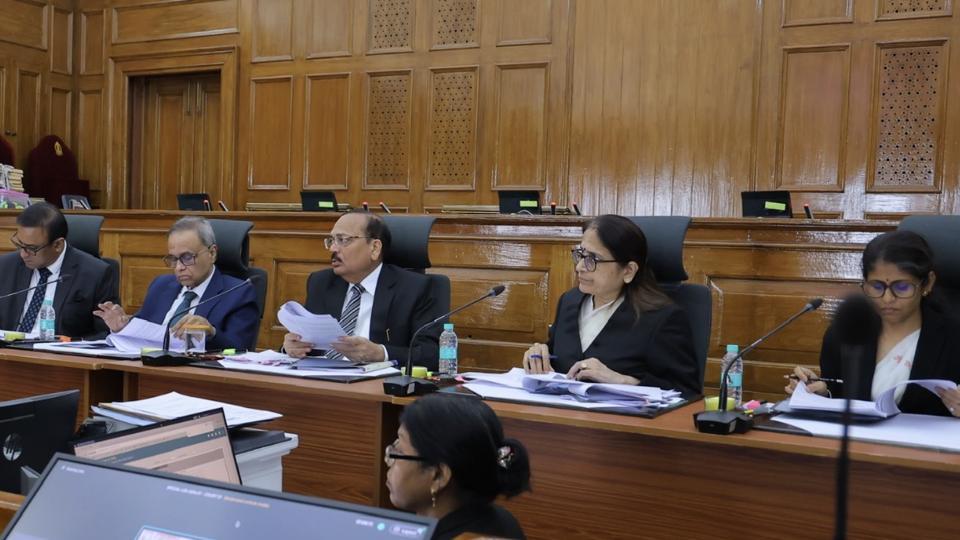
Shedding their usual judicial attire, judges sat in their courtrooms, just below the raised platforms they usually occupy, in combinations of two (the only exception being the Chief Justice of India, who sat with two other judges), and heard cases of litigants who appeared either physically or virtually, either through their lawyers or through the district legal services authority that represented their cases.
The litigants interacted freely with the judges, who settled several cases after ascertaining whether the parties who came with settlement deeds had done so consciously and without any pressure. This was the first time lawyers joined the judges as part of the process of adjudicating disputes.
Also Read: Ludhiana: Lok Adalat settles over 1.10 lakh cases in district
The matters listed before the court involved cases involving banking, matrimonial disputes, motor accident claims, consumer compensation disputes, labour law, RERA disputes, cheque bouncing, industrial disputes, property and land-related disputes, eviction proceedings, service law cases, and taxation matters.
This was the first day of the Supreme Court Action for Mediated Adjudication and Disputes Harmonization Across Nation (SAMADHAN) Samaroh, as judges will be holding court over the weekend on Saturday and Sunday as well.
CJI Kant held the court along with Justices Joymalya Bagchi and V Mohana, accompanied by Supreme Court Bar Association president and senior advocate Pradeep Rai and advocate-on-record Yugandhar Pawar Jha. Almost 15 benches of the top court conducted the Special Lok Adalat beginning at 2pm after they concluded the usual business for the day.
While most cases were disposed of or withdrawn, the CJI-led Special Lok Adalat Bench actively took up tax disputes and decided to identify similar matters involving faceless assessment of tax that are clogging the judicial docket and directed them to be listed before it on Saturday.
Also Read: National Lok Adalat disposes 45k+ cases in UT, settlements worth ₹27 crore
Earlier in the day, as part of the attempt to clear the pendency of old matters, the CJI listed a series of public interest litigations (PILs) that had not been heard for years. The court disposed of matters that included petitions filed during the COVID-19 pandemic involving rationalising the supply of oxygen cylinders, vaccination for disabled people and vagabonds, the job guarantee scheme under Mahatma Gandhi National Rural Employment Guarantee Act (MNREGA), service conditions of nurses, care for migrant children, among others.
While the farm laws were repealed by the Centre in 2021, the petitions challenging them were taken up on Friday and dismissed as infructuous. Similarly, the court dismissed a petition challenging the imposition of President’s Rule in Jammu & Kashmir since its bifurcation in 2019.
At the end of the Special Lok Adalat, CJI Kant thanked the members of the bar for their cooperation as no case was adjourned on account of the non-availability of lawyers. The process for organising the Special Lok Adalat began almost four months ago, when the top court issued a public notice inviting advocates, litigants and stakeholders to indicate their willingness to settle their long-standing disputes amicably through an out-of-court settlement. The settlements arrived at during these three days between parties will be equivalent to a judicial order.


