
 E-Paper



Supreme Court refuses to roll back Stage-4 of Grap in Delhi-NCR
The Supreme Court upheld air pollution curbs in Delhi but allowed hybrid school classes, directing the CAQM to monitor air quality for future relaxations.


The Supreme Court on Monday refused to relax the stringent curbs against air pollution under Stage 4 of the Graded Response Action Plan (GRAP) while allowing the Commission for Air Quality Management (CAQM) to consider relaxation for holding physical classes for schools and educational institutions in Delhi and the national capital region (NCR) by the end of the day.
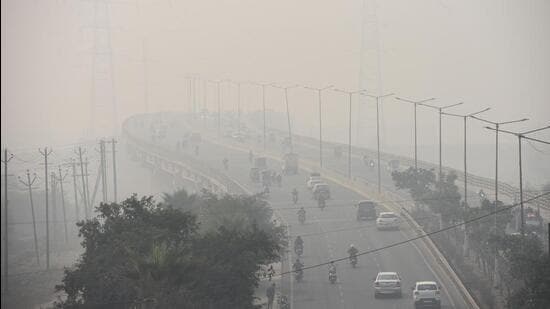
The commission, on Monday evening, announced changes to clauses in Grap, allowing schools and colleges to run on hybrid mode, instead having of only online classes.
A bench headed by justice Abhay S Oka also directed the CAQM to provide air quality index (AQI) figures till Wednesday, when the matter will be heard next, to decide on further relaxations . “Unless the court is satisfied there is a consistent downward trend of AQI, we cannot permit the CAQM to go down to Stage 3 or 2.”
This means the ban on construction activity is to continue, but the bench, also comprising justice Augustine George Masih, directed CAQM to consider passing decision on various mitigating measures in this regard and ordered the states of Uttar Pradesh, Haryana and national capital territory of Delhi to provide subsistence allowance to labourers and daily wagers as per a previous order of the court passed in November 2021.

The court decided to make an exception as far as educational institutions is concerned after a petition moved by parents of students belonging to underprivileged sections of society raised vital concerns over the closure of schools -- in terms of both access to mid-day meals available to students and lack of access to devices that support online classes.
Additional solicitor general (ASG) Aishwarya Bhati appearing for Centre and CAQM submitted average AQI figures over the past five days when AQI dipped from 419 on November 20 to 318 on November 24. The court said, “We direct CAQM to place updated data (on AQI) on Wednesday so that court can take a call on continuing GRAP 4 measures.”
The matter was last heard on November 23 when the court appointed 13 young lawyers to act as court commissioners and visit the entry points leading into Delhi to check the ground situation as regards enforcement measures under GRAP 4 to ban entry of heavy trucks and light commercial vehicles (LCV) registered outside the state.
The commissioners informed the court that on inspection of 83 out of nearly 120 entry points, of which 23 were major points, several gaps were noticed in the implementation of GRAP 4 curbs. According to their reports submitted to court, monitoring teams and police personnel in most check posts visited by them were stationed only after the court order of November 23, although GRAP 4 was introduced in Delhi from November 18. The reports pointed to the absence of barricades and transport enforcement teams to communicate which vehicles are to be exempted.
Pulling up the Delhi government and police over the reports, the bench said, “Show us a single document issued after the order of November 18 to inform people at the entry points to stop heavy trucks and LCVs.”
The court directed CAQM to immediately initiate action against the concerned officers under Section 14 of the CAQM Act, 2021 which allows it to prosecute public servants who violate the commission’s orders. ASG Bhati informed the court that Delhi police issued orders on November 18 itself, though copies of it were not readily available in court, to post policemen at 23 major entry points.
The bench said, “This itself is negligence. Who decides to post police only in 23 points. We will direct the CAQM to prosecute your Commissioner for inaction.”
Senior advocate Shadan Farasat for Delhi government said that though no specific directions were issued by the transport department, enforcement of court orders was the job of the police and the CAQM had directly instructed the police in this regard.
The court was also informed of the plight of construction workers who had no means of livelihood during the GRAP 4 restrictions on ban on construction of linear public projects such as highways, roads, flyovers, overbridges, power transmission, pipelines, tele-communication etc. The bench was shown an order passed on November 24, 2021 when a similar situation arose due to GRAP curbs.
The states of Haryana and UP had then paid a subsistence of ₹1000 per week while Delhi paid registered labourers a weekly sum of ₹5000. The court reminded the commission that under Section 12 of CAQM Act, it had powers to issue directions to various authorities to take measures to ensure labourers and daily wagers do not suffer.


