
For two decades, a large stretch of the Yamuna bank between the Agra Fort and the Taj Mahal lay fallow, courtesy the much-hyped-but-eventually-shelved Taj heritage corridor project.
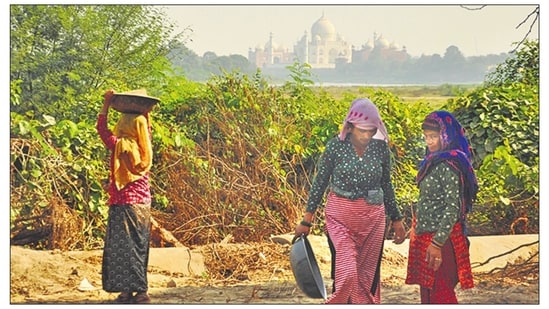
Now, that might change. The state horticulture department is turning a 40,000-square-metre patch of this land into a landscaped garden. Uttar Pradesh horticulture minister Dinesh Pratap Singh said the state decided to develop the land with two aims. “The first is to protect the Taj from dust and pollution by increasing green cover and planting more trees. The second is to give tourists a more serene and beautiful setting from which to view the monument. An initial amount of around ₹1.5 crore was allocated and work is likely to be completed in the next few months,” he added.
Rajnish Pandey, superintendent of the state horticulture department in Agra, said three lawns already existed in front of the Agra Fort. “There is another patch of land measuring 40,000 square metres alongside the river Yamuna, facing the Agra Fort, which was not in a good state and reflected the remains of the unfinished Taj heritage corridor project. It has now been taken up by the state horticulture department to be developed on the pattern of the three existing lawns,” Pandey told HT.
Also read: Taj Mahal security reviewed, blind spots identified
Existing trees to be preserved as ornamental and seasonal plants are added
{{/usCountry}}Also read: Taj Mahal security reviewed, blind spots identified
Existing trees to be preserved as ornamental and seasonal plants are added
{{/usCountry}}When HT visited the site, about a dozen women workers were clearing pebbles and stones from the ground. Many trees had grown on the land over the years. Officials said these will be preserved and made part of the landscaping. “The area will be filled with ornamental plants besides seasonal ones to add natural beauty,” Pandey said.
The site lies along Yamuna Kinara Road, facing the Agra Fort and looking towards the Taj Mahal. It is part of a cluster of Taj View Gardens, landscaped lawns along the river from which visitors can view the Taj Mahal. Two belong to the Archaeological Survey of India (ASI). The horticulture department has one garden of over 25,000 square metres.
In all, about 26-29 acres of land between the two monuments is being developed. Of this, ASI has about 10-12 acres, while the horticulture department has about 16-17 acres, including its existing garden and the new patch. Work on the project began in September. “We might have some cultural events after due permission if things go as planned. It will provide green cover much needed to hold SPM (suspended particulate matter) in the air around the Taj Mahal,” said Pandey.
Agra Development Authority vice-chairperson Vijay Kumar said the body was backing the project at every stage.
Also read: Green patches re-appear on Taj Mahal walls, ASI on alert
Supreme Court directions underpin efforts to increase green cover near Taj
An ASI official said the agency had its own green landscape. “Our gardens are spread over an area of about 10 to 12 acres and are towards the river Yamuna” he said. “These green landscapes are coming up in compliance with directions of the Supreme Court in the matter related to the Taj Trapezium Zone, for developing greenery to keep the air clean near the Taj Mahal,” he said, requesting anonymity.
Proposed in 2002, the Taj heritage corridor was an ambitious plan of then- CM Mayawati, under which the Yamuna would be diverted to reclaim about 75 acres of riverbed between the Agra Fort and the Taj Mahal for food plazas, shops and amusement facilities. But, environmentalists and a Supreme Court-appointed expert panel said the project was rushed through without ecological or structural studies and could endanger the two heritage sites. It was stayed by the Supreme Court in May 2003 and a CBI probe into irregularities in the project was ordered in July 2003. “Expert committees constituted on the instruction of the Supreme Court found that the best way to safeguard the reclaimed area was to develop greenery on the affected patches alongside the river Yamuna, and the Supreme Court approved the plan,” activist KC Jain said.
Also read: Floral patterned marble slab from Taj Mahal set for UK auction
In its landmark 1996 Taj Trapezium judgment, the Supreme Court noted that sulphur dioxide from nearby industries combined with moisture in the air to form sulphuric acid. In May 2018, a Supreme Court bench of justices MB Lokur and Deepak Gupta expressed concern that the Taj’s marble had turned yellowish, then brownish and greenish. Experts have long linked the loss of green cover to the Taj’s discolouration.
“The continuous felling of trees in the Taj Trapezium Zone, along with dust and vehicular pollution, is a significant contributor to the yellowing of the Taj Mahal’s marble,” said SN Tripathi of IIT Kanpur’s Centre for Environmental Science and Engineering.
ABOUT THE AUTHOR
Hemendra Chaturvedi is a senior journalist based at Agra. He covers eight districts of Agra and Aligarh division namely Agra, Mathura, Mainpuri, Firozabad, Aligarh, Etah, Kasganj and Hathras. He had been with HT since 1992 and has completed three decades of association with HT and has worked for Hindustan Times only all through his career of about 35 years. Having Masters in Chemistry, Hemendra is also a law graduate with diploma in Personnel Management and has utilised broad based academic qualifications in his indepth, accurate and high impact stories from this part of western Uttar Pradesh while being based in the city of Taj Mahal. In such long span of career with Hindustan Times, Hemendra Chaturvedi has led his team of reporters which was instrumental in bringing out supplements including Region Scan, Agra Live, HT City time to time and proven his leadership qualities and has made presence of HT felt in the region covered by him. In the process of time, Hemendra has attained expertise in a variety of beats, being sole reporter for HT and has covered Aligarh Muslim University, Taj Mahal centric tourism, religiously sensitive city of Mathura and had been witness to Agra Summit having attendance of top leaders of India and Pakistan.