
 E-Paper



Green patches re-appear on Taj Mahal walls, ASI on alert
Pollution-fueled insects are staining the Taj Mahal green, prompting ASI cleaning and renewed calls to tackle pollution in the Yamuna.

 Prefer HTon Google


Recurring phenomenon of green patches appearing on the inlay work on northern walls of the Taj Mahal has yet again become a matter of concern for ASI officials.
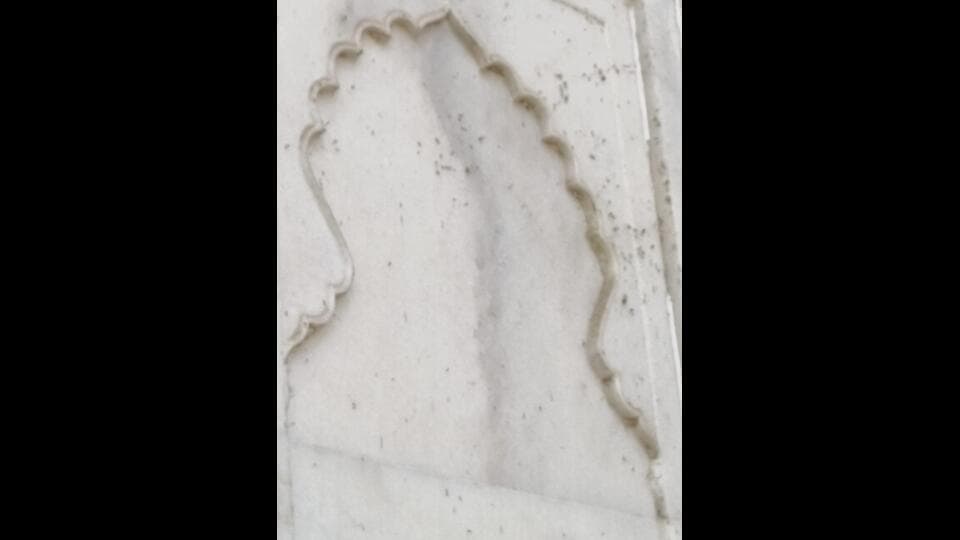
The ASI officials at the Taj Mahal have written to the science branch of ASI for remedial measures to tackle this ‘attack’ by the ‘Goeldichironomus’ insect for which the quality of water in the Yamuna is yet again under scanner.
The issue has been a matter of concern for the Archaeological Survey of India since 2016. Although the phenomenon has been observed on the white surface of the Taj Mahal since 2015, it was previously limited to the hot months of May and June but now these green marks appear during months of October also as seen in recent years when water in Yamuna recedes after monsoon gets over.
Although the green marks left by the insect can be washed away with cotton dipped in distilled water, this pattern is predominantly found on the northern wall of the Taj Mahal, facing the Yamuna, believed to be on the portion that remains illuminated during night hours.
In 2016, scientists and faculty members at the School of Entomology at St John’s College in Agra identified the culprit behind the issue as the insect ‘Goeldichironomus,’ believed to thrive on the pollution of the Yamuna, flowing behind the Taj Mahal’s northern side. Measures to control pollution in the river were suggested to mitigate the insect’s impact on the Taj Mahal.
“We are looking forward to Friday, the day when Taj Mahal remains closed for public viewing. An extensive drive will be taken up to clean these green marks manually,” said the ASI official, engaged in conservation work at Taj Mahal for ASI, on Tuesday.
On Monday, the superintending archeologist for Agra Circle of ASI, Dr Smita Kumar inspected the northern walls of Taj Mahal and found these green and blackish spots there. The science department having specialist chemists are being asked to look into the matter.
The cleaning process, conducted by the Science branch of ASI, will be repeated, but repeated interventions are deemed unfavourable for the sensitive surface of a monument like the Taj Mahal, renowned for its beauty and charm.
In 2016, Dr Girish Maheshwari, the then head of the School of Entomology at St John’s College in Agra had explained that ‘Goeldichironomus’ serves as a bio-indicator of water quality, indicating localised water pollution. The high concentration of phosphorus in the water and sediments of the river enhances the reproductive productivity of the female insect, which can lay more than one thousand eggs.
Dr Maheshwari’s report in 2016 highlighted that the insect’s larval form feeds on algae and waste in the river, transforming into a pupa before emerging as an adult. These adults form massive swarms, attracted to the white stone of the Taj Mahal. While non-feeders, the chlorophyll within their bodies is transformed and discarded as excreta, staining the Taj Mahal walls green. The root cause of the insect’s growth in the Yamuna is attributed to pollution.
Dr Sharad Gupta, a prominent environmentalist in Agra, points out that major drains, on both sides of Taj Mahal, go untapped and add to pollution in Yamuna leading to such fallouts.
“There is need of some ‘real’ work at ground level and to begin with, the nullah (drains) need to be tapped so that water quality added to the river can be monitored. The city which relies on the Taj Mahal for its economy needs to at least take some sincere efforts to control river pollution’ he said.


