
 E-Paper



Take punitive action against officials for inaction on hate speech: Plea in SC
Two petitions have been filed in the Supreme Court on hate speeches in recent past. One petition asked the court to issue directions for action in such cases while the second plea sought special provisions, insisting that the IPC wasn’t enough to deal with hate speech and rumour mongering.


NEW DELHI: The Supreme Court on Friday posted for November 22 a petition filed by former Planning Commission member Syeda Hameed and academic Alok Rai that sought directions to authorities to curb hate speech failing which punitive steps should be taken against them for inaction.
The bench of justices AM Khanwilkar and CT Ravikumar told the petitioners to serve a copy of their plea on the centre and decided to hear the case on Friday along with another petition filed by Ashwini Upadhyay.
The petition filed by Syeda Hameed and Rai said they were concerned over concerted events in the recent past that targeted political, social and economic exclusion of Muslims through a series of rallies and hate speeches. The petition, filed by lawyer Shahrukh Alam said, their plea was not adversorial and sought implementation of guidelines on hate speech passed by Supreme Court in 2014 and on mob violence and lynching events in a subsequent decision in 2018. The latter decision even prescribed punitive steps against public authorities who failed to contain such incidents.
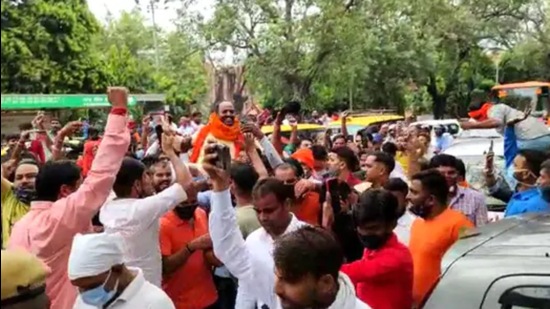
Referring to an August 8 event at Jantar Mantar where anti-Muslim slogans were raised at an event organised to end colonial-era laws, the petition said, “The petitioners are personally affected by the stigmatising and the push towards social and political exclusion that is the result of a concerted and organized series of events aimed at targeting Muslims and their sympathisers.”
It said that the constitutional guarantee from protection from ‘hate speech’ is not supposed to protect people from being offended but to protect the dignity of an individual or group. “In recent months, there have been rallies replete with speeches that directly and hatefully target a religious community, use pejoratives to describe them, identify them falsely as predators of land, resources and of Hindu women and advocate their social, economic and political boycott,” the petition said, adding, “In some cases, speeches have advocated direct violence as the final solution.”
Pointing to the Jantar Mantar event, which was organized without permission and in violation of Covid-19 protocols, the two petitioners stated, “There is a close proximity of such events that are made in communally charged atmospheres, to incidents of ‘hate crimes’ that range from lynching, and threats of sexual violence to more structural discrimination….The latest episode of 8 August was only one amongst a series of such events.”
Incidentally, one of the persons named in the Jantar Mantar case was advocate Ashwini Upadhyay who filed the second petition on framing a law on ‘hate speech’ and ‘rumour mongering’ that came up for hearing before the same bench on Friday.
Upadhyay was told to serve his petition on the Centre as well.
Upadhyay, also a former Bharatiya Janata Party spokesperson, has claimed that he was framed.
in his petition, Upadhyay said the Indian Penal Code was not sufficient to deal with the situations of hate speeches and rumour mongering and sought special provisions in this regard.
“Anonymity of internet allows a miscreant to easily spread false and offensive ideas,” Upadhyay said, adding, “Incitement to violence should not be the sole test for determining whether a speech amounts to hate speech or not. Even speech that does not incite violence has the potential of marginalising a certain section of society or individuals.”
Both petitions relied on a 2020 Supreme Court decision in Amish Devgun case where hate speech was linked to the violation of unity and fraternity and breach of human dignity, which constitutes an essential facet of the right to life and liberty under Article 21 of the Constitution.
In addition, the petition by Syeda Hameed and Rai said, “Hate speech is a discursive process of pushing marginalised groups outside of social, economic and political spheres of society by disseminating hate propaganda and encouraging discrimination. At its most harmful, it is widely recognized as a precursor to ethnic cleansing.”
They highlighted isolated events in the Capital and other places involving violence against a particular minority community in breach of top court’s earlier guidelines.
“Public authorities must be held accountable for dereliction of the duty of care and also for non-compliance with this court’s orders by not taking action to prevent vigilante groups from inciting communal disharmony and spreading hate against citizens of the country and taking the laws into their own hands,” added the petition.


