
 E-Paper



Test health workers, hospital staff once a week to reduce transmission risk: Study
In India, according to the Union health ministry’s testing protocols, only symptomatic health care workers will be eligible for a Covid-19 test.


Health workers deployed in high-risk environs such as hospitals should be tested for the coronavirus disease (Covid-19) once a week, according to a new study by researchers in the United Kingdom who say that doing so could reduce the risk of them spreading the infection further by 25%.
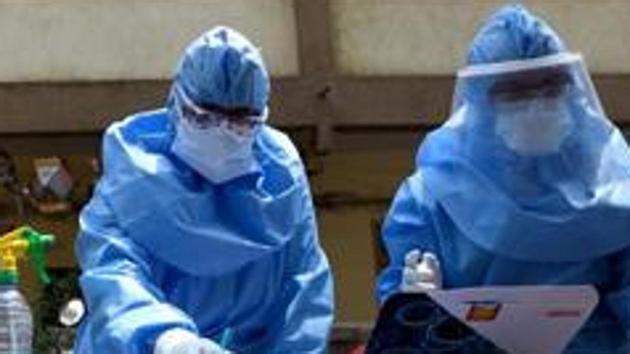
On Sunday, at least 29 health workers – including 12 doctors and 11 nurses -- tested positive for Covid-19 at a single hospital in New Delhi.
The findings are part of a study on what testing strategies countries can adopt to reduce the spread of Covid-19. The researchers, from Imperial College of London which is one of the centres collaborating with the World Health Organization for infectious diseases modeling, identified health care workers (HCWs) – doctors, nurses and hospital staff – as people who need to be tested at regular intervals.
“We find that testing is most useful when targeted at high-risk groups such as health care and care home staff, where regular screening in addition to testing of symptomatic individuals may prevent an additional 25-33% of their contribution to transmission in hospital and the community,” said the study’s lead author, Nicholas Grassly, in an email to HT.
Grassly added that while widespread testing to detect the virus as well as the antibodies will help understand the scale of the pandemic and play a crucial role in how lockdown measures are lifted or rolled out, it is unlikely to reduce the spread of infections in itself.
For that, testing will need to be focused.
“This study shows that regular testing of health care workers, for example once a week, could reduce their contribution to transmission by 25%, provided that test results are delivered quickly (less than 24 hours after the swab is taken). This is in addition to the reduction in transmission seen when healthcare workers self-isolate after developing symptoms,” said Marga Pons Salort, who also authored the study.
“If tests were to be done at the end of a shift and results made available before the next shift, then the time delay between testing and isolation would effectively be zero, increasing effectiveness to 25-33%,” the study also said.
The researchers note that the need to continuously screen healthcare workers stems from the nature of the disease: approximately 20-50% of infected people are without symptoms while they may be just as infectious, and nearly 40% of infections occur before symptoms set in.
In India, according to the Union health ministry’s testing protocols, only symptomatic health care workers will be eligible for a Covid-19 test. The protocols, however, allow individuals who have been in direct contact or are taking care of a confirmed Covid-19 patient to be tested between 5-14 days after the first time they were exposed to the infected person.
According to a study in China’s Wuhan, where the coronavirus causing Covid-19 first infected a human, close to 30% of health care staff were infected at one of the city’s main hospitals. They then spread the infection to family members.


