
 E-Paper



The 1949 Karachi accord that defined the ceasefire line
Military representatives of India and Pakistan this evening reached full agreement on a ceasefire line for Jammu & Kashmir.


Karachi: Military representatives of India and Pakistan this evening reached full agreement on a ceasefire line for Jammu & Kashmir.
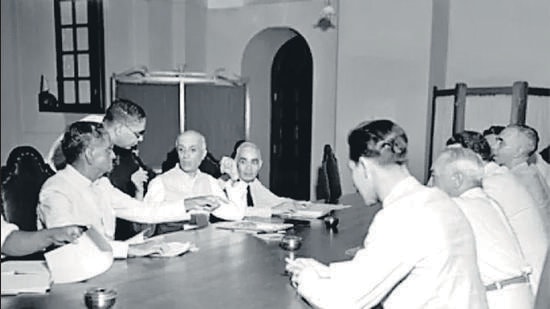
This agreement followed instructions brought by both India and Pakistan delegations from their respective governments on two outstanding disputes which arose during the last week. These points of dispute related to the control of the Kishenganga river and the Burzil Pass.
The agreement is subject to ratification by the Indian and Pakistan governments which is expected in four days.
The joint conference will meet again tomorrow to “discuss minute details of the agreement” and decide on fixation of a date for bringing the new agreement into operation.
This is the first time since the ceasefire that India and Pakistan have reached mutual agreement on an approximate 800-mile-long frontier running from Manavar in the south in Jammu to Keran in the north, thence east to Marol and up to the Shyok glaciers.
It is after seven months that a ceasefire line has been defined specially in the northern areas of the state, where, because of weather and terrain, the ceasefire on January 1, 1940, left many factual positions unclear.
The newly demarcated ceasefire line in the disputed mountainous area from Keran to Gurez and beyond runs south of the Kishenganga river to a point south of Taobat. From this point the line runs north of the river to Gurez and Talel valley. The ceasefire line then cuts across the Burzil nullah, north of Chorwan.
Both India and Pakistan have agreed that the nullah and the track south of Minimarg, five miles south of Burzil Pass, down to Chorwan will be under Pakistan administration and will be demilitarized.
Commission’s statement
An official statement issued by the Kashmir Commission’s Truce Subcommittee, which sponsored the present joint military talks, said: “Today’s overall agreement cleared up points of difference outstanding since last March. On Thursday and Friday of last week the delegations defined a line from Manavar to Keran, noting positions at Patrana, 18 miles south of Naushahra, and at Bugina, south of Keran. They also reached general accord on a line in the north from the Retagah Chhish hilltop near Gurez to Marol. In an effort to meet the points of view of both parties on the main question — control of the Kishenganga river — Gen Delvoie, Military Adviser to the Commission, presented a compromise line on Friday, July 22. It was on the basis of this compromise line, with modifications proposed and accepted by the two delegations, that final agreements were achieved.”
The chairman of the UNCIP’s Truce Subcommittee, Hernando Samper, Columbian member, commenting on the success of the conference, declared: “The agreement which has been reached on the demarcation of a ceasefire line in Jammu and Kashmir is unequivocal proof of the desire of the Governments of India and Pakistan to ensure and promote peace in the state.
“On behalf of the Commission, whom we have represented in Karachi during these joint meetings, I would express our sincere appreciation to the Indian and Pakistan delegations for their goodwill, their determined effort and their mutual understanding. But for their willingness to make concessions where points were in dispute and the spirit of friendliness underlying the debates, there would have been no agreement.
“It is a tribute to the military representatives of India and Pakistan that, aware of the significance and benefits, of a clearly defined line, they did not allow minor issues to obstruct its achievement.
“The Truce Sub-committee attaches the greatest importance to this event and earnestly hopes that it may prove to be a portent for future understanding on the questions which today remain outstanding for a final settlement.”


