E-Paper



The coming of age of India’s Grandmaster club
The last fortnight, however, has shown that Gukesh, Praggnanandhaa, Sarin and Sadhwani are as much the present as the future of the chess world.

 Prefer HTon Google


It seems far-fetched now, but the India B team that secured bronze in the open section of the 44th Chess Olympiad on Tuesday wasn’t even going to feature in the event until February. Had Moscow remained the host city of the tournament as originally scheduled, only one Indian team each would have been fielded in the open and women’s sections. The open category team would have comprised P Harikrishna, Vidit Gujrathi, Arjun Erigaisi, SL Narayanan, and Krishnan Sasikiran.
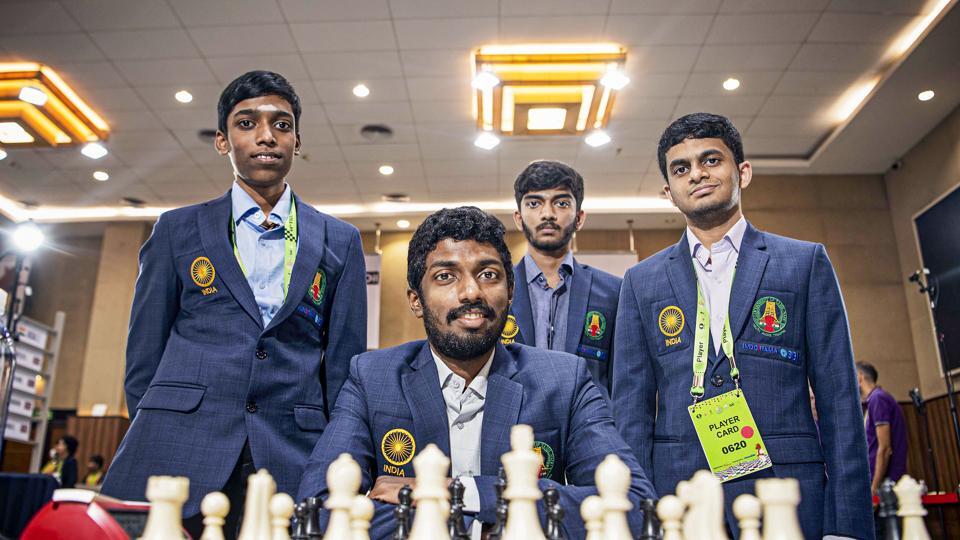
They did form the India A team that finished fourth in Mahabalipuram. The young India B team that turned heads with a stupendous showing came in only when hosting rights were awarded to India by the International Chess Federation (Fide) due to the Russian invasion of Ukraine (the host nation is allowed to field two teams).
In essence, the teen quartet of D Gukesh, R Praggnanandhaa, Nihal Sarin and Raunak Sadhwani that played for India B alongside 29-year-old B Adhiban could well have been silent spectators as India hosted the Olympiad for the first time. The teams were picked on the basis of Fide rating in the classical format, and at the time of selection, India A players had a superior score to those in India B.
The last fortnight, however, has shown that Gukesh, Praggnanandhaa, Sarin and Sadhwani are as much the present as the future of the chess world. Gukesh, Praggnanandhaa and Sarin along with Arjun Erigaisi are also in the top 10 in the Junior Fide rankings for August.
“It’s taken this Olympiad to make us realise the potential of the players who would not have come into the top team,” said Pravin Thipsay, head of the Indian delegation at the Olympiad and the country’s third GM.
As India A captain Srinath Narayanan pointed out, he did not expect the youngsters to shine to the extent they did. India B were seeded 11th in the competition while the four teenagers had no previous experience in the Olympiad. Gukesh and Sadhwani are 16, and Sarin is 18. Praggnanandhaa turned 17 on Wednesday.
“We all knew their emergence was going to happen at some point, but nobody could have predicted this will happen in 2022,” Narayanan, 28, said. “For India B to dominate teams like the US, which has four players in the top 15, I don’t think people saw it coming. I was sure these juniors would take over, but I didn’t expect this Olympiad to be that point. They have come up so fast and toppled most teams.”
None barring Norwegian world champion Magnus Carlsen, perhaps. On the eve of the Olympiad, the world No 1 picked India B as the more dangerous of the Indian teams. Carlsen was outdone in the race for individual gold on the first board by Gukesh, who led his team’s charge with an exemplary score of 9/11. His victims included far superior rated Fabiano Caruana, Alexei Shirov, and Gabriel Sargissian.
The youngster also surpassed a rating of 2700 again. He first went past the mark during a tournament in Switzerland in July, becoming the third youngest to acquire the informal status of a super Grandmaster (GM). He was India B’s standout player though his loss to Uzbekistan’s Nodirbek Abdusattorov in the 10th round, by his own admission, cost his team a gold or silver medal.
“Gukesh played amazingly. He played some very good games, especially against Shirov and Sargissian. He played well against Caruana too, though the American did not play well,” said Hungarian legend Judit Polgar, who had notched up a score of 12.5/13 in the 1988 Olympiad as a teenager.
The spotlight on Gukesh — he has overtaken Harikrishna as India’s No 2 behind Anand — is understandable, but the others in this gifted cluster seem to be on an equal footing. Praggnanandhaa, for instance, has beaten Carlsen twice this year in online rapid events. If there’s a reason why his rating isn’t already over 2700 — it’s 2661 — it is only because he hasn’t played too many games in the classical format. Sarin went unbeaten in the competition.
“They are very much the present. With Anand not playing as much, these are the guys who are going to get invites for the top tournaments and win over the next five years. Maybe they need another couple of years to start winning the big events, but we don’t need to wait for 10 years or something like that,” said Gukesh’s coach Vishnu Prasanna.
Even Sadhwani, the least known of this group, showed his aptitude with a win over world No 17 Leinier Dominguez of the US in the eighth round.
“They are all improving very fast. It is just a matter of having good events. At the moment, Gukesh is ahead in the ratings but I see all of them crossing 2700 very soon. There is no doubt about that. Even Sadhwani was very impressive. I think there is some inconsistency, but beating Dominguez was not at all a simple thing,” added Prasanna.
Jealousy and insecurity can sometimes creep in when there is a group of youngsters operating at the same level and jostling for recognition at the same time. But instead of pulling each other down, a fellow player’s success only seems to be spurring their collective drive to excel.
“Initially, Gukesh was scoring these impressive wins. I think Pragg, Nihal and Raunak took inspiration from that. The other three registered some important victories too. Nihal did his usual thing. He was quite solid. He was in a bit of a rut in recent months, but he is incredibly strong. I expect him to cross 2700 in no time. It is probably the same with Pragg,” Narayanan said.
Shrewdness on the 64 squares aside, another quality that binds them is their level-headedness. Neither the pressure of the clock nor the supremacy of the opponent seems to make them veer away from their game plan. You can add Arjun Erigaisi to this group. Although a part of the India A team, the 18-year-old from Telangana crossed a live rating of 2700 during the final round on Tuesday. It is perhaps these five that will be wearing the India blazer when the next Olympiad is held in Budapest in 2024.
“This is the best generation of Indian chess,” Narayanan asserted. “We can take it for granted that they are part of the first team now. The competition is not even with the best players in India. It is with the best players in the world...people like Magnus.”