
 E-Paper



The face-off behind the battle for AIADMK
For close to a week, the two had not been on speaking terms. Panbeerselvam’s native Theni district unit had passed a resolution to take back “all those who had left the party”, an obvious reference to the third pole of power in the AIADMK, VK Sasikala.

 Prefer HTon Google


It was March 8, and at the AIADMK’s Chennai headquarters stood a beaming O Panneerselvam and Edapaddi Palaniswami. The party was celebrating women’s day, and both OPS and EPS, as they are popularly known, showed little sign of animosity, feeding cake to former ministers Gokula Indira and B Valarmathi.
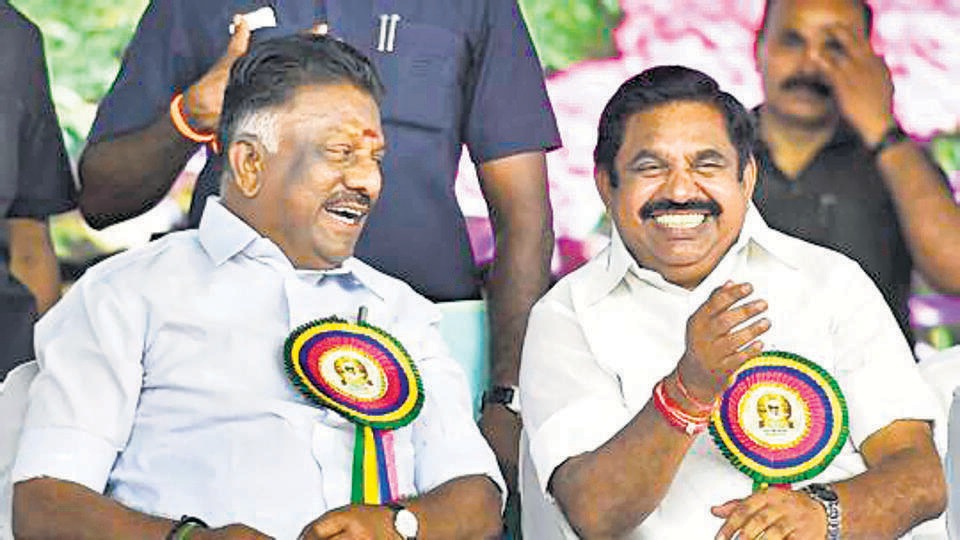
Yet, despite the practised smiles, there was tension.
For close to a week, the two had not been on speaking terms. Panbeerselvam’s native Theni district unit had passed a resolution to take back “all those who had left the party”, an obvious reference to the third pole of power in the AIADMK, VK Sasikala. An angry EPS camp retaliated, saying they would push for him to be sole leader. Only the day before the event did the two engineer a fragile peace.
For five and a half years since the death of the AIADMK’s undisputed matriarch, J Jayalalithaa, in December 2016, this fractious relationship has been at the centre of the party’s politics — two pre-eminent leaders jostling for power, flexing their strength, fighting and making up, but eventually staying together to keep Sasikala out.
In that period, much has happened in Tamil Nadu’s politics — the DMK swept to power, the AIADMK has allied with the Bharatiya Janata Party and Sasikala is making her presence felt again — but the jousting has continued unabated.
Yet, this time feels different. On June 23, in a fraught general council meeting of the AIADMK, EPS’ supporters pushed for the party to move to a unitary leadership under him. The night before, OPS had gone to the Madras high court, asking for status quo. The court ordered that besides 23 resolutions on the agenda agreed by the leadership previously, meaning both OPS and EPS, no other resolution and amendment to the party’s laws could be made.
OPS, despite the loud protests against him at the meeting, had lived to see another day. On Monday, however, EPS’ loyalists said no resolutions being passed meant that even the one that governed the dual leadership arrangement had come to an end, and called for a meeting on July 11.
In politics, there are no permanent friends or foes, but at least for the short term, this may be a fight to the finish.
The genesis of EPS and OPS
The 68-year-old Palaniswami began his political career from Edappadi in Salem district, joining the AIADMK in 1974. From a family of farmers, Palaniswami grew up in Siluvampalayam, and in his younger years would sell jaggery at the Chithode market in Erode.
He won the assembly elections from Edapaddi in the years 1989, 1991, 2011 and 2016. In 2011, he was made highways minister in the state cabinet, and was seen as a strong, firm administrator. During his time, his reputation at home grew, with the village receiving its first and only government arts and sciences college in 2014.
On December 5, 2016, seven months after AIADMK swept to power under her leadership, winning the assembly elections with 136 of 234 seats, Jayalalithaa died after a prolonged illness. As Tamil Nadu mourned, it was O Panneerselvam, till then the finance minister, who took oath as Tamil Nadu chief minister for the third time.
Twice before, he had briefly stepped into a vacuum left by Jayalalithaa, in 2001 and 2014, when she was jailed in a land scam and a disproportionate assets cases, respectively. In those two terms, he ruled for six and eight months, respectively, keeping the seat warm for the party matriarch.
In February 2017 though, Panneerselvam was pushed to resign, with Sasikala waiting in the wings. Two clear factions emerged, one that backed OPS, and the other that backed Sasikala. One of the leaders of the Sasikala faction was Edapaddi Paliniswami.
When Sasikala’s own chief ministerial ambitions were cut short after she was convicted in a disproportionate assets case that February, she handpicked EPS to become chief minister.
Then she went to jail and everything changed.
The OPS and EPS factions merged, and removed Sasikala in a general council meeting inSeptember2017, cancelling her appointment as interim general secretary, and that of her nephew TTV Dhinakaran as deputy general secretary, a case which is still being fought in a city court.
The party also amended the by-laws to create new posts for OPS as coordinator and EPS as joint coordinator, giving birth to the so-called dual leadership. All powers vested with the post of the general secretary went to these two new posts and the party made Jayalalithaa their “eternal general secretary”.
On paper, the relationship was meant to be one of equals. Both their signatures were required for all AIADMK decisions. EPS was chief minister, while OPS was his deputy. In the party, OPS was coordinator, and EPS the joint coordinator.
But being chief minister brings an undeniable heft, and EPS consolidated his public perception, both within the party and in Tamil Nadu. Those close to him grew in strength, such as SP Velumani, whose influence grew manifold in Coimbatore. With Sasikala at the helm, the party had been dominated by the Thevars, a caste which OPS belongs to as well. But under EPS, the Gounders, strong in western Tamil Nadu, began to gain prominence.
The early days of the EPS regime did face the criticism of being subservient to the BJP, which it had allied with. But when Covid-19 hit in March 2020, EPS was seen as a worthy administrator, steering the state with a sense of calm. The party may have lost in the 2021 assembly polls, but EPS has grown in Tamil Nadu’s estimation.
Through the twists and turns, EPS has kept his silence, as opposed to the much more voluble OPS. “His silence is his special quality because he shows his strength through his actions,” an EPS loyalist said, seeking anonymity.
“Have you ever seen EPS backtrack? It’s always OPS who says one thing and then makes a U-turn. OPS was brought in during Amma’s absence. He performed what was expected of him and earned praise. That was enough at that time. But after her death, he does not command that respect on his own. He should know when to smile and when to be stern,” a former minister and another EPS supporter said, declining to be named. “OPS’ Gandhian style will not work. EPS’ toughness commands more respect.”
OPS, the eternal number two
The 71-year-old OPS joined the AIADMK in 1973, the firstborn son of a farmer. He set up a tea shop in the 1980s and ran other small businesses. His political future changed in 1996, when he was elected chairman of the Periyakulam municipal council, and he grew when he became close to Sasikala’s nephew Dhinakaran, who became Lok Sabha MP from Periyakulam in 1999.
He went on to win the Periyakulam and Bodinayakanur assembly seats, both in Theni district, five times. He was a minister in various AIADMK governments, holding important portfolios of finance and public works, and in 2006, was made leader of the opposition. While OPS’ son P Ravindranath is a Lok Sabha MP from Theni, his brother O Raja was also part of the AIADMK, but was removed from the party after he met the exiled Sasikala recently.
In the six months he was in power in 2001, the ever accommodative Panneerselvam kept Jayalalithaa’s picture on the table, and never sat in the chief minister’s chair. It was typical of a man who was seen as obedient, calm and non-confrontational — the perfect number two. In 2014, when he took Jayalalithaa’s place again, he sobbed uncontrollably as he took oath.
In 2021, there were hectic negotiations between the EPS and OPS factions on who would be the chief ministerial candidate, and eventually the latter gave in, announcing himself that EPS would be the AIADMK-led National Democratic Alliance’s chief minister if they came to power.
The DMK swept to victory, but EPS saved face. In western Tamil Nadu, where he is from, the AIADMK won 33 of 50 seats. In southern Tamil Nadu, where Panneerselvam is from, the AIADMK only won 18 of 58.
Palaniswami beat the DMK candidate in the Edapaddi constituency by a massive 92,849 votes, increasing his margin, while Panneerselvam survived a close fight in Bodinayakanur in Theni, trailing for a few rounds, but eventually winning by 12,154 votes.
This then helped EPS consolidate. There were tensions between the two, but it became clear that OPS would remain number two, and become deputy leader of opposition, while EPS would lead the party as the leader of the opposition.
OPS supporters, however, said he has always acted with dignity. They point to the June 23 general council meeting, when unruly cadre raised slogans against OPS and threw a bottle at him. OPS stood his ground, smiling calmly with his hands on his hips.
“You saw how he behaved. Is this how people treat such a dignified leader? Why didn’t EPS ask the cadre to calm down?” asked JCD Prabhakar, an OPS supporter. “Let’s be clear. Neither OPS nor EPS can ever be MGR or Amma. But from what I can see, the leadership is with EPS and the cadre are with OPS.”
This feeling, even among the erstwhile OPS camp, isn’t unanimous. Former minister K Pandiarajan and former MP V Maitreyan are among those who have jumped ship to the EPS camp. “Those who have supported OPS have lost strength and lost elections. So, even they feel that they will grow if they support EPS now,” another EPS loyalist said on condition of anonymity.
Why does AIADMK want a unitary leadership?
The dual leadership of EPS and OPS hasn’t worked at the ballot — the party has seen a series of electoral reverses, including the 2019 parliamentary polls, May 2021 assembly elections, December 2021 rural body elections and February 2022 urban body elections.
“During Amma’s period, AIADMK would be the first party to announce candidates. Now we are never first off the mark,” said RB Udhayakumar, former minister.
The party is in dire need of rejuvenation at the cadre level, another senior leader said. “There has been no assessment of party workers since Amma’s death. Under the dual leadership, there is no reward and no punishment. If we continue like this, we will end up like the Congress, which have no fresh energy.”
Losing support, OPS has invoked a trump card, saying that he is not against bringing back Sasikala, a move that has threatened EPS. At the general council meeting, former minister and Rajya Sabha MP CV Shanmugham read out a letter signed by 2,190 of 2,500 members who wanted unitary leadership.
“There is a need for a strong, brave and clear singular leader like Puratchi Thalaivar MGR (revolutionary leader and party founder MG Ramachandran) and (his successor) Puratchi Thalaivi Amma,” he said.
EPS has struck at an opportune moment, political analyst Maalan Narayan said. “OPS and EPS had an opportunistic relationship when they came together to keep Sasikala out. The BJP had advised them to remain together to not let the anti-DMK vote split,” Narayan said. “Now that no election is near, and there is time to prepare for the 2024 general elections, the BJP will not interfere.”
However, OPS is not giving in just yet. “I have never seen OPS this angry and upset. Even when he conceded the chief ministerial nomination, he didn’t feel like this. Now he feels betrayed after offering so much support to EPS,” a senior OPS backer said, requesting anonymity.
In Tamil Nadu, and in the AIADMK, there is always another act yet to be written.


