
 E-Paper



Tiger monitoring scheme a far cry from conservation
The arrest of poacher Sarfuddin Mey, who has confessed to poaching a big cat in Sariska Tiger Reserve, has exposed many a loophole.

 Prefer HTon Google


The success story of India’s first tiger relocation from Ranthambore National Park (RNP) to the Sariska Tiger Reserve (STR) a decade ago has been dampened. A poacher, Sarfuddin Mev, has confessed to having poached a tigress for sale of body parts. This is the first such incident here since 2004.

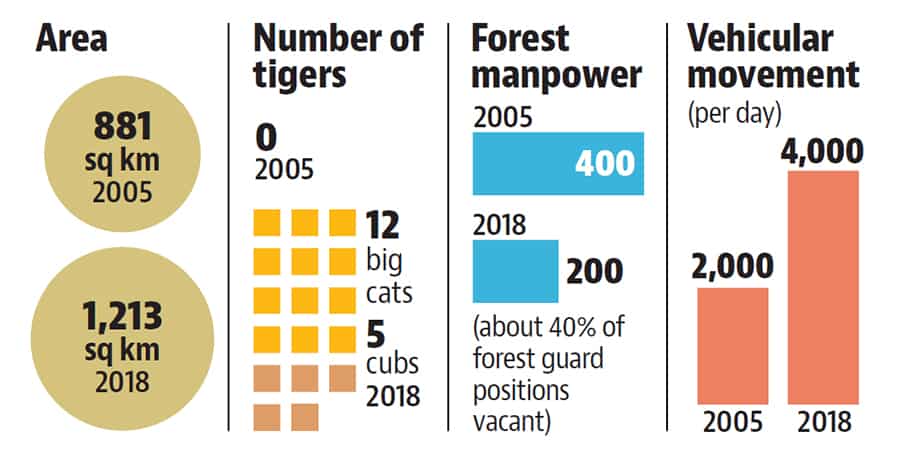
STR had 12 big cats until poacher Sansar Chand wiped out the entire tiger population in the early 2000s. Various committees, including a Supreme Court-appointed panel, identified five factors that lead to poaching — including the presence of villages inside the reserve.
The Rajasthan government had agreed to address the issues, and as a safety measure, relocated eight tigers from RNP in 2008. Within a decade, the number of tigers there increased to 17, including five cubs. This inspite of a resident allegedly poisoning a tiger in 2009 and a cub dying after getting entangled in a barbed wire around a farm in April this year.
STR deputy forest conservator Nitin Singh said Mev was arrested for killing a sambar and a blue bull (nilgai) on October 27, and confessed to killing the tigress in February. He said the department has nothing except his confessional statement to link him to the poaching.
Mev’s arrest has also raised questions over the tiger monitoring programme. The tigress was killed on February 25 and her skin and body parts were reportedly sold to an unidentified Gurugram-based trader, an official said. Yet, her movements — based on signals from a radio collar — were reported until March 10.
“That (the radio collar signals) is a matter of investigation now,” said chief forest conservator Govind Sagar Bhardwaj. He admitted something went wrong with the monitoring mechanism. “We informed the Wildlife Institute of India (WII) that a tigress was missing. After some days, they told us that a signal from her radio collar has been recorded. By the end of March, the signal went dead and we thought she may have strayed out and died. We have asked WII to submit a report.”
The tigress’ killing would have remained a mystery had Mev not confessed to killing the big cat in Sariska’s Akbarpur range. “The killing happened in the critical core of the reserve, which, as per Supreme Court guidelines, should be most protected,” said NGO Wildlife Cat Conservation’s Nishant Singh Sisodia.
Mev’s confession was recorded before the additional forest conservator, which is admissible before a court under the Wildlife Protection Act, 1972. He admitted to having killed the tigress along with his four associates and removed her skin inside the reserve before smuggling it. “He was able to do so because his village is close to the place where the killing happened,” Singh said.
This has highlighted the failure of authorities in relocating residents of most of the 29 villages around its core tiger habitat. Residents of only three villages have been moved out of the reserve since 2005. This was because the villagers resisted the move. Residents of around 10 villages have free access to STR since their farmland is located inside the reserve, an official said.
Most of those residing inside the reserve are from the cattle-rearing Gujjar and Meo communities. They are reluctant to move out as the reserve provides them free fodder for their animals. “There will be no grazing land and our livelihood will be impacted if we move out of Sariska,” said Ramdev Gujjar, who lives inside the reserve and earns about ₹10,000 per month by selling milk and its products. “What the government is offering for relocation is not enough.”
Sisodia said the easy access enables some of the villagers to hunt deer and blue bulls. “The forest department has found snares used to hunt these animals inside the reserve which shows that hunting does happen,” he said. Gujjar called such instances an aberration and said the tiger population would not have increased had that been the case.
According to a forest department study, the dependence of tigers on cattle as prey has increased from 19% in 2004 to 72% in 2018, though the habitat has deer and blue bull population. Killing slow moving cattle is easier for tigers. But it also exposes them to poaching. Officials blame the shortage of forest guards for it. The strength at STR – about 100 – is half of what it was in 2005. “Sariska is a tough area to manage with a lot of vehicular movement,” said Wildlife Protection Society of India’s Tito Joseph.


