E-Paper



Tracking the Monsoon amid surplus rain weeks
Three charts and one map capture the state of play across India as far as the monsoon is concerned
Published on: Jul 22, 2023, 00:32:21 IST

 Prefer HTon Google
Share via


Copy link

Even as attention shifted from the flood in Delhi to heavy rains and landslides in the western parts of the country, one-third of India faces a 20% cumulative deficit in monsoon rain as of July 21. To be sure, the monsoon deficit has reduced compared to what it was last week -- this is also reflected in better sowing numbers of kharif crops, and things may improve further on this count with key eastern states expected to receive more rain in the first half of August. Here are three charts and one map which capture the state of play as far as the monsoon is concerned.
The charts that matter
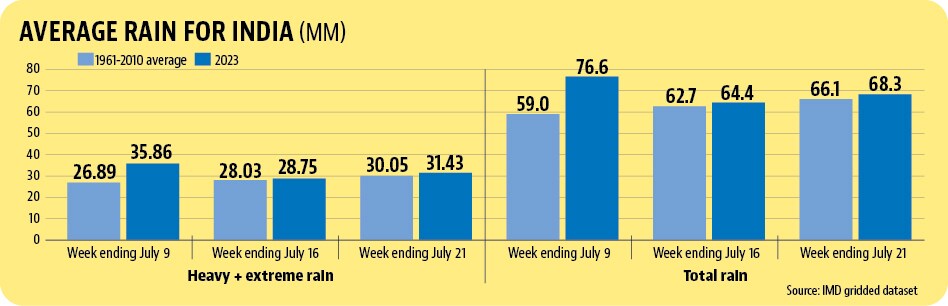
 Week ending July 21 is the third consecutive week to receive surplus rainfall at the national levelAn HT analysis of the India Meteorological Department’s (IMD) gridded dataset shows that the total rainfall in the week ending July 21 – it captures rain till 8.30am on July 21 – was 68.3 mm. This makes the week ending July 21 the third consecutive week to get more than “normal” rainfall, which is the average of rainfall in 1961-2010. To be sure, the amount of surplus rainfall has come down as July has progressed. India received 76.6mm, 64.4mm, and 68.3mm rain in the weeks ending July 9, July 16, and July 21 when the 1961-2010 average for these weeks is 59mm, 62.7mm and 66.1mm respectively. (The overlapping weeks of July 16 and July 21 have been shown in this analysis because July 9 was the rainiest day so far this monsoon.) This has also led to the cumulative surplus rainfall coming down from 5.9% on July 11 (the highest at any point this season) to 4.6% on July 21.
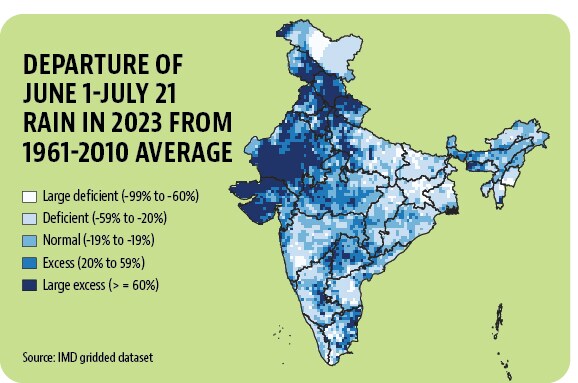
- But the national picture hides large regional variationsWhile the headline cumulative rainfall performance suggests that the monsoon is progressing on normal lines, a region-wise picture suggests otherwise. 34% of the country’s area faces a cumulative deficit of 20% or higher as of July 21, while 37% of the area has received rainfall which is 20% or higher than the 1961-2010 average. Rainfall in July has played a major part in driving this regional disparity. While states such as Uttarakhand and Himachal Pradesh have received excess rainfall to the tune of 67% and 127% in the month so far, Bihar has seen a deficit of 32% compared to the 1961-2010 average.
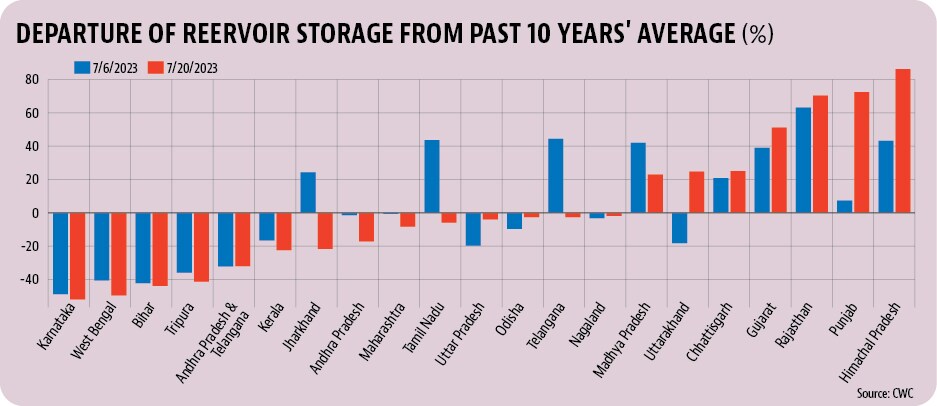
- Which means the reservoir deficit has grown in states with a deficitTwelve states among the 20 for which the Central Water Commission (CWC) tracks reservoir levels had a deficit compared to past 10 years’ average on July 6. Since then, the deficit has improved in only Kerala, Odisha, Nagaland, Uttar Pradesh, and Uttarakhand. In Uttarakhand, reservoirs expectedly turned their 18% deficit on July 6 to a 25% surplus, the only state with a deficit last week to turn a surplus this week. Deficit in the other states has only worsened after regionally skewed rain.
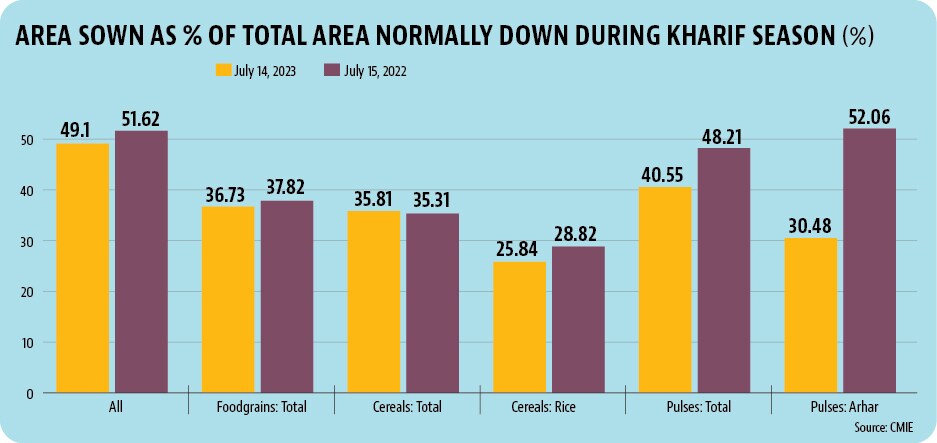
- Sowing also moved closer to averages in the past weekWhether above, close to, or below historical averages, very few places in the country have been absolutely dry in the past couple of weeks: only 0.5% of India in the week ending July 9, and 1.8% and 1.7% in the weeks ending July 16 and July 21 didn’t receive rain. Therefore, sowing has shown progress. The gap with last year’s sowing levels is now narrower for all foodgrain, and cereals and pulses in particular. Arhar (pigeon pea) sowing still lags among pulses, but should improve in the coming days as the major crop-growing states of Bihar, Jharkhand, West Bengal and Uttar Pradesh are expected to receive surplus rain in the first half of August, according to IMD forecasts. Other big crop-growing states are expected to receive normal rain in what remains of July. But the fact that the government has banned the export of non-basmati rice suggests that it is expecting some sort of disruption to normal cultivation for the most critical kharif crop.