
 E-Paper



Centre files review plea over SC order on services in Delhi
The decision granting Delhi government control over services has the effect of destroying the basic structure of the Constitution, the Centre has contended.

 Prefer HTon Google


The decision granting Delhi government control over services has the effect of destroying the basic structure of the Constitution, the Union government has contended in its petition for the Supreme Court to review a ruling on May 11, which it said amounts to giving the national Capital the status of a full-fledged state.
Also Read | Explained: Ordinance must pass test of legislative competence
Filing a 63-page review petition late on Friday — hours after it issued an ordinance virtually negating the May 11 verdict — the government highlighted 68 “errors” in the judgment and faulted the five-judge bench decision for not considering whether the matter should be sent to a larger nine-judge bench.
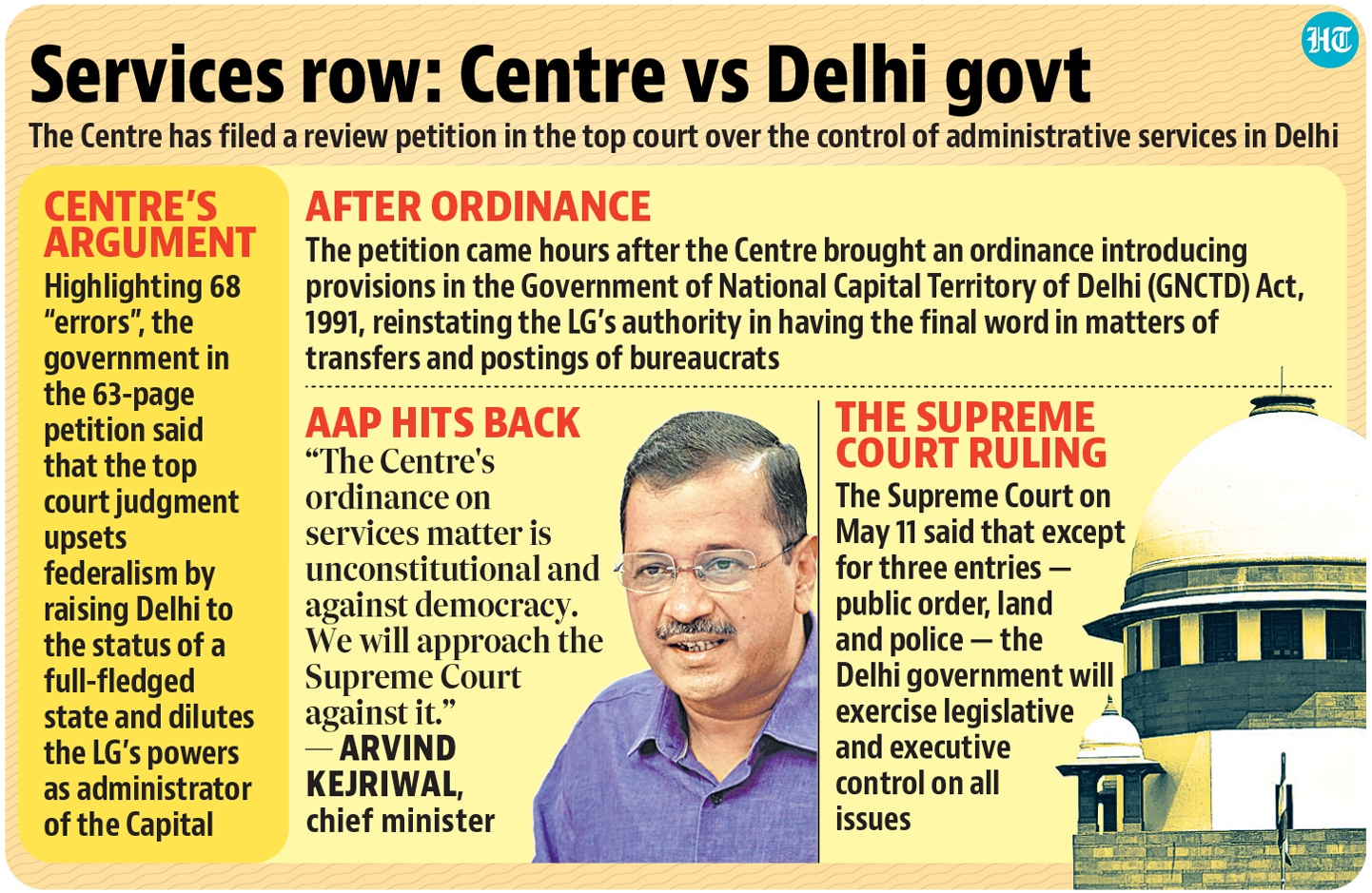
Seeking an open court hearing to put forth the arguments, the Centre said the judgment has led to an “anomalous” situation where on one hand, the State List (List II) and Concurrent List (List III) are both concurrent in the case of Delhi because the Union government can legislate over any of the subjects, the Delhi government shall exercise legislative and co-extensive executive power over all entries other than three (land, police and public order), it said.
“The judgment dated May 11 rendered by the Constitution Bench suffers from an error apparent on the face of the record, in as much as despite accomplishing the status of national capital territory of Delhi (NCTD) as a Union Territory, the same effectively elevates it to the status of a full-fledged state by giving legislative competence over all entries in List II and List III to its legislative assembly, irrespective of whether an entry is otherwise applicable to a Union Territory,” it said.
Also Read | Kejriwal reveals strategy on ordinance row: ‘It is Supreme Court vs Centre’
While the decision said the elected government of NCTD should be given full expression, the review plea pointed out that L-G, being the nominee of the President and the Central government, is also “manifestation of democracy” who exhibits the democratic conscience of the country as a whole when compared to the elected government of Delhi.
The May 11 ruling came after a years-long bruising fight between the Union government, controlled by the Bharatiya Janata Party (BJP), and the elected Delhi government, controlled by the Aam Aadmi Party (AAP). Just as it seemed to have laid the confrontation to rest, the Union government on Friday released an executive order.
The Supreme Court, in its ruling, restored to itself the power over bureaucratic postings via a raft of amendments in the Government of National Capital Territory of Delhi (GNCTD) Act, 1991. The ordinance strengthened the position of the Lieutenant Governor (LG), making him the final authority who can act in his “sole discretion” in deciding the matters relating to transfer and posting of bureaucrats, and introduced a new chapter to create a National Capital Civil Service Authority (NCCSA) and a public service commission for transfers and postings of the officers serving in the affairs of the Delhi government.
Also Read | ‘Delhi govt began flexing’: BJP on why Centre issued ordinance
This came after the Supreme Court’s order on May 11 held Delhi to be at an elevated position with respect to other Union territories, especially since it has a legislative assembly. “The members of the legislative assembly have been chosen by the electorate to act in their stead. Thus, the legislative competence of NCTD must be interpreted to give full impetus to the will of the electorate,” it had said, noting that “The Union and NCTD share a unique federal relationship. It does not mean that NCTD is subsumed in the unit of the Union merely because it is not a State.”
The Union government said the decision has “upset the basic tenets of the constitutional idea of federalism, inasmuch as the NCTD has been equated to a state, by granting it legislative and executive authority akin to a State, leaving the Parliament with recourse only to its plenary powers to legislate for a territory...”
The anomaly, the petition added, exists as under Article 239AA that “the Parliament undeniably enjoys legislative supremacy, yet the council of ministers of GNCTD would now enjoy executive supremacy, which effectively means that as regards executive powers, Delhi, despite being a Union Territory, and thus not a full-fledged State, has been elevated to the status of a State.”
Also Read | Centre's ordinance to regain govt control adds twist to day of drama in Delhi
The Centre noted a further “fundamental fallacy” that the working and functioning of the Capital’s government affects the nation as a whole.
Since review of a judgment requires the Court to consider whether there is any “error apparent” on the face of the record or grave injustice being caused due to its decision, the Centre pointed towards this “inherent irreconcilable contradictions” in the judgment creating an error apparent requiring reconsideration.
The Centre claimed that such an interpretation by the Court went contrary to a nine-judge judgment in NDMC vs State of Punjab (1996) which held that introduction of Article 239AA does not elevate Delhi to the status of a state and Parliament alone can legislate for union territories. For this reason, the Centre sought reference to a nine-judge bench. The Centre had also filed an application in this regard and even argued it before the five-judge bench.
Also Read | Delhi ordinance act of bad, poor, graceless loser: Advocate Abhishek Singhvi
The petition said that the Constitution bench rendered its decision without considering this application and this amounts to an “error apparent on the face of the record”, meriting review of the judgment.
It further said, “unless the anomalies as pointed out above, are harmonised by a bench of a competent strength (of nine judges), the issue cannot be conclusively adjudicated.”
The Union government further stated that the judgment under review “substantially dilutes” the powers of Lieutenant Governor as administrator of Delhi. The petition said that the judgment “extinguishes his role as an ‘administrator’ in respect of subjects other than those covered under Entries 1, 2, and 18 of List II (public order, land, police), which in effect takes away the authority of the President to administer a Union Territory and virtually renders Article 239 otiose.”
Further, the plea said that subjecting L-G to act by the aid and advice of the Council of Ministers on all entries in List II and List III has resulted in “eroding the constitutional office of the L-G” who acts as a delegate of President of India by virtue of Article 239.
The decision of May 11 was pronounced by a bench of Chief Justice of India (CJI) Dhananjaya Y Chandrachud, justices MR Shah (since retired), Krishna Murari, Hima Kohli and PS Narasimha after the same was referred to it by a three-judge bench in May 2022. The issue arose for consideration as Delhi government challenged a May 2015 notification issued by ministry of home affairs taking away services from the legislative scope of Delhi assembly.
The petition, while challenging the judgment on several other grounds, questioned the conclusion of the Constitution bench in deciding Delhi to have control over “state services” under Entry 41 of List II despite being a Union territory. The Centre argued that while dealing with scope of Entry 41, the bench did not consider the scope of Entry 70 under List I dealing with Union public services.
The Centre also claimed that the Constitution bench did not consider the Balkrishnan Committee report that formed the basis for Parliament to introduce Article 239AA in 1991. “The judgment fails to take into consideration the submissions made by the review petitioner with regard to the importance and relevance of the Balakrishnan Committee Report.”
The Balakrishnan committee report formed the basis for introducing Article 239AA in the Constitution in 1991 giving special status to Delhi.
Further, it argued, that the five-judge bench also failed to consider another Constitution bench decision of 2018 (also by five judges) in Bir Singh v Jal Board that held that services created for administration of NCTD are central civil services.


