
 E-Paper



UP carpet factory owners disgruntled as relaxations come with conditions, refuse to open units
India exports carpets worth about Rs 12,000 crore annually. Eastern UP’s Bhadohi district alone accounts for Rs 7,000 crore of the exports, according to Carpet Export Promotion Council India (CEPC) data.


To help states grapple with the economic impact of the coronavirus outbreak, the centre had announced that certain industries would be allowed to function starting April 20. Uttar Pradesh allowed 11 types of industries, including paper, sugar mills, cement, fertilisers, among others to start operations. The carpet industry was another.
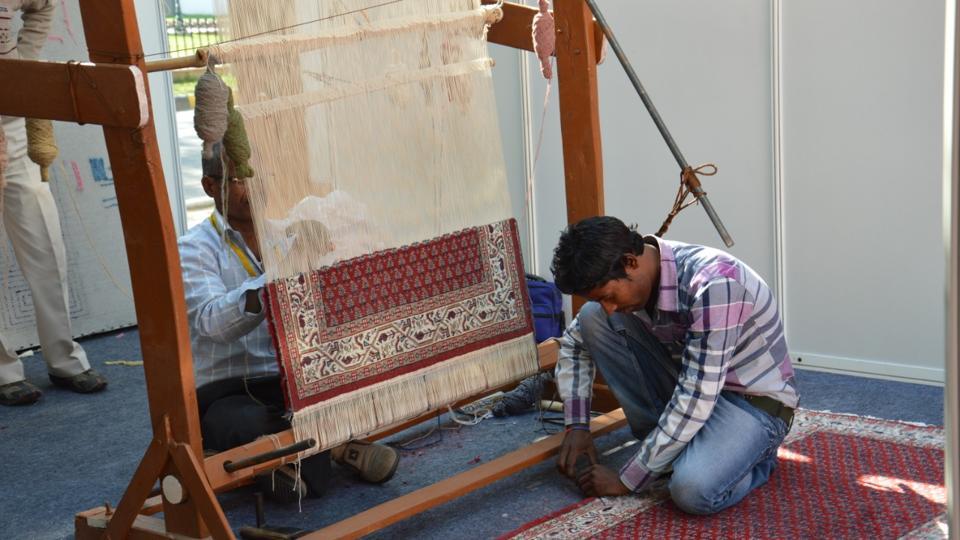
India exports carpets worth about Rs 12,000 crore annually. Eastern UP’s Bhadohi district alone accounts for Rs 7,000 crore of the exports, according to Carpet Export Promotion Council India (CEPC) data.
However, carpet manufacturers in the district are disgruntled because the relaxation of the curbs has come with conditions which they said were not feasible. At least 40 carpet manufacturers and factory owners, who attended a meeting with district authorities on April 20 have unanimously decided not to begin operations despite the financial losses they are incurring during the lockdown, as the authorities have asked them to provide accommodation to workers inside factory premises. This is not possible, they said, as factories have not been designed for residential purposes and they would not be able to guarantee that the coronavirus would not spread in such makeshift accommodations.
The Bhadohi district administration on Monday held a meeting with the members of All India Carpet Manufacturers Association (AICMA) and CEPC to give them permission to open the factories starting April 21 as long as certain conditions were fulfilled.
The administration asked factory owners to screen workers, make sure they wore masks and maintained social distance, and significantly only employ those workers who didn’t live near Covid-19 hotspots. The authorities also asked factory owners to ensure that the workers are provided accommodation within factories.
“In a meeting on Monday, the carpet manufacturers and owners of carpet factories were apprised of the guidelines and instructions required to be followed by them. They have been allowed to operate the factories with certain conditions as per instructions from the government,” Deputy commissioner industries, Bhadohi, Harendra Pratap Singh confirmed.
According to AICMA executive member and former honorary secretary Piyush Barnwal, not all conditions are practical, which is why the owners have decided not to reopen the factories as long as the lockdown continues.
“The administration has imposed many conditions and it is not possible for us to implement them practically. Therefore, we have decided to not run our factories and start production till the lockdown is over,” he said.
According to some owners, factories cannot be converted into proper residential facilities due to a lack of space and the existing design. Barnwal said that in most factories, it would not be possible to keep even 50% of the workers together on the premises, and the possibility of spread of Sars-Cov-2 could not be ruled out.
Bhadohi district has one case of a Covid-19 patient: an 18-year-old migrant worker in a makeshift shelter home at a college tested positive on April 12. He was later shifted to an isolation ward where he is under treatment.
Imtiyaz Ahmad, owner of Textico, a carpet manufacturing and export unit based in Bhadohi said he would not open his factory for the same reason. “The government should ease the conditions,” he said.
Another factory owner, who doesn’t wish to be named said that while it is possible to screen workers, it is difficult to find out which area they have visited or whom they met in the past 15 days.
Rajkumar (who goes by his first name), a carpet weaver who lives in the outskirts of Bhadohi said that it would be difficult for weavers like him to live in factories at this time, as this was the harvesting season.
The carpet industry provides employment to 2 million persons nationwide. A majority of them, like Rajkumar, belong to the unorganized sector. In UP, for instance, the industry provided employment to the people largely in rural pockets of Mirzapur, Bhadohi and Varanasi. After the carpets are woven — usually at home, women comprise a large section of the weavers — they are carried to factories, where they are washed, stretched, bound and made ready for shipment.
The Indian floor coverings industry, which includes the carpet manufacturing hub in and around Bhadohi is already staring at heavy losses as at least 40% international orders have been cancelled in past three months due to uncertainty in the international market caused by the pandemic, said CEPC chairman Siddh Nath Singh.
With the lockdown in place, existing orders have been on hold for the past month. “Around 60% orders are on hold. Of these around 2/5th are at the ports awaiting shipment and one fifth is held up in godowns due to lack of transportation. Uncertainty looms large over these orders too,” Singh said.
Even if the manufacturers begin production of the carpets, Singh feared that it would be difficult to get export orders from the United States of America and the European market comprising Italy, Germany, France and Spain — both of which form the bulk of our export market at 55% and 25% respectively.


