
 E-Paper



UP elections: BJP banks on Jan Vishwas Yatra to retain state
The BJP which has relied heavily on rallies and big gatherings for public outreach ahead of elections, is hopeful that its performance in UP will benefit from its recently concluded Jan Vishwas Yatra.

 Prefer HTon Google


The Bharatiya Janata Party (BJP), which has relied heavily on rallies and big gatherings for public outreach ahead of elections, is hopeful that its performance in Uttar Pradesh will benefit from its recently concluded Jan Vishwas Yatra, just as the Parivartan Yatra of 2016 helped its performance in the state during the last election.
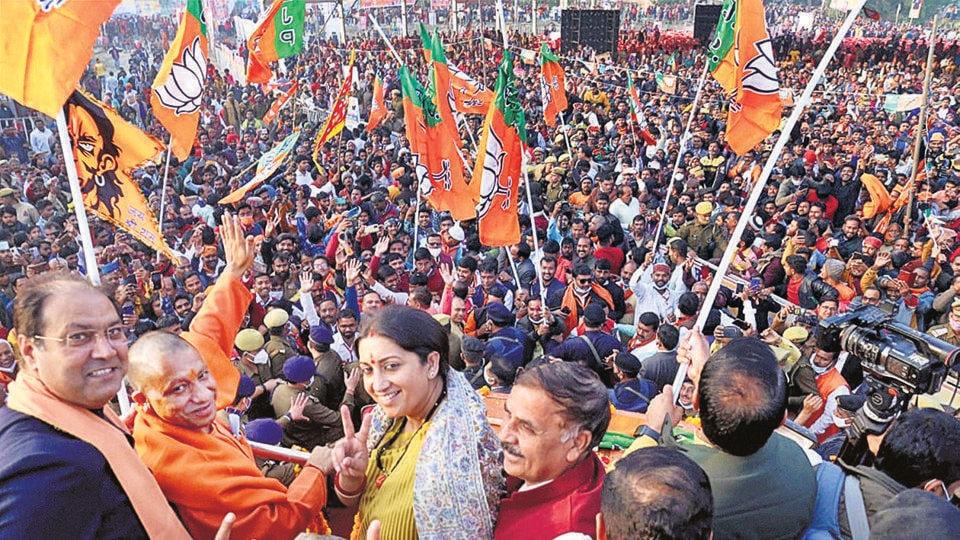
The Jan Vishwas Yatra that started on December 19 and concluded on January 3, covering 381 of the 403 assembly constituencies and featuring 43 big rallies, was the last big-ticket outreach programme that the party could organise before the election commission’s rules forbidding large gatherings in election-bound states till January 15, came into force.
Announcing the poll schedule on Saturday, the poll panel said in view of the raging pandemic, political parties would be barred from holding rallies and public programmes that will lead to people congregating in large numbers. It is likely that this moratorium could continue, with Covid-19 cases continuing to rise around the country.
“With this yatra, we communicated the exceptional work done by our ‘Double Engine Sarkar’. People of the state expressed their faith in the BJP by participating in the yatra in large numbers with enthusiasm. The success of Jan Vishwas Yatra is a clear indication that the faith that people have in the honest and decisive leadership of Narendra Modi and Yogi Adityanath Ji is not just intact, but has only grown over the past years,” said BJP’s UP unit president Swatantra Dev Singh, emphasizing the advantages of the same party being in power in the state and the Centre.
Rallies and yatras have been the BJP’s strong suit. Leaders who spoke to HT said rallies as tools of mobilizing public support and conveying the party’s stance on political and strategic issues have been preferred since the days of the Jan Sangh, the precursor to the BJP.
“Rallies and yatras themed around issues have always worked to the advantage of the BJP. The party uses the outreach to connect to the people, pick up the sentiment on the ground and lay bare the failures of our opponents. This method was introduced to the party by the Sangh (the RSS), taken forward by (LK) Advani and has been scaled up by Prime Minister (Narendra) Modi,” said a senior party functionary who has been involved in several such outreach programmes.
Rallies bear results
The functionary said rallies specifically designed for electioneering have borne rich rewards.
“When the Parivartan Yatra was proposed the BJP had been out of power for decades in UP. The party carefully picked themes on which it attacked the Samajwadi Party (SP) that was in power and highlighted the failures and unmet promises. The 49-day yatra covered 17,000 km and passed through all 403 assembly seats with senior leaders addressing 26 big rallies. It helped establish a connection between the people of UP and the party,” added this person.
To be sure, the BJP reinforces its rallies with an energetic digital campaign and a well-executed last-mile booth-management strategy.
In 2017, all these, in addition to other factors including the popularity of Modi and the anti-incumbency against the SP, helped the party improve its tally and vote share. The party won 312 of the 403 seats up from 2012’s 47 and its vote share went up to 39.67% from 15%.
The correlation between the success of a yatra with electoral outcome was mapped post the Rath Yatra of 1990, said a second functionary. “In 1989 when the BJP passed a resolution for the construction of the Ram temple in Palampur, Advaniji planned the Rath Yatra which started from Somnath in Gujarat in 1990 to Ayodhya in Uttar Pradesh. After the yatra ended the BJP had established its political might and carved out more space for itself in Parliament. In the 1991 Lok Sabha election, BJP emerged as the main opposition party with over 120 seats (it won 85 seats in the 1989 polls). The party’s vote share also nearly doubled from 11.36% in 1989 to 20.11%,” the second functionary added.
In Uttar Pradesh too, the BJP’s performance in the 1991 assembly polls showed marked improvement. It won 221 seats up from 57 in 1989 elections and more than doubled its vote share from 11.61% to 31.45% ; Kalyan Singh was sworn in as chief minister.
In states where the BJP stakes claim to form government it organises Parivartan Yatras, as was done in Rajasthan and more recently in West Bengal; and in states where it contests to retain power, theyatras are organised as a show of strength and for showcasing the achievement, for instance the Gujarat Gaurav Yatra of 2017.
National issues
Yatras pivoted around issues of national security, nationalism and other ideological considerations of the BJP have also contributed to the party’s success.
The 47-day Ekta Yatra helmed by party patriarch and former minister Murli Manohar Joshi that culminated in Srinagar with unfurling the Tricolour in Lal Chowk in 1991, when terrorism raged in Jammu and Kashmir helped the BJP’s cause (it wasn’t the only factor, though) in Gujarat, Bihar and Maharashtra that went on to pick on new assemblies soon after.
“In Maharashtra the BJP won 65 seats, up from 42 in the previous election; in Bihar 141 seats with 12.96% votes against 39 seats and 11.61% votes, and in Gujarat it won with an absolute majority of 121 seats and 42.5% votes,” said a third leader.
While the focus on rallies continued during the 2014 and 2019 general elections with Narendra Modi addressing hundreds of rallies, the party also planned yatras after coming to power at the centre.
To increase the membership, the party organised the Sampark Yatra; to showcase the achievements of the government and dissemination of public schemes union ministers were asked to tour across the country and address public meetings. The latest such initiative was the Jan Ashirwad Yatra that saw 39 union ministers travel across 22 states to drive home the message of the Modi government’s policy of inclusivity, demonstrated by picking representatives from different castes and communities for top jobs.
These yatras are also a feedback mechanism. They become a means of gauging public response to policies and government’s performance, said leaders.
Political analysts believe rallies give parties a preview to the mood on the ground. Are huge gatherings relevant in a digitally connected world where news and views are filtered into the living rooms? Gujarat based analyst Shishir Kashikar thinks so.
“They are still relevant,” he said. “For the parties, these become a show of strength and means of connection, especially in semi-urban and rural areas where people still gather to listen to popular leaders.”


