
 E-Paper



US visa rejection to ties with Xi, Modi shares views on key topics
Prime Minister Narendra Modi said that a decision by the US to deny him a visa in 2005 when he was the chief minister of Gujarat was an insult of an elected government, the state and the country


Prime Minister Narendra Modi on Friday said that a decision by the US to deny him a visa in 2005 when he was the chief minister of Gujarat was an insult of an elected government, the state and the country, adding that he was certain at the time that one day, the whole world will be standing in queue to enter India.
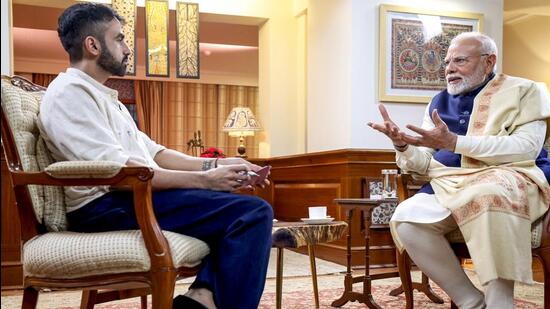
In a two-hour-long podcast with Zerodha founder Nikhil Kamath, Modi spoke about a range of issues -- he said that Chinese premier Xi Jinping had told him about their “special connect”; that Mahatma Gandhi and VD Savarkar may have taken different paths but shared a “common ideology of freedom”; and that his life’s mantra was that ge could make mistakes as a human being, but should never do anything with wrong intentions.
“I was the chief minister of a democratically elected government when the American government refused to give me a visa. As an individual, going to America was not a big thing, I had visited before also; but I felt the disrespect of an elected government, the state and the country.. I was in a dilemma, what was happening? How could it be that some people spread lies and this happened?”
Modi said he held a press conference the same day where he informed the people that the American government had rejected his visa. “I also said that I see an India where the world will stand in queue for a visa. This is my statement in 2005, and today we are standing in 2025. So, I can see that now, the time is of India,” he said.
In the podcast, Modi said it was his life’s mantra that he might make mistakes but would not do anything with bad intentions. “When I became chief minister, I said I will not spare any effort to work hard. I will not do anything for myself. And, I am human and I can make mistakes. But I will not do anything wrong out of bad intentions. I have made it a mantra of my life. Mistakes are inevitable. I must have made mistakes. I am a human too, not a god,” he added.
The PM spoke about the importance of idealism in politics, noting that Mahatma Gandhi and Savarkar charted different paths but their ideology was freedom.
“Idealism is far more important than ideology. Without ideology, politics can’t happen. However, idealism is very much required. Before Independence, the ideology (of freedom fighters) was freedom. Gandhi had a different path, but the ideology was freedom. Savarkar took his own path, but his ideology was freedom,” the PM said.
The comment comes at a time of a fierce debate between the Bharatiya Janata Party and the Congress on the role played by Savarkar in the freedom movement, and his legacy.
He went on to summarise his ideology as “nation first”. “If I have to leave old ideas behind, I am ready to discard them. I am ready to accept new things. but the benchmark should be ‘nation first’. I have only one parameter and I don’t change it,” he said.
Modi elaborated on his relationship with Chinese premier Xi Jinping and unveiled a common connection – the Chinese pilgrim Hiuan Tsang who travelled through India in the seventh century.
“In 2014, when I became the PM, I got courtesy calls from all the world leaders to congratulate me. At that time, Chinese president Xi Jinping called and congratulated me. During the call, he said he wanted to visit India, specifically Gujarat, my village Vadnagar,” said Modi. “I welcomed him.”
“Xi said there is a special connection between us. I asked, What connection?. He replied, the Chinese philosopher Hiuan Tsang spent the longest time in your village. And when he returned to China, he also stayed in my village. So, we both have this connect,” Modi said.
The PM also spoke about how India was perceived globally and the Indian stance of standing for peace amid raging global conflicts. “There is confidence in us, we do not have double standards, during this crisis, we said we are not neutral, we are in favour of peace. I said this to Russia, Ukraine, Iran, Palestine and Israel. They have faith in what I say, that is why India’s credibility has gone up. Indians too know their country will save them, the world too knows we are dependable.”
The PM recalled how India helped evacuate its citizens and those of Pakistan, Nepal and Bangladesh during the global pandemic.
In the podcast, Modi shared details from his early life in Gujarat’s Vadnagar, where he was born and received his education, his political journey from a party worker to prime minister, and his views on politics.
He spoke about his experience and his aspirations as the head of the government. “In the first term, the people were trying to understand me, and I was trying to understand Delhi. In the second term, I used to think from the perspective of the past. In the third term, my thinking has changed, my morale is high, and my dreams have grown. I am only thinking about 2047 and Viksit Bharat,” the PM said.
Modi said his risk-taking capacity was not “fully utilised yet”, and added that while political speeches were a necessity during elections, he’d rather focus attention on administrative issues. “In a democracy, voters are also politicians, they apply their mind on who to vote for. I am not like the so-called politician. I make speeches only during polls, I do not like it, but I have to. Otherwise, my time is focussed on governance, earlier it was on the organisation,” he said.
The PM went on to cite the example of Gandhi and said oratory was not the only way to win the people’s vote. “Communication is more important than bhashankala (art of oratory)... Gandhi ji was frail and his oratory was not much… had a stick taller than him, but was an advocate of ahisma (non- violence). He did not wear a topi (cap), but the world wears a Gandhi cap....he never contested polls, but after his death, that place is known as Raj Ghat,” he said.
Modi went on to say that politics was not only about contesting elections. “Some people are lucky. They don’t have to do anything but they keep getting benefits. I don’t want to get into reasons,” he said in a veiled reference to dynastic politicians.


