
 E-Paper



Uttar Pradesh panel on OBC quota holds meet, says report in 3 months
The newly constituted five-member committee to decide the other backward classes (OBC) reservation in the Uttar Pradesh urban local body elections, on Saturday said it will take at least five to six months to complete the task


Lucknow: The newly constituted five-member committee to decide the other backward classes (OBC) reservation in the Uttar Pradesh urban local body elections, on Saturday said it will take at least five to six months to complete the task.
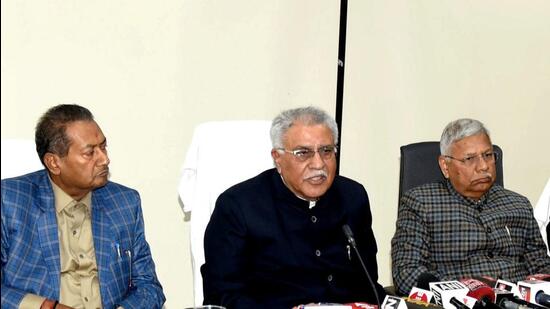
Justice (retd) Ram Avtar Singh, a former Allahabad high court judge, chaired the first meeting of the commission on Saturday, two days after it was constituted by the Yogi Adityanath government.
“We have to submit our report to the government in about three months and the follow up actions would consume another few months. We will consult all those parties and politicians that approach us, try to complete the task quickly but it’s a huge exercise, unlike any before and hence will take time,” the retired judge said in Lucknow.
He added the commission will hold meetings virtually on a daily basis and its members will travel across all 75 districts in the state, meeting stakeholders, including public representatives.
“During our visits, we will collect data with the help of local administrative officials,” he said.
There are apprehensions that the urban body polls might be pushed back until May-June, 2023, even as the Lucknow bench of the Allahabad high court had on December 27 ordered that the state government should notify the polls “immediately” as the term of several municipalities would end by January 31. Chief minister Adityanath and his cabinet colleague Keshav Prasad Maurya, among others, have repeatedly said the polls will not be held until the OBC quota is decided.
The high court had also quashed the government’s December 5 draft notification which provided for reservation of seats in the urban body polls for OBCs apart from those for Scheduled Castes, Scheduled Tribes and women. On December 29, the Uttar Pradesh government moved the Supreme Court challenging the high court’s order.
When asked if the local body polls will be pushed back, the chairman of the commission said: “The government has approached the Supreme Court on the issue. Let us see.”
The Allahabad high court’s order had mirrored similar developments in Maharashtra, Madhya Pradesh and Odisha — the states that tried to institute OBC quotas earlier this year but the judiciary struck down their moves for not adhering to the triple test. The report of a panel set up to decide the OBC quota by the Madhya Pradesh government was later accepted by the court.
“The commission would also study what was done in states like Bihar, Madhya Pradesh, Maharashtra and Karnataka on similar issues,” the retired judge said. “It’s a completely new thing for us. We will take time as there is no precedence. It’s a new thing for us.”
The OBC commission has been constituted in line with the Supreme Court order in 2010, when a constitution bench had laid down a “triple test” for reserving seats in local body polls.
The “triple test” included setting up of a dedicated commission to conduct contemporaneous rigorous empirical inquiry into the nature and implications of the backwardness with respect to local bodies, specifying the proportion of reservation in light of the commission’s proposals, and not exceeding the 50% quota cap as laid down by the top court in a landmark 1992 judgment.


