Chief ministers of southern states on Thursday discussed regional water disputes, parliamentary delimitation demands, and more devolution of funds in proportion to their central tax pool contribution in a regional council meeting chaired by Union home minister Amit Shah.
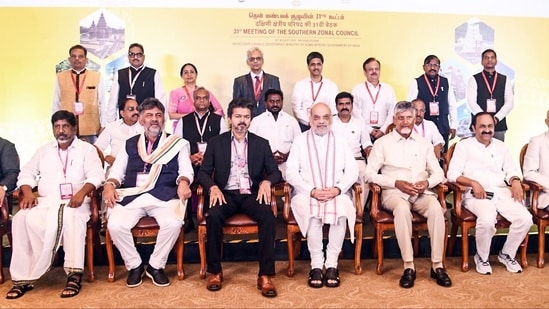
At the 31st meeting of the Southern Zonal Council in Mahabalipuram, Karnataka chief minister DK Shivakumar backed the controversial Mekedatu project, Tamil Nadu CM C Joseph Vijay underlined the rights of lower riparian states, Kerala CM VD Satheesan said his state would fund the Mullaiperiyar dam, Telangana deputy CM Bhatti Vikramarka Mallu called for resolving Krishna river water dispute with Andhra Pradesh, and Andhra Pradesh CM Chandrababu Naidu proposed a Godavari-Cauvery river-linking project.
Shivakumar's request to home minister
Shivakumar also urged the council to adopt a resolution calling upon the Union government to honour the 1971 census as the basis for delimitation, retain the Lok Sabha’s existing strength of 543 seats for the next 25 years, and accommodate women’s reservation within these existing seats – a view the Karnataka chief minister said was supported by Satheesan and Bhatti Vikramarka Mallu. All three states are ruled by the Congress. Vijay urged the Union government to provide a clear legislative assurance that no state will suffer a reduction in its percentage of representation in Parliament.
Deep Dive
What issues were discussed regarding water disputes among southern states at Amit Shah's meeting?
Why did CM Vijay emphasize the need for assurances regarding representation in Parliament during the delimitation discussion?
How did the southern CMs propose to resolve ongoing water sharing issues according to the discussions led by Amit Shah?
Shah said the foundation of India’s progress was development of southern states, which rested on three pillars – high literacy rate, trained manpower and technical expertise in utilisation of the deep sea – while their progress depended on water.
{{/usCountry}}Shah said the foundation of India’s progress was development of southern states, which rested on three pillars – high literacy rate, trained manpower and technical expertise in utilisation of the deep sea – while their progress depended on water.
{{/usCountry}}“We have succeeded in making water-related issues dispute-free across entire North India; we will also have to think afresh on issues of water sharing in South India…If great rivers of India, from Brahmaputra to Cauvery and Godavari, are interconnected, India may not face any water shortage for the next 100 years,” Shah said.
“There is nothing wrong with protecting one’s own state’s interests, but if protecting those interests means that states do not get water for years, then no one’s interests are truly being protected,” he added.
The meeting was attended by Vijay, Naidu, Shivakumar, Satheesan, Puducherry lieutenant governor K Kailashnathan, Andaman and Nicobar Islands lieutenant governor Admiral (retired.) D.K Joshi, Lakshadweep administrator Praful Patel, and Bhatti Vikramarka Mallu. Chief secretaries, advisers and other senior officers of the state governments, as well as senior officers of the central government, also attended the meeting.
“That (delimitation) is the main agenda. I think Tamil Nadu, Kerala, Telangana and myself we all have come to the same agreement, the majority of the southern states.” Shivakumar said.
His comments came against the backdrop of a push by the Union government to pass constitution amendment bills that implement the 33% women’s reservation in state assemblies and the Lok Sabha through delimitation. In April this year, the constitution amendment bill to increase the maximum number of Lok Sabha seats from 550 to 850 and link the women’s quota with the last published census failed to garner the required two-thirds majority.
What Vijay told Amit Shah
Vijay took a relatively softer stance, only asking for the proportion of representation of the southern provinces not to be shrunk – unlike the Congress-ruled states that asked for a freeze.
“Such an approach would uphold the principles of equity, preserve the federal balance envisioned by our Constitution and reinforce the confidence of all states in our democratic institutions,” Vijay said.
Shah said that five out of the eight issues related to river water-sharing in north India were persisting since the pre-British era. “A final agreement was reached five months ago, and by resolving 100% of the issues, spanning from Kashmir to Uttar Pradesh, a dispute-free north India has been achieved,” he said.
He emphasised the need for the early resolution of pending water-related issues concerning southern states, through joint meetings involving the ministry of jal shakti, the ministry of home affairs, the inter-state council, and the respective states.
The southern states agreed with the Home Minister’s suggestion to resolve these pending water disputes expeditiously through mutual dialogue and constructive solutions, the Press Information Bureau said in a statement. “Regarding issues concerning the division of assets and liabilities between Andhra Pradesh and Telangana, both states agreed to resolve these matters in consultation with the ministry of home affairs,” the statement added.
Shivakumar spoke about benefits of the Mekedatu dam – on the Cauvery – for farmers in Tamil Nadu and Puducherry, adding that water sharing should be based on “equity, transparency and cooperation” while protecting Karnataka’s lawful share and the rights of lower riparian states on the Cauvery, Krishna, Tungabhadra, Pennar and Palar rivers.
He also requested the home minister to call a separate meeting to resolve water sharing issues “amicably” and added that he had assured the home minister that except 5 TMC (thousand million cubic feet), all water from Mekedatu will flow into Tamil Nadu. “So, Tamil Nadu and Puducherry will be rest assured and a dam will be built for you and not for us,” he said.
Vijay said that the legitimate rights of lower-riparian states and the livelihoods that depend on assured river flows must be fully protected. “On the Cauvery issue, the timely implementation of the Supreme Court’s judgement and the decisions of the Cauvery Water Management Authority remains essential. On the Mullaiperiyar, the safety must continue to be guided by judicial decisions for increasing the water level to 152 feet. Any upstream intervention with the potential to affect the rightful share of another State must proceed only within this legal and institutional framework,” Vijay said.
Satheesan backs Mullaiperiyar dam project
Satheesan said Mullaiperiyar dam – opposed by Tamil Nadu – would ease water problems in the neighbouring state. “Keralam is willing to provide Tamil Nadu with its full share of water from a new Mullaperiyar dam…Tamil Nadu will manage the design, location and construction of the new dam, while Keralam will bear the entire cost,” he said.
Bhatti Vikramarka Mallu, who attended the meeting as CM Revanth Reddy is in the US, called for resolving Krishna river water dispute with Andhra Pradesh, terming it as its “legitimate entitlements” and the protection of downstream rights through established legal frameworks.
Naidu called for coordinated effort by all southern states to resolve water sharing disputes. He also proposed diversion of over 500 TMC of water through the Godavari-Cauvery river-linking project to Tamil Nadu. He also called for coordinated efforts by Andhra Pradesh, Telangana, Karnataka and Tamil Nadu on the river water issues.
The home minister also spoke about the early disposal of rape and POCSO cases through fast-track special courts, adding that after the introduction of the new criminal laws, many tools became available for accelerating the process.
Shah informed the CMs that the home ministry prepared a three-year road map for the Drug Free India campaign, in which the roles of several departments of the states and the Centre were defined.
Vijay asked the Centre to strengthen the regulatory framework governing the online sale of medicines to effectively address emerging substance abuse among the youth. Satheesan sought more intelligence sharing to crack down on drug syndicates and spoke about the joint efforts of Kerala, Tamil Nadu and Karnataka against drug trafficking.
The CMs also raised the issue of southern states’ significant contribution to India’s growth. Shivakumar said Karnataka was a key driver of India’s growth, contributing 9% of the country’s GDP, with 5.5% of its population, 42% of its software exports and hosting 1,100 Global Capability Centres (GCC). He demanded immediate release of ₹5,495 crore special grant and ₹6,000 crore state-specific grants recommended by the 15th Finance Commission, along with additional central support for projects such as the Bengaluru-Mumbai high speed rail, Satellite Town Ring Road Project, AIIMS at Raichur, among others.
Underlining that the southern states contribute over 30% of India’s GDP, Vijay said, “We are at the forefront of the country’s manufacturing, exports, service and innovation. By addressing our shared challenges and leveraging our collective strengths, we can unlock even greater opportunities.”
Vijay stressed greater flexibility for states in GST-rate determination.
“Such an approach would uphold the principles of equity, preserve the federal balance envisioned by our Constitution, and reinforce the confidence of all states in our democratic institutions,” he said.
Vijay requested the Centre to allow Tamil Nadu to fill all state-quota medical and dental seats based on marks obtained in the Class 12 examinations.
Naidu called for a bullet train corridor connecting Andhra Pradesh, Karnataka and Tamil Nadu through Kuppam, and suggested a transport network connecting Amaravati, Bengaluru and Chennai.
Satheesan said the financial architecture of central schemes was increasingly “inequitable” to states.