
 E-Paper



‘Wearing hijab is an essential part of Islam’: Petitioners in HC
Countering arguments made in the court that hijab is not mandatory in Islam, advocate Dar said hijab is the “last commandment from Allah”.

 Prefer HTon Google


The counsel for the petitioners seeking to wear hijab in educational institutions of Karnataka, on Thursday, argued in the state’s high court that hijab is an essential part of Islam and said public order will not be disturbed merely because a Muslim girl wears the hijab.
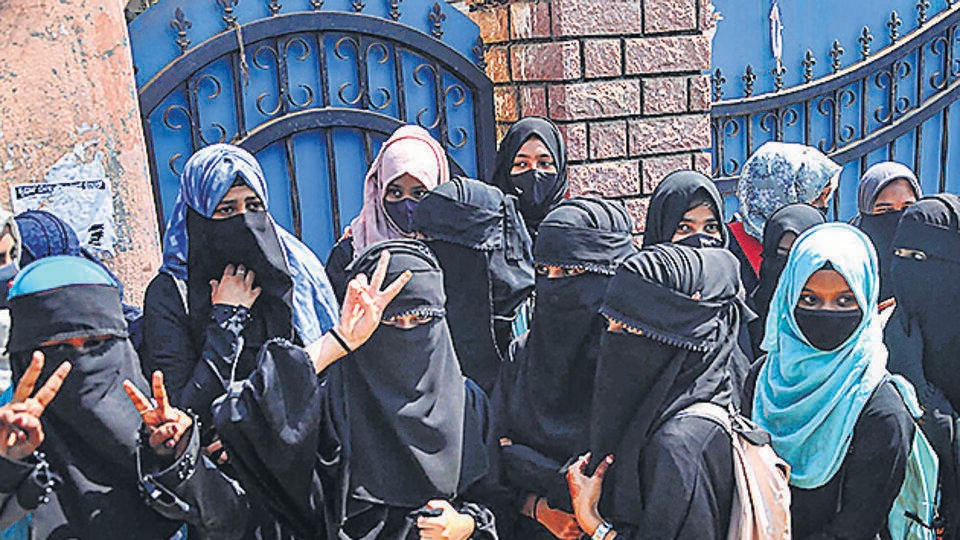
The high court heard the matter for the tenth day on Thursday. The petition was filed by a group of Muslim students from a pre-university college in Udupi who were banned from entering the institution while wearing a hijab.
The issue had snowballed through last month with more institutions across the state banning the hijab and counter-protests by students wearing saffron scarves.
During Thursday’s hearing, counsel for petitioners, senior advocate AM Dar, said: “If someone desecrates the image of Lord Ram or any Hindu goddess, then it is a public order issue. If you desecrate the image of another religion, then it hurts feelings and it can be public order. But simply covering the head; how does it cause a public order issue?,” Dar said. “This is not a Hindu Rashtra or an Islamic republic. It is a democratic, sovereign, secular, republic where rule of law must prevail,” he added.
Countering arguments made in the court that hijab is not mandatory in Islam, advocate Dar said hijab is the “last commandment from Allah”.
“It has come in 4 Hijri, by the time Quran was complete,” he added.
“First commandment from Allah is daily five prayers. It is a different thing if every Muslim follows it. The second is zakat. If Muslim persons are rich, then they can give zakat. The third is ruling on inheritance. It is defined in Quran and it is obligatory. Fourth is fasting,” Dar said, adding that the fifth is Haj.
“Hijab word is not there in Quran: The term refers to partition, in the literal meaning it is some kind of partition. Hijab is mandatory. Even the wives of prophet would wear it. I will read the suras,” Dar said.
Addressing justice JM Khazi, who is one of the three judges of the full bench hearing the case, Dar said, “Your ladyship will be in a position to understand”, as he cited verse in Arabic.
“...When the prophet was spreading Islam, one of the communities from Indonesia, which was a Hindu country, said we will accept provided we can keep our Kundan. See the generosity of the Prophet, Prophet allowed it, allowed them to keep their essential religious practice,” the advocate said.
Senior advocate Devadatt Kamat questioned the validity of the government order (GO) issued by the Karnataka government banning the hijab. Kamat was making the rejoinder submissions before the bench comprising chief justice Ritu Raj Awasthi, justice Krishna S Dixit and justice JM Khazi after the advocate general argued on behalf of the state.
Before challenging the GO, Kamat pointed out that the AG failed to give a rebuttal to the plea from the student that they have been using a headscarf right from our admission and till the GO came.
Taking on the GO, he said, “AG has clearly said that the three judgments relied by GO on hijab are not the purport of the order. He said it might have been a result of over-enthusiasm by drafters and it might not have been required... and this part of the GO has to go,” he pointed out.
In the February 5, the government order (GO), before the operative order, a paragraph was added, which claimed that banning of hijab will not violate Article 25, after referring to a few high court and Supreme Court judgments. When the Bench inquired on these aspects, the AG had conceded that the draftsman was ‘enthusiastic’ and conceded that the reference in the GO relating to restrictions on hijab, ‘could have been avoided’.
In his context, Kamat argued that if the judgments mentioned in the GO are irrelevant, how does the GO arrive at the conclusion that the hijab is not a part of fundamental rights.
“I have sought for quashing of the GO and for allowing the petitioners to wear… Much of my task as far as this GO is concerned has become very easy because 90% of GO has been given up by the AG. Learned AG in all fairness on the first day of opening has clearly said that this is not the purport of the order. He has said that it could be the result of over-enthusiasm and he has said it may be not required,” Kamat pointed out.


