Under big yellow block lettering, a group of men lumber around a shed next to a blue ice cream freezer and orange campaign posters bearing the lotus emblem. Behind them is the exposed engine of a lorry, framed by half-raised yellow shutters and contact numbers. Raw concrete pillars and scaffolding support an unplastered second storey. Below, broad bands of saffron, white, and green cover the ground floor. Small saffron flags hang from the railing, echoing the lotus motif.
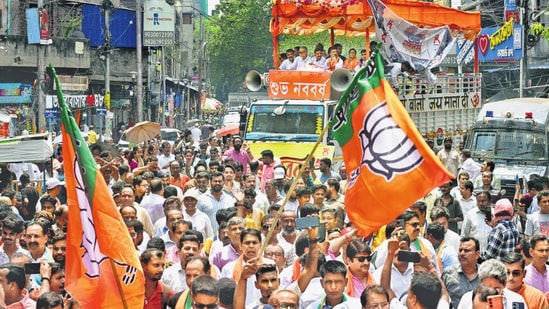
Off Diamond Harbour Road near the southernmost tip of Bengal, the venue for the gathering one scorching July morning might be humble, but the purpose is anything but. Around 200 people, mandal and block-level spokespersons and leaders of the Bharatiya Janata Party (BJP), have gathered for a daylong session. The Pandit Deendayal Upadhyay Prasikhsan Maha Abhiyan 2026 is running such workshops in every block in West Bengal, especially where the BJP barely had a presence before this summer’s assembly elections.
The anchor is a 54-page booklet, printed by the BJP in Delhi, seen by HT, and translated into regional languages nationwide – Bengali here. Old-time BJP workers, fresh recruits, 20-something men with smartphones, women self-help leaders, panchayat turncoats and schoolteachers jostle for space as state-level leaders instruct them on social media campaigns, signature drives, membership logs and monthly programmes. In hour-long sessions, attendees learn how to expand booth presence, whom to target for recruitment – new voters, rickshaw pullers, daily labourers, hawkers, working women – how to field tough questions on corruption, what to post online, and how long a reel should run.
“Those who receive the training here will return to their zones and hold mandal-wise camps for booth presidents and other ground level leaders,” said Soumen Patra, a BJP leader from Diamond Harbour. “The target is that outsiders and TMC elements cannot infiltrate our ranks and claim to be our workers.”
{{/usCountry}}“Those who receive the training here will return to their zones and hold mandal-wise camps for booth presidents and other ground level leaders,” said Soumen Patra, a BJP leader from Diamond Harbour. “The target is that outsiders and TMC elements cannot infiltrate our ranks and claim to be our workers.”
{{/usCountry}}It is a mission the BJP has only partly succeeded at. Days after sweeping to power, the party declared it would not allow indiscriminate new membership, an attempt to firewall itself against an avalanche of former Trinamool Congress leaders. Yet on the streets, in auto stands and rickshaw unions, college politics, Durga Puja committees and Bengali cinema unions, men and women have swapped the TMC’s twin flowers for the saffron flag overnight, trying to rule their petty fiefs with the same iron hand.
Also Read I ‘Pleaded with her’: Amit Shah slams Mamata Banerjee over border land delay
What is happening on the other side is unprecedented in independent India’s history. The Opposition is splintered into three groups – 20 former TMC parliamentarians who have joined the little-known Nationalist Citizens Party of India, another 62 TMC legislators who have formed a separate grouping, and a hapless Mamata Banerjee trying to keep her flock together but aware that her still-considerable popularity isn’t enough to win new followers yet. At least 90 former TMC lawmakers and panchayat leaders, Banerjee among them, have had eggs and mud hurled at them since the election.
Under the weight of expectation after a historic victory, the BJP has charted a careful course, with chief minister Suvendu Adhikari underlining transparency and industrialisation – areas where his predecessor slipped. But in a state where the party system – under the Left for 34 years, then TMC for 15 – has percolated into everyday life and every arm of government, the party is attempting to assert the supremacy of government instead, 100 days in. And in this churn, this has also reshaped what words like Hindu, refugee and citizenship mean for the state. HT takes stock.
Falta’s fallen strongman
A black SUV, its windows shattered, stands outside a hulking white two-storey compound beside a pond, its surface a blanket of green algae. The plastered walls of the house are shorn of paint, the iron gate mutilated, long scorch marks bearing scars of repeated mob outrage. Pasted next to the gate is a West Bengal State Electricity Distribution Co Ltd notice claiming a pending bill of ₹3,23,956.
This is the house of Jahangir Khan, a former strongman of the TMC in Falta’s Srirampur village, around 50km south of Kolkata. “Both Khan and his wife Regina Bibi have been arrested; their two sons have fled and the house is now under lock and key,” said Imtiyaz Ali, a neighbour.
The house towers above the modest hutments and one-storey dwellings around it, expanding in fits and bursts – in tandem with Khan’s swelling power over the past decade. “He was just the son of a small local businessman but he had the blessings of the almighty number 2,” said a neighbour, referring to TMC general secretary Abhishek Banerjee.
Khan’s fief represented what scholar Dwaipayan Bhattacharya called party society, the party organisation woven into the texture of everyday life in Bengal. No place exemplifies this more than the former industrial hub of Falta, which changed hands from the Left Front to the TMC in 2011.
Ringed by rice fields on the banks of the Hoogly, the region’s roughly 220,000 residents saw everyday life shaped by the diktat of the local TMC office; those who aligned with Khan and his gang were rewarded with welfare schemes, cash doles, prime stall locations, a compliant police force, easy access to open new organisations or register businesses with dubious documents, and seats on plum quasi-government committees and Durga Puja organisations.
“Khan’s boys ran youth clubs that held blood donation camps, sports meets, and wedding bookings. Anyone building a house or repairing a wall had to purchase sand, bricks and cement from Khan-approved outlets. If someone brought outside materials, local party youth stopped the trucks or levied a fee,” said local resident Sreelata Haldar.
Penalties were reserved for those who wouldn’t fly the twin-flower flag or offer their walls for electioneering, or who approached the police instead of the party office. A senior police official admitted, on condition of anonymity, that before the May 4 results, the local station would largely ignore complaints against TMC-linked people or refer them to the party office informally.
Also Read I Bengal court issues arrest warrant against TMC MP Mahua Moitra in hate speech case
Many villagers – especially Khan’s erstwhile neighbours – refused to speak openly, aware of recriminations and alert that many former TMC associates were already crossing the ideological divide.
“This is a place where operating a toto [e-rickshaw] would need the driver to pay line money to the party union and roadside hawkers had to pay fees to the party samiti for permission to stand on the road or footpath. You think it’ll evaporate in two months?” asked an elderly man.
Left leader Sambhu Nath Kurmi, who came second in the Falta bypoll, agreed.
“There was no law and order. Whether the police or the DM, BDO, it was under Khan’s control. Things have changed now. But all grassroots TMC boys lined up to go to the BJP overnight. Does the BJP have booth workers here? All protests against TMC here are done by the new BJP men,” he said.
The former TMC fortress – the pinnacle of Abhishek Banerjee’s so-called Diamond Harbour model – is turning saffron. Most TMC leaders are in hiding or arrested. BJP flags flutter along the highway; banners of Suvendu Adhikari, Narendra Modi and Amit Shah line the road. The TMC party office has been ransacked and set ablaze more than once, leaving behind charred flags and banners.
“More than 100 TMC leaders and workers in Falta have been arrested since the results on charges of extortion, cheating, fraud, intimidating villagers and the 2021 post-poll clashes. Many have gone into hiding,” said a police officer.
A little-known party
Two lanes off the Calcutta high court stands an imposing but shabby 19th century building, its interior a maze of tiny, windowless single-desk cubicles partitioned with plywood, tin and faded wooden screens. Soot-stained walls, peeling plaster, creaky staircases, piled garbage and dangling wires fill this, home to hundreds of practising lawyers. One of them, however, is also the founder of what might become India’s fifth-largest political party by parliamentary strength.
Shewly Kundu, 39, grew up in a hamlet in border district Nadia and completed her LLB after marrying social worker Uttiya Kundu. “We didn’t have much but both my brother and I were studious. My uncle was in the RSS and father in the local BJP so we had that connect from childhood,” she said.
She began her practice in 2022, two years after her law degree. On October 13 that year, she took out an ad in newspapers, according to the requirements for registering as a recognised unregistered political party. The office of NCPI was listed at Hatgacha village in Howrah district, Saikat Das – software engineer-turned-businessman – as general secretary, and Sudam Jetty – an electronics trader – as treasurer.
In 2022-23, NCPI received ₹1,13,075 in “donations from well-wishers”. Its expenditure was almost identical, ₹1.135 lakh, including ₹49,400 on the 2023 Tripura assembly polls, per ECI records. Among the nine contributors were Kundu and vice-president Uttiya Kundu, who gave ₹15,000 and ₹18,000 respectively. The party closed the year with a balance of ₹75. No report was found for 2023-24 and 2024-25.
“We started building our social organisation around 2020. From my own funds, we built a self-help group of around 1 lakh women in Sankrail, distributed sarees and helped them get jobs,” she said.
The party’s first electoral foray was bumpy. In Tripura, the party fielded three candidates in the assembly elections. The most votes went to Chawamanu candidate Barjeda Tripura, who polled 536 votes, narrowly beating NOTA. Kundu claimed her party wasn’t allowed to field candidates in the 2023 Bengal local polls in Sankrail and Nadia.
“It was only after the state panchayat polls in 2023 that we decided to lend our full support to the BJP. We campaigned all out, organising meetings door-to-door. Many of our members had BJP-RSS backgrounds,” she said.
An NCPI leader said the party had been in touch with central and state BJP leaders since 2024, though the TMC dismissed it as small fry. “But the coordination with the BJP grew as 2026 came closer. We were part of the RSS groundwork. It is on the instructions of the BJP that Kundu resigned in June before the TMC MPs jumped ship. Many meetings happened before that,” said this leader, requesting anonymity.
Despite bursting onto the national stage two months ago, NCPI remains shrouded in mystery. Dey says Kundu never consulted him on the new joinees; Kundu says Dey never took primary membership. Kakoli Ghosh Dastidar announced in July that Jyotiprakash Chatterjee would be the new NCPI chief, but he hasn’t made a public appearance since. It remains unclear what NCPI’s plans are.
“It is not just MPs but even legislators and councillors who are in touch with us. BJP leaders from Delhi and the rebel TMC MPs are in constant touch with us. There will be more surprises in the future,” said the NCPI leader cited above.
The biggest mystery is Kundu’s elusive husband, a self-described Bengali newspaper editor, owner, publisher, mathematics teacher, motivational speaker, auditor, health consultant and yoga volunteer. His stated qualifications include an “MSc in Mathematics” along with diplomas in yoga, technical courses and land surveying.
A narrow unpaved bylane in Howrah’s Sankrail town, around 20 km from Kolkata, leads to a two-storey house painted green and saffron, with an unkempt garden. This is the registered address of both NCPI and Uttiya’s newspaper, Jago Biswa. Uttiya – who remains vice-president of NCPI – has stayed away from the media; his social media posting is prolific.
“I am not stone but water,
I stay as I am placed.
I don’t break—I adapt,” is his descriptor on Facebook.
Also Read I 100 Days of Change in West Bengal
Many of his posts riff on bite-sized philosophy – be simple, not cheap – but he has prominently posted photographs with Adhikari, and criticism of Banerjee. His most popular posts, though, are on love, pain, anger, and the frailty of human nature, each accompanied by an AI-generated poster of himself.
“In days of joy, the world is bright,
With friends around in golden light.
But hidden then, it stays away,
Waiting for a darker day.
When shadows fall and crowds depart,
And loneliness surrounds your heart,
No hand is there to hold you tight,
Through the silence of the night.
Yet gently falling down your cheek,
It speaks the words you cannot speak.
The truest friend that will appear,
Is nothing but your silent tear.”
Grassroots churn
For more than half a century, Bengal’s politics has identified itself in opposition to the national mainstream, depriving the state’s ruler of central patronage and revenue. In a populous, largely rural state with few potent axes of mobilisation, the Left made land and resource distribution its emotive issue, using rural units as instruments of control – not just for elections but everyday life and sociocultural goals. Panchayat bodies were up and running decades before the 1993 reforms that operationalised panchayati raj nationwide, and the Left used that head start to entrench its hold over the electorate. As Bengal sank into financial quicksand, these bodies grew more important in distributing largesse and securing votes. Holding the countryside laid the foundation for power. When the Left wobbled after Singur and Nandigram, it lost the panchayats first.
When Banerjee swept to power in 2011, the Left’s iron grip gave way to her personal popularity as the new glue. Left-era goons and strongmen morphed into middlemen for builders, contractors, transporters and fishery owners, coalescing around Banerjee’s brand and using extortion to grease a financial machinery that shielded them from the law – an arrangement Bhattacharya calls franchisee politics. By the evening of May 4, this model was coming apart.
Near Gariahat in south Kolkata, Bablu Mondal had taken the twin-flower flag off his auto and stand, replacing it with a saffron flag. “We couldn’t get a BJP flag because they were all sold out. We put a plain flag in the evening and changed it the next day,” he said. “Our union leader also switched sides because his dada, the councillor, left TMC.”
Having burnt its fingers with TMC turncoats in 2021, the BJP was quick to say its doors were closed to new entrants from the party. But that hasn’t stopped the migration of grassroots operatives – bus unions, conductors, auto, taxi and rickshaw operators, mill and factory workers, tea garden and coal belt unions, railway workers and porter unions, and contract worker groups. Across Kolkata, stands now display the BJP flag and many men continue to run petty local rackets, extracting money from contractors and shops – with a different garb this time.
At Howrah station, porter Rajbir Sahu had hoped his weekly “voluntary” contribution to the union dada would stop. “But he put on a gerua [saffron] cap the next day and said he was always sanatani,” he said. Clips of men misbehaving in public while claiming to be BJP leaders now rival, in number, videos of TMC leaders being chased and egged. The switches became so galling that BJP lawmaker Jitendra Tewari said publicly that extortion had doubled under the new regime, and state unit chief Samik Bhattacharya twice warned of action against those extorting money using the BJP’s name – admitting his own name was used once.
This is a strange dichotomy. Just this week, two men claiming to be youth BJP members beat up staff at a famous Kolkata sweetshop over a service complaint – but the party insists these aren’t genuine leaders. It might be technically correct, but in a state with no strong farm, caste or linguistic associations, party affiliation – official or perceived – remains the sole ladder to power. Hence, despite explicit diktats to the contrary, BJP leaders have replaced TMC leaders atop prominent puja committees, the ABVP has expanded its college-union presence fourfold in three months, and BJP-backed associations are attempting to take over the Bengali film industry and the Kolkata Book Fair, the biggest date on the Bengali cultural calendar.
Party society, reborn
Over the past 100 days, the BJP has tried to push Bengal from a party society to what Bhattacharya now calls a command society – a mirror image of Uttar Pradesh: a strongman chief minister, a controversial-but-popular law against organised crime, bulldozer action against alleged encroachers, big-ticket infra projects, and a government moving away from negotiation (what detractors call appeasement) to assert muscular dominance. The party and government remain popular; the scars of TMC excess are fresh, though some discontent is bubbling internally over rewarding turncoats and the proliferation of “good” TMC leaders.
In a landscape without an effective Opposition – Banerjee has no lieutenants, and leader of the Opposition Ritabrata Banerjee is a first-time MLA with little statewide pull – the BJP has delivered on many headline poll promises, secured the border and implemented central schemes, notwithstanding hitches with the Annapurna cash transfer scheme, whose complicated 12-page form and sub-clauses have shrunk the pool of beneficiaries.
Adhikari is set to introduce a Uniform Civil Code in a state that opposed it for 50 years. Demolished station-side stalls, a shifted Eid prayer venue and stray communal comments – all coming months after the most polarised election Bengal has seen in decades – haven’t dented this popularity. “The appeasement had to stop. Even in Park Circus, those people have to obey the law. Helmet-less motorbike hooligans used to run amok and Mamata’s police didn’t do anything. Now it’s all quiet. Suvendu has shown those people their place. This is why we voted for the BJP,” said Pratik Biswas, a Kolkata resident.
For a party battling anti-incumbency headwinds in the Hindi heartland, Bengal is a welcome breeze. But not all is well. Spiralling clashes at Jadavpur University this week triggered widespread criticism of the ABVP and belied claims that the new regime will remove politics from the campus. Three districts were paralysed as hundreds of women blocked roads and railways over being denied money under the Annapurna Yojana and its onerous conditions. And job protests have sporadically roiled Kolkata.
But on one count, the BJP’s policies might prove more consequential than anyone imagined – citizenship.
Erased from the rolls
The clump of huts where Johara Khatun lives stands in the shadow of striking Gothic palaces built by 19th century zamindars in North 24 Parganas’ Dhanyakuria hamlet. Rice fields ring this village of Nehalpur, bisected by a narrow paved road that touches all three palaces before looping back. It has been three years since Khatun, 26, was married into the village. Her husband, Ruhul, is caring, but married life has been anything but smooth.
“When the SIR was conducted, they told me that my father’s name didn’t match. But his name was there in the 2002 roll. I filled up the affidavit that the BLO gave me but they still rejected me. I filled the logical discrepancy appeal form both online and offline. But I have yet to hear from them,” she said, a sheaf of documents peeking from a scratched plastic file in her hand.
Moslem Mondal, 60, offered his own blue packet of papers. Mondal, along with his two sons Habibul and Mahabul, was removed by SIR; their appeal is pending before the Supreme Court-mandated judicial tribunal.
“We are poor villagers who have been living here for generations. But ever since our names were deleted, we have been spending sleepless nights. Already we have spent a few thousand rupees on photocopies. The man at the local computer centre charges ₹150 for each form, and we had to pay him eight times,” said Mondal.
Khatun and Mondal are among 2.71 million people removed from the electoral roll under a disputed “logical discrepancy” category, their appeals still pending before slow-moving tribunals.
Also Read I Did SIR exercise win West Bengal for the BJP?
Last week, the Supreme Court ordered a performance appraisal of the 19 tribunals – housed on Kolkata’s eastern fringes – after finding the Election Commission had no hard data on their functioning. Earlier this year, the Calcutta high court noted that at the current pace, clearing the backlog would take 21 years.
“Several cases come to us with names pending before the tribunals. I received around 13–14 such applications from Birbhum, all Muslim. It will cost ₹15,000 to file a case in the high court. Most backed out because of the financial constraints. I could file only one case,” said Kishore Mukherjee, an advocate in the Calcutta high court.
Most tribunals aren’t functioning at full capacity, listing double-digit appeals a day and winding up before the afternoon, said an official. The top court has intervened in only a handful of cases.
“I had moved the Supreme Court challenging the legality of the adjudication process and the appellate tribunals. Even my name was struck off. The Supreme Court disposed of the petition by directing the appellate tribunal to expeditiously clear my name,” said Md Yean Ali, a 75-year-old advocate from Murshidabad.
In Nehalpur, panic has mounted since the state government announced that people excluded by the SIR wouldn’t be eligible for welfare schemes, including cash doles. “I didn’t even apply. Everyone told me I wouldn’t get it,” said Khatun. “But I am scared of being called Bangladeshi.”
Roughly 30km away in Tentulia, on the edge of the international border, the state government has commandeered a guest house, Pather Sathi, into a makeshift holding centre for Bangladeshi citizens. Thirteen such centres dot the eight border districts, where suspected undocumented migrants are detained for up to five days before being controversially pushed across the border. Tentulia’s is the largest in the district.
“At present, there are around 200 illegal immigrants. They are kept in the holding centre before being handed over to the BSF to be sent across the border. They are mostly families with men, women and children. A doctor and two nurses are present during the day. They are served three simple meals but not allowed to go out,” said a police official.
A robust anti-migrant stance is at the core of Adhikari’s tough administrator image, sitting uneasily with the BJP’s new strategy of lionising Partition as an event that saved Bengali Hindus, in contrast with its rhetoric elsewhere in the country blaming the Congress for Partition. But in Nehalpur, the uncertainty of citizenship and the vitriol of being branded Bangladeshi makes for a bitter cocktail.
“I had around ₹37,000 in the bank. As panic gripped the villager and rumours grew, everyone told me that I could be branded a Bangladeshi and my account could be frozen. I withdrew the entire amount and kept it in my house,” said Ansar Mondal, 59.
Also Read I SIR exercise: 1 lakh plus voters flagged for scrutiny, 67% served notices so far in Chandigarh
Arman Gazi wondered why his name and his elder brother’s were left off the rolls while his parents made it. Anju Khatun – who has seven siblings – was flagged because her father was connected to more than six people. Julie Khatun couldn’t prove her name was misspelled on the rolls. “I gave documents of my mother and father, Aadhaar, Madhyamik (Class 10) pass certificate, admit card, but nothing worked. I worry what if they cancel my ration card,” she said.
Johara Khatun is more sanguine. She is clear the chances of receiving the Annapurna money are bleak, as is getting enrolled in any new scheme; her family has promised to divide the dole. But she is still waiting on that call from the local dada about her appeal.
“I went to every camp organised here that taught us how to fill the forms, but failed. Maybe it is my fault that I am illiterate. But I didn’t come from anywhere else, I am Indian,” she said. “Please believe me.”