
 E-Paper



Why pole position matters in Formula 1
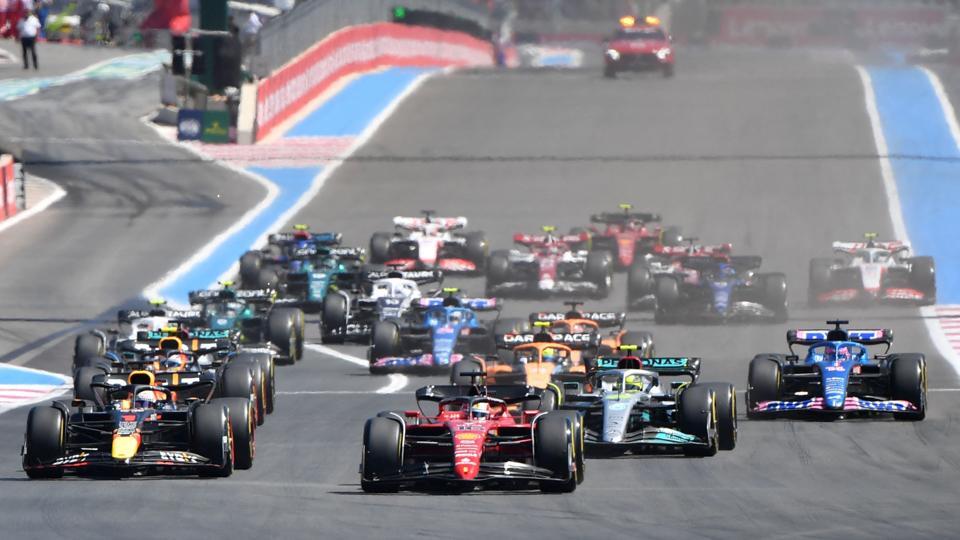
In the 2022 Formula 1 season, Ferrari has lined up first in eight of the 14 races. But it has won just three of these eight races, underscoring its failure to take advantage of a position that has historically proven extremely rewarding.

 Prefer HTon Google


In the 2022 Formula 1 season, Ferrari has lined up first in eight of the 14 races. But it has won just three of these eight races, underscoring its failure to take advantage of a position that has historically proven extremely rewarding. Since 2003, half the races in F1 have been won by the driver starting from pole position. Some circuits have shown even greater winnability from pole position. Conversely, some drivers have demonstrated greater ability to wind their way through the field and fashion a win even when not qualifying in front of the pack.
Saturday leaders to winner on Sunday
Over its 72-year history, the qualifying format in F1 has undergone many changes. For the last three decades, F1 has mostly followed a Saturday-Sunday format, with a qualifying session on Saturday deciding the order in which drivers lined up for the race on Sunday. We looked at data for all drivers on where they qualified and where they finished for 19 seasons, beginning 2003.
Of these 374 races, 191 -- or 51% -- were won by the driver who qualified first. That is also the inherent nature of F1, where technology can give an inordinate advantage to the fastest car and certain tracks can make overtaking difficult. For drivers eyeing race wins and titles, qualifying first is a prime goal. But qualifying second is also not too bad. About 24% of races during this period were won by drivers starting second. In other words, about three-fourths of races were won by the top two qualifiers.
[Chart 1]
Nature of the circuit
The relationship between qualifying high and a high finishing position is not linear across circuits. Since 2003, F1 races have been held in 37 circuits. In 14 of these, the share of races won by the lead driver is less than 50%.
The circuit least rewarding for pole sitters, and by extension opening up opportunities for those below, is Nurburgring in Germany. The win rate for pole sitters here is just 22%. It is followed by Sochi in Russia (25%) and Autódromo Hermanos Rodríguez in Mexico (33%).
At the other end is Catalunya in Spain, a track notorious for making overtaking difficult. Nearly three-fourth of races have been won by the pole driver, the most among circuits that have hosted at least 15 races since 2003. It is followed by Monza in Italy, and Monaco. Zandvoort in Holland, where the F1 race will be held this weekend, has hosted 31 Grands Prix. While it was a popular track until the 1980s, it returned to the F1 calendar only last year. Overall, the pole sitter has won 13 of 31 races, or 41%. That adds intrigue for this weekend, as Ferrari’s Charles Leclerc has shown better qualifying pace, while Max Verstappen of Red Bull has looked in better race trim.
[Chart 2]
Winning through the field
This quality of Verstappen to maximise his car performance, and at times overcome its deficiencies, shows up in another metric. Among drivers who have won at least 10 races in the 19 seasons beginning 2003, three out of every five race wins of Verstappen have come without starting on pole. Compared to Verstappen, Kimi Raikkonen and Jenson Button have seen a greater share of race wins when not starting on pole (greater than 65%), but they have also won fewer races (less than 25%). Among those who have won more than Verstappen, one name that stands out is Fernando Alonso, who’s won nearly half his races while starting third or below.
A large percentage of wins from pole position should also be seen in context of car performance. During our study period, drivers such as Lewis Hamilton, Sebastian Vettel and Michael Schumacher had a decidedly superior car for lengthy stretches, and hence also won a lot of pole positions. So, it’s natural for them to win a large share of their races starting pole.
[Chart 3]
Why Alonso stands out
In order to adjust for the car factor, we looked at how well drivers preserved or improved their positions while qualifying at pole. Qualifying is a good reflection of a car’s competitiveness. A top-five qualifying means a car is reasonably competitive and the minimum expectation would be for a driver to hold position. So, we looked at where leading drivers of the past two decades finished when they qualified in the top five.
The leader on this count is Alonso, who retained or improved his position two-thirds of the time he qualified in the top five. He is followed closely by Verstappen (65%) and Hamilton (61%). Notably, Leclerc, lags at 48%. This season, Verstappen has finished a race in the top five 90% of the time from a qualifying position in the top five, Leclerc 74% of the time. That contrast has been decisive this season.
[Chart 4]
Payoja Ahluwalia is a Hindustan Times-How India Lives data journalist fellow


