
 E-Paper



With a historic joint statement, India and US inaugurate a new chapter in ties
PM and President Joe Biden affirm a vision of the two countries being among the “closest partners” in the world

 Prefer HTon Google


Washington In a historic joint statement during Prime Minister Narendra Modi’s state visit to the US, released late on Thursday afternoon eastern time (early Friday IST), the PM and President Joe Biden affirmed a vision of the two countries being among the “closest partners” in the world; building a relationship anchored in a “new level of trust” and grounded on shared principles of “democracy, freedom and the rule of law”; and deepening a partnership that touches every corner of human enterprise, from the “seas to the stars”. (ALSO READ: How US newspapers are reporting PM Modi's State visit)
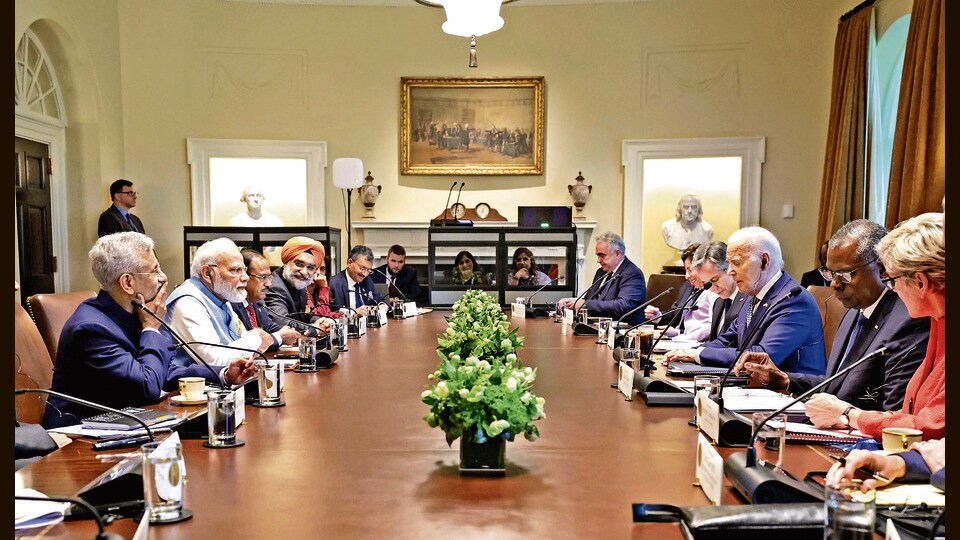
The language of collaboration finds concrete manifestation in the 58-paragraph joint statement across the domains of technology, defence, space, climate, economic investments, trade, education, health, people to people links, and strategic convergences across geographies, platforms, and institutions. Without it being explicitly stated, many of the specific items were quite clearly driven by the need to ensure a balance in global order to deter China’s belligerence. And they laid out an expansive vision, in a sign of the broadening of ties, where it is not just the government, but also industry and academia that are set to play a critical role.
In the past two weeks, HT was the first to report on many of the outcomes that find mention in the joint statement as well as the process that led up to it. Here is a snapshot of what Delhi and Washington have agreed to do.
ALSO READ: US expects India to follow G7 price cap for Russian oil, says White House
Technology
Hailing the initiative on critical and emerging technologies (iCET), the framework unveiled by the national security advisers of both countries this January, the statement took forward cooperation into new domains.
On space, NASA and ISRO agreed to “develop a strategic framework for human spaceflight cooperation by the end of 2023”. Under this, NASA will train Indian astronauts with the goal of mounting a joint mission to the International Space Station in 2024. And India joined the Artemis Accords, which lays out principles for cooperation in the civil exploration and use of the moon, Mars, comets and asteroids for peaceful purposes. India and the US also agreed to enhance commercial space collaboration, which will help India’s mushrooming private space sector.
A key barrier to tech cooperation has been the complex maze of US regulations that often work on the principles of tech denial. The two leaders agreed to adapt regulations that “facilitate greater technology sharing, co-development, and co-production opportunities”, particularly through the Strategic Trade Dialogue mechanism which had its first meeting this month.
Semiconductor cooperation also saw a huge leap forward, with both countries hailing an agreement on a Semiconductor Supply Chain and Innovation Partnership. Micron announced its investment of $800 million for a $2.75 billion worth assembly plant, Lam Research will train 60,000 Indian engineers to develop workforce, Applied Materials will invest $400 million to establish a collaborative engineering centre. Promoting a domestic semiconductor manufacturing ecosystem has been a top priority for India, and diversifying supply chains in the domain has been a top priority for the US.
With an eye on China’s edge in telecom, India and the US agreed to partner on Open Radio Access Network (ORAN), a disaggregated and interoperable telecom network, trials and roll-outs, including scaled deployments, backed by US International Development Financing Corporation. “They endorsed an ambitious vision for 6G networks, including standards cooperation, facilitating access to chipsets for system development, and establishing joint research and development projects.”
The area of quantum research will see cooperation through various institutional mechanisms — Indo-US Quantum Coordination Mechanism, working towards a Quantum Information Science and Technology agreement, India’s participation in the Quantum Entanglement Exchange and in the Quantum Economic Development Consortium, quantum training and exchange programmes, and a $2 million grant for the joint development and commercialisation of Artificial Intelligence (AI) and quantum technologies. Still an evolving field, India’s talent and data-richness, and US capital and tech edge, are seen as key complementarities.
On AI, India and the US also agreed to work closely together as governments begin the process of thinking through the regulatory mechanisms that need to be created to deal with a tech domain filled with potential and danger. Washington also backed Delhi’s leadership as chair of the global partnership on AI.
Relevant public bodies and agencies launched 35 research collaboration projects “in computer and information science and engineering, cyber physical systems, and secure and trustworthy cyberspace”, and agreed to fund joint projects in applied research. They also agreed work together on scientific infrastructure.
ALSO READ | Biden's gift to PM Modi: 'Future is AI' t-shirt. It's not what you think it is
Defence
India and the US took a huge leap in creating a next generation defence partnership. The leaders supported the conclusion of the defence industrial cooperation road map, which, as Modi indicated at a joint press conference, really helps the relationship move from a buyer seller arrangement to a more equal partnership taking into account India’s aim of building an indigenous defence industry.
The joint statement hailed the GE jet engine manufacturing deal, with tech transfer, with Hindustan Aeronautics Limited (HAL), as a “trailblazing initiative”. US supported “India’s emergence as a hub for maintenance and repair for forward deployed U.S. Navy assets and the conclusion of Master Ship Repair Agreements with Indian shipyards”. Through Indus-X, the two sides will build a defence innovation bridge connecting startups with governments, defence majors and each other with department of defence already signing specific agreements with Indian startups. They also hailed India’s decision to procure General Atomics’s Predator drones, with GA agreeing to set up a global maintenance and repair facility in India.
At the institutional level, too, the statement said that both sides have commenced negotiations on a “Security of Supply arrangement and initiate discussions about Reciprocal Defense Procurement agreement”, mechanisms that will ease export control barriers and make it easier to work with each other. Given the rising challenge in the Indo-Pacific, they will collaborate on “maritime security cooperation, including through enhanced underwater domain awareness.”
Climate and energy
While there has been growing collaboration in the climate domain, discussions between the two sides have often got stuck around Washington wanting Delhi to do more, and Delhi seeking the climate finance mobilisation that the developed world historically owes for its sins of the past in contributing to the climate crisis.
The joint statement made a breakthrough by focusing on specifics. Besides existing institutional mechanisms, the two countries launched the US-India New and Emerging Renewable Energy Technologies Action Platform to deepen cooperation in green hydrogen, offshore and onshore wind, and other emerging technologies. They called for “development of joint efforts in carbon capture, utilisation, and storage” as well as investments by Indian companies in the US to promote clean energy.
In the transportation sector, they lauded the creation and development of the Global Biofuels Alliance, USAID’s support for the Indian Railways’s ambitious target to become a net-zero carbon emitter by 2030, and announced the creation of a payment security mechanism that will help India deploy 10,000 made-in-India electric buses. The countries announced the intent to develop a multibillion-dollar investment platform aimed at providing catalytic capital and de-risking support to accelerate the “deployment of greenfield renewable energy, battery storage, and emerging green technology projects in India”.
India will also join the Mineral Security Partnership (MSP) “to accelerate the development of diverse and sustainable critical energy minerals supply chains globally”. The two sides also made incremental progress on civil nuclear cooperation, which hasn’t gained the momentum expected after the civil nuclear deal of 2008, noting ongoing conversations between American majors and Indian agencies, including on “developing next generation small modular reactor technologies”.
Strategic picture
On Ukraine, where India and the US have divergent approaches, the two sides found common ground in the impact of war on food, fuel and energy security, India’s support for principles of sovereignty and territorial integrity, and humanitarian assistance.
But the real convergence was in the shared vision for a free, open and Indo-Pacific.
“Both leaders expressed concern over coercive actions and rising tensions, and strongly oppose destabilizing or unilateral actions that seek to change the status quo by force. Both sides emphasized the importance of adherence to international law, particularly as reflected in the United Nations Convention on the Law of the Sea (UNCLOS), and the maintenance of freedom of navigation and overflight, in addressing challenges to the maritime rules-based order, including in the East and South China Seas,” the statement said in a paragraph that encompasses a range of concerns over China’s actions.
More specifically, the two countries agreed to continue empowering Quad as a force for global good; the body had seen substantial deliverables in the recent summit in Hiroshima. Modi welcomed the US’s decision to join the Indo-Pacific Oceans Initiative, and both governments agreed to host a dialogue on the Indian Ocean next year.
On terrorism, India and the US agreed to continue working together and condemned cross-border terrorism. They called for concerted action “against all UN-listed terrorist groups including Al-Qa’ida, ISIS/Daesh, Lashkar e-Tayyiba (LeT), Jaish-e-Mohammad (JeM), and Hizb-ul-Mujhahideen” and called on Pakistan to ensure its territory wasn’t used to export terror and justice for 26/11 and Pathankot terror attacks.
What was striking about the section on strategic convergence was the range of geographies and themes that both countries now speak about with each other. This includes West Asia where they work through I2U2; ensuring an “open, secure, inclusive, safe, interoperable, and reliable Internet” and cybersecurity; North Korea, Myanmar, Afghanistan, among others and find common ground even if they aren’t on identical page.
Economy, digital and trade
A big breakthrough happened in the domain of trade, where India and US resolved their six disputes at the World Trade Organisation bilaterally.
They also agreed to work together on the agenda of multilateral development bank reforms, where US has supported the work of the expert group set under India’s G20 presidency; debt restructuring issues; and resilient infrastructure.
Among the key achievements for India, arguably, was the support from US for its innovative digital public infrastructure (DPI) which has been a key enabler of India’s economic and welfare journey, and Delhi hopes to export globally. The joint statement recognised its potential for open and inclusive digital economies, with both countries agreeing to provide global leadership. “They will explore developing a U.S.-India Global Digital Development Partnership, which would bring together technology and resources from both countries to enable development and deployment of DPIs in developing countries.”
Health, education, people-to-people
To boost the knowledge partnership, India and America agreed to set up the Indo-US Global Challenge Institutes “to spark deeper research partnerships and people-to-people exchanges” between a range of diverse institutions in semiconductors, sustainable agriculture, clean energy, health and pandemic preparedness, and emerging technologies.
Mobility has remained a key concern, especially given the visa delays as well as backlogs on the US end. To this end, the State Department will launch a “pilot to adjudicate domestic renewals of certain petition-based temporary work visas later this year, including for Indian nationals, with the intent to implement this for an expanded pool of H1B and L visa holders in 2024”. The US will open consulates in Bengaluru and Ahmedabad while India will open a consulate in Seattle and explore more locations.
On health, too, with the pandemic having shown both countries the enormous room for cooperation, the joint statement indicated that India and the US are moving into new domains. They committed to holding a US-India Cancer Dialogue, hosted by President Biden’s Cancer Moonshot, to bring experts together from both countries to identify concrete areas of collaboration to accelerate the rate of progress against cancer. They also agreed to “secure, de-risk, and strengthen pharmaceutical supply chains, with a focus on active pharmaceutical ingredients, key starting materials, and key vaccine input materials” and work towards a broader and deeper bilateral drug policy framework.
“Taken together, the leaders today affirmed that this document, in its breadth and depth, represents the most expansive and comprehensive vision for progress in the history of our bilateral relationship,” the statement concluded. And for once, it was not hyperbole. India and the US have indeed embarked on a new journey.


