
 E-Paper



With no contracts, casual workers may be worst hit
According to data from the Periodic Labour Force Survey (PLFS) conducted in 2017-18, workers engaged in so-called casual work – their wages were based on daily or periodic renewal of a work contract – form a quarter of the total workforce.

 Prefer HTon Google


The Uttar Pradesh and Maharashtra governments on Tuesday took steps to protect the livelihoods of daily wage earners. While the Maharashtra government has urged employers to pay daily wagers if they are not able to work from home, the Uttar Pradesh government is looking to make cash transfers to such workers.
How large is the number of such workers who have no safety net? According to data from the Periodic Labour Force Survey (PLFS) conducted in 2017-18, workers engaged in so-called casual work – their wages were based on daily or periodic renewal of a work contract – form a quarter of the total workforce. The survey estimated their number to be around 93 million.
Casual workers are going to be among the worst affected in case of an economic slowdown resulting from the Covid-19 outbreak. Barring 41% of such workers, who worked in non-skilled agricultural jobs, the PLFS survey asked such workers if they had a written job contract or got paid leave, or had any social security benefits. An overwhelming 98% of them said their work didn’t involve a written contract or paid leave. And while 86% said they didn’t get any social security benefits, the response of another 13% was not known. The social security benefits considered for this survey were provident fund and pension, gratuity, and health care and maternity benefits.
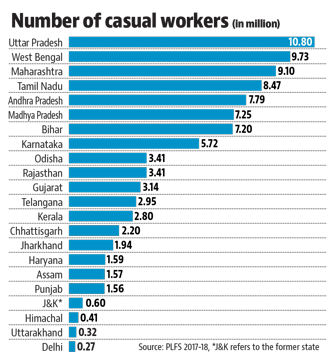
Such precarious terms of employment require that the government step in to provide support during such a disease outbreak. This will probably mean a higher level of support in states where there are more casual workers. Uttar Pradesh, West Bengal, Maharashtra, Tamil Nadu and Andhra Pradesh are the top five states in terms of the number of casual workers. This will mean that the Union government or the respective state government might have to spend more in these states if they decide to support casual workers.
Chart: State-wise number of casual workers in India
However, experts suggest that only including daily wagers in such a scheme might exclude other workers whose work might be affected due to layoffs, their workplace shutting down, or a quarantine. This is because only a small proportion of workers can work remotely.
For example, apart from the 25% casual workers in the workforce, there are 52% who are self-employed, and 23% who are salaried or regular wage workers. Even among the salaried, 71% have no written job contract, 54% are not eligible for paid leave, and 50% have no social security benefits, according to the survey. This is despite the fact that they are the best paid among the three groups of workers.
Ishan Anand, assistant professor at OP Jindal Global University, said that since only a small proportion of workers in India can afford to shut down work or work remotely – both are essential for social distancing – the government should adopt a multi-pronged approach to tackle the economic fallout of the Covid-19 outbreak. This could involve using existing infrastructure to provide advance payments of schemes such as PM-KISAN and social security benefits such as old age and disability pension, and delivering PDS and mid-days meals at home without worrying about Aadhaar authentication, he suggested. “There are talks in other countries of a direct cash transfer. In India, many might not have functional bank accounts or have difficulty in accessing the banking system. For people who are not covered by existing measure, we might have to think of a comprehensive package which helps in slowing the spread of the virus. Private employers can be asked to give paid leaves, NREGA and other public workers can be paid in advance,” he added.


