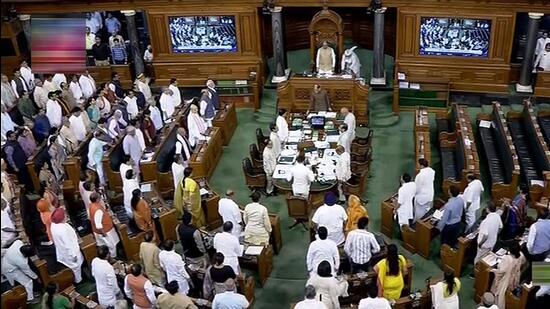
27 years and one week after the first such bill was introduced in parliament on September 12, 1996, Union law minister Arjun Ram Meghwal introduced a bill to reserve one-third seats in the Lok Sabha, the state legislative assemblies, and the Delhi legislative assembly for women on September 19. Data shows that in these past 27 years, some organic improvement in women’s representation has already happened. However, even in 2023 (the failed attempts were made in 1996, 1998, 1999, and 2008), such a law will be a big and quick leap forward for women’s representation, and more so for state assemblies than the Lok Sabha, according to data analysed by HT.
The bill introduced Tuesday also tries to address the concern that women elected from seats reserved for them will be from other than Scheduled Castes (SCs) and Scheduled Tribes (STs). It does this by proposing reservation across General, SC, and ST category of constituencies. Interestingly, data shows that the latter two categories have had higher representation of women since the 1990s. (PTI)
The bill introduced Tuesday also tries to address the concern that women elected from seats reserved for them will be from other than Scheduled Castes (SCs) and Scheduled Tribes (STs). It does this by proposing reservation across General, SC, and ST category of constituencies. Interestingly, data shows that the latter two categories have had higher representation of women since the 1990s.
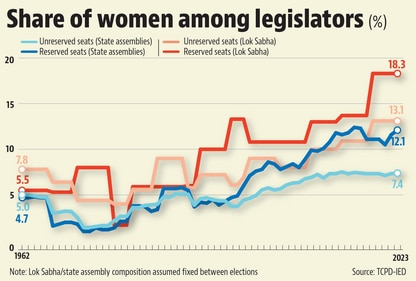
Election results by gender show that India’s first two elections had 4.5% women winners. This number gradually improved even without affirmative action for women. In the 2019 Lok Sabha election, 14.4% of winners were women, the highest ever. However, as on September 1, this share (it has increased to 15.2% because of bypolls, deaths, and other reconfigurations) was ranked 141st out of 185 countries for which Inter-Parliamentary Union, a global organisation of parliaments, maintains this data.
As the data above suggests, the natural improvement in women’s representation in Lok Sabha has still left India far behind the world. State assemblies are even further behind. If the composition of Lok Sabha and state assemblies is assumed to be fixed between elections, they can be compared on a yearly basis. This shows that women’s representation in state assemblies has also improved, but has always been lower than in the Lok Sabha. To be sure, not all state assemblies are the same. After the last assembly election, the share of women MLAs in Tripura, Chhattisgarh, and West assemblies was similar to that in the Lok Sabha after the 2019 election: 15%, 14.4% and 13.7% respectively.
Just as some individual state assemblies have performed relatively better, some parties performed better than the rest in the 2019 Lok Sabha in giving tickets to women. At least a third of the candidates (33%) fielded by four parties that fielded more than 10 candidates, Maharashtra Navnirman Sena, Naam Tamilar Katchi, All India Trinamool Congress, and the Biju Janata Dal, were women. To be sure, none of these parties fielded more than 62 candidates when the Bharatiya Janata Party (BJP) and the Congress fielded 436 and 421 candidates (55 and 54 of them were women, respectively). Clearly, affirmative action by small individual parties has limited impact on women’s overall representation.
This means that the bill introduced Tuesday is necessary for increasing women’s share among legislators. In Lok Sabha as well as in state assemblies, the share of women legislators in SC, ST reserved seats has been higher than in unreserved seats continuously since the 1990s. Therefore, unreserved seats will be making a bigger leap in women’s representation from their current status.
The bill introduced Tuesday is necessary for increasing women’s share among legislators.
This does not take away the importance of the bill overall. As HT explained on the 25th anniversary of the 1996 bill , women continue to be under-represented in state and national legislative assembly simply because the bar for them is higher. They have had a higher strike rate than men in every Lok Sabha election and in most state assembly elections. This means that only winnable women are given tickets while that is less so the case for male candidates. As one expert explained at the time, the only way to improve women’s representation in India’s legislative bodies is through affirmative action.

 E-Paper