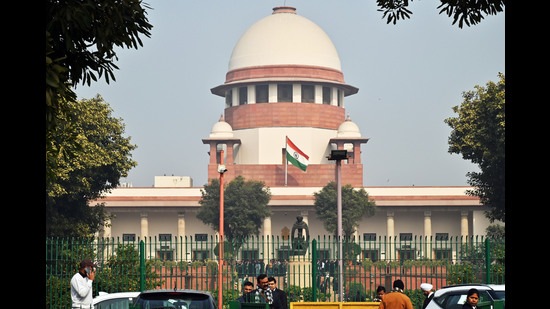
Won’t enact law on passive euthanasia, suitable norms a must: Centre to SC
The Union government told a Supreme Court Constitution bench that it will not enact a legislation on passive euthanasia, adding that the anxiety to take someone’s life must not outweigh the requirement of essential safeguards
New Delhi The Union government on Thursday told a Supreme Court Constitution bench that it will not enact a legislation on passive euthanasia, adding that the anxiety to take someone’s life must not outweigh the requirement of essential safeguards.
The Supreme Court adjourned the case for January 24. (ANI)
According to the Centre’s submissions before the five-judge bench, the top court’s 2018 judgment on allowing passive euthanasia after complying with certain safeguards sufficiently occupies the field and that there is no need for a specific law on the subject matter.
“A legislation is not required. There is no need of an enactment... Whatever directions have been passed by this court, we accept it,” additional solicitor general (ASG) KM Nataraj told the bench, headed by justice KM Joseph.
The law officer emphasised that the government is more concerned about protecting life. “While we have accepted the court’s judgment, there should not be an anxiety to take someone’s life. Our concern is to protect life. Let there be proper checks before this can be done,” said Nataraj.
The ASG further countered a demand for doing away with the involvement of a judicial magistrate in the process of the execution of passive euthanasia, stressing that the issue of taking life will ensue several legalities.
The views of the government came as the bench, which also included justices Ajay Rastogi, Aniruddha Bose, Hrishikesh Roy and CT Ravikumar, considered modifying the 2018 judgment that had laid down certain guidelines in recognition of living wills made by terminally ill patients for withdrawal of treatment essential to life.
On Tuesday, the bench had asked Nataraj about the status of a legislation on the matter, reminding him that the 2018 judgment clearly maintained that the guidelines laid down by it shall remain in force till a legislation is brought on the issue.
Under the 2018 judgment, an adult can make a living will, which should be signed in the presence of two attesting witnesses and affirmed by the concerned judicial magistrate. If the executor of the will becomes terminally ill and goes through prolonged medical treatment with no hope of recovery, the doctor has to constitute a board consisting of experts of general medicine, cardiology, neurology, nephrology, psychiatry or oncology with experience in critical care on the request of family members.
After the certification of the first medical board, the district collector concerned constitutes another board of medical experts. Following the consent of the second medical board, the last call is taken by the magistrate. If the hospital’s medical board denies permission to withdraw medical treatment, the family members of the patient can approach high court, which forms a fresh board of medical experts to enable the court take a final call.
However, a plea, argued by senior counsel Arvind Datar and advocate Prashant Bhushan on behalf of the petitioners, contended that the three-step process encompassing onerous conditions has made the entire judgment nugatory, and that there has not been a single case where someone desirous of exercising the right to passive euthanasia could finally comply with the procedural requirements.
On Thursday, Datar argued that the top court may rethink the need to have a review board after the primary board, consisting of experts from the relevant medical fields, have already taken a call. He also said that there is no need to involve a magistrate or a collector after the medical board’s approval to the withdrawal of life support system.
ASG Nataraj, however, opposed this. “There should be a review board and the decision of the review board must be given to a magistrate because there are issues of legalities involved. The applicants seem to be in a hurry to take away someone’s life. But we want proper checks and safeguards in place,” he said.
At this point, the bench said that the petitioners and the government do not seem to on the same page. “The government, by way of an affidavit in these proceedings, took a stand years ago that it does not want a law. Five years on, it is still telling us the same thing. We are getting kind of contrary signals as you two argue. Why don’t you give to us a joint compilation of guidelines?” the bench asked the ASG and Datar.
It said that the court is willing to “tweak” and “simplify” the process but the government, being an important stakeholder in the entire process, should be on board. “We only want this to be workable so that people can make use of this judgement. Our judgements are not meant to only fill pages. You have a joint meeting and submit a document to us with consensus. Once you agree on what’s agreeable to both of you, we can examine it and pass suitable directions,” said the bench, adjourning the case for January 24.
Earlier this week, the bench set about to untangle the “cumbersome” legal process impeding the execution of passive euthanasia, and provide a definite timeline for medical experts to take a call. To die with dignity is a right of those who are terminally ill and have made a living will, it observed on Tuesday, adding the 2018 judgment needed a “little tweaking” since it made the whole process “cumbersome”.
In March 2018, a Constitution bench recognised a person’s right to die with dignity, saying that a terminally ill person can opt for passive euthanasia and execute a living will to refuse medical treatment. It permitted an individual to draft a living will specifying that she or he will not be put on life support if they slip into an incurable coma.
The five-judge bench in 2018 included the present CJI Dhananjaya Y Chandrachud, who, in his separate judgment, said: “Dignity in the process of dying is as much a part of the right to life under Article 21. To deprive an individual of dignity towards the end of life is to deprive the individual of a meaningful existence.”
Follow India news real-time updates and the latest news covered on Hindustan Times, featuring today's critical updates on Sonam Wangchuk LIVE and more across India.
Home/India News/Won’t Enact Law On Passive Euthanasia, Suitable Norms A Must: Centre To SC

 E-Paper