
Sign in

Yamuna water level crosses ‘warning level’ in Delhi

The Central Water Commission’s website said a marginal decline was likely in the Yamuna water level in Delhi, possibly touching 204.65 metres by 4pm

Updated on: Aug 7, 2025, 10:00:06 IST
Share
Share via
  • facebook
  • twitter
  • linkedin
  • whatsapp
Copy link
  • copy link

The Yamuna water level crossed the “warning level” of 204.50 metres at 5am on Thursday, as the river continued to swell following an increase in the discharge from Haryana’s Hathnikund barrage. By 9 am, the level touched 204.89 metres, the highest so far this season. The “danger level” of 205.33 generally warrants evacuation.
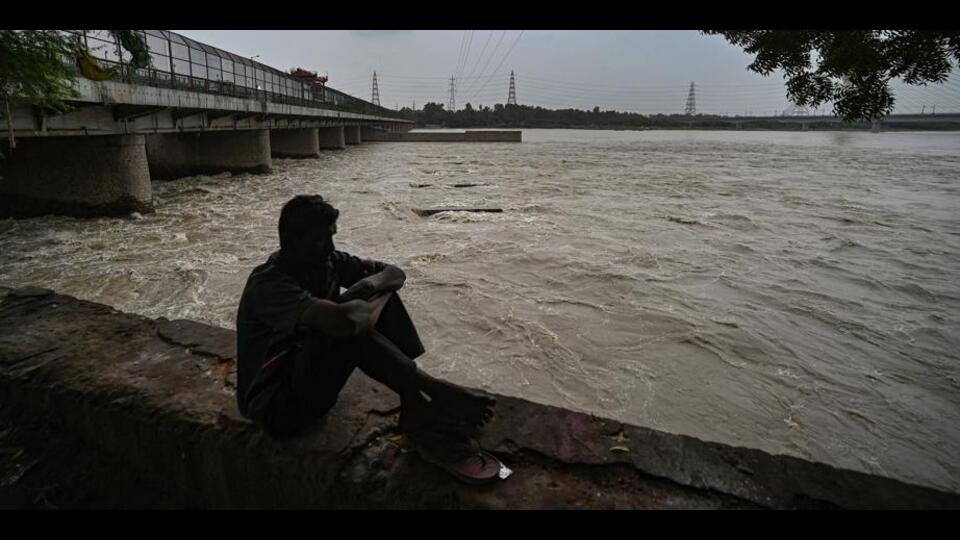
By 9am, the water level touched 204.89 metres, the highest so far this season. (HT PHOTO)

The Central Water Commission’s website said a marginal decline was likely in the level, possibly touching 204.65 metres by 4pm. On Wednesday, the Yamuna was flowing at 204.15 metres at 6pm, following a season-high hourly discharge of 61,729 cusecs from the barrage due to heavy rainfall and flooding upstream.

The discharge remained over 50,000 cusecs hourly between 4am and 8am on Wednesday. It continued to be above 40,000 cusecs thereafter. The discharge went above 50,000 cusecs again after 9pm. On Tuesday, the Yamuna’s water level was 203.61 metres.

Bhim Singh Rawat of the South Asia Network on Dams, Rivers and People said the water level may stabilise a bit now and even fall marginally, as per forecasts.

Delhi’s irrigation and flood control department officials said they were prepared for evacuations from floodplain areas. An order issued last month said the first warning should be sounded when discharge from Hathnikund exceeds 100,000 cusecs.

Last year, the Yamuna peaked at 204.38m on September 26, without breaching the warning mark. The river surged to 208.66m on July 11 after a peak Hathnikund discharge of 359,760 cusecs, with several spells over 100,000 cusecs, in 2023.

  • Jasjeev Gandhiok
    ABOUT THE AUTHOR
    Jasjeev Gandhiok

    Jasjeev Gandhiok is an Assistant Editor with Hindustan Times, where he covers environment, climate change, the clean energy transition and wildlife at the National Bureau. Gandhiok has over a decade of experience in journalism and is based in Delhi. He has reported extensively on Delhi and the National Capital Region (NCR). This includes the region's air pollution woes, a polluted Yamuna and on urban wildlife still thriving in the region. He joined HT in October 2021. Prior to that, he had five-year stint at The Times of India in Delhi, where he also covered Delhi, with a focus on environment and wildlife. Gandhiok has covered some recent events around the Capital too, ranging from the farmers' protests, the northeast Delhi riots and the CAA-NRC protests, reporting from the ground on all of these. He also travels across the country to report on how environment and climate change impact everyday life, while also writing on endangered species. His reports in 2019 on toxic leachate from Delhi's landfills led to the National Green Tribunal (NGT) taking suo motu cognisance and ultimately asking the state government to start bio-mining to flatten and remove all three landfills in the capital. He also closely tracks the implementation of government policies on climate, renewable energy and environmental protection. His focus remains on impactful, public-interest journalism which explains how environmental decisions affect people's everyday lives.Read More

Get the latest India News, breaking headlines and real-time updates from across the country. Stay informed about politics, government policies, crime, weather major national developments and Karnataka Bandh LIVE.